German scientists R.Classius and J.C. Maxwell had propounded the kinetic theory of gases. According to this model, every gas is made up of very fine particles called molecules. All
the molecules of a gas are similar in all properties. We know that $ 1 cm^{3}$ of water is heated at $100^{\circ}C$ temperature, producing $1$ atmosphere pressure $1671 cm$ of water vapour. From this, it is known that the volume actually occupied by the molecules in $1671 cm^{3}$
of water vapour is only $1 cm^{3}$, and the remaining $1670 cm^{3}$ of volume is empty. In other words, in the gaseous state of matter, there is a lot of free space between the molecules. This fact is true for all gases. The molecules of gases are always moving randomly in all possible directions. During motion, these molecules collide with each other and with the walls of
the vessel in which the gas is kept. After each collision, both the direction and speed of motion of these molecules keep changing.
All collisions between molecules and molecules or between molecules and the walls are elastic. This implies that total kinetic energy and momentum are conserved.
Assumptions of Kinetic Theory of Gases
There are the following assumptions of the kinetic theory of gases.
1. The molecules of a gas are very small, rigid, spherical and completely elastic. The volume of the molecules is the volume in which the gas is present, is negligible compared to the volume of the gas.
2. Although the molecules of a gas can move with every possible velocity in every direction, but the number of molecules per unit volume or molecular density remains the same.
3. There is no force of attraction or repulsion between the molecules, as a result of which they do not have potential energy; their entire energy is kinetic energy.
4. When the molecules of a gas come very close to each other, there is a repulsive force between them, due to which their speed and direction of motion change.
This phenomenon is called a 'collision' between two molecules. Between two consecutive collisions, the molecules move in a straight line with a constant speed. The distance travelled by the molecule between two consecutive collisions is called the free path and its average is called the mean free path.
5. The mutual collision between the molecules and the collision between the molecule and the wall is perfectly elastic, that is, the kinetic energy of the molecules is conserved.
6 The time of collision between the molecules is negligible compared to the distance travelled freely by the molecule.
7. Since the amount of molecules is negligible and the velocity is high, therefore there is no effect of gravity on the motion of the molecules.
Newton's Corpuscular Model
Newton's Corpuscular Theory
In the year 1675, Newton proposed the corpuscular theory of light to explain the existing phenomenon of light. There are the following assumptions of this theory:
1. The light consists of very small, lightweight, and invisible particles. These particles are known as corpuscles.
2. These corpuscles move with the velocity of light in a homogeneous medium in all possible directions in a straight line and they carry kinetic energy with them.
3. When these corpuscles fall on the retina of the eye, they produce the sensation of vision.
4. The size of corpuscles of different colors is different (ie, the color of light depends on the size of the corpuscle).
(A) Success of Carpuscles Theory
Based on this theory, the following facts related to light were explained successfully:
1. The light has energy: Since corpuscles have kinetic energy. Therefore, the energy of the light beam is due to the kinetic energy of the corpuscles.
2. Motion of light along a straight line: Since velocity of the corpuscle is very high, the effect of external forces on it is
negligible. Therefore, it moves in a straight line.
3. Motion of light in vacuum: Corpuscles can move through vacuum.
4. Reflection of light: To explain the reflection of light, Newton assumed that when a corpuscle reaches close to a reflecting surface, then the surface repels it with a force whose direction is perpendicular to the surface and whose magnitude decreases sharply as the distance of corpuscles increases from the surface.
 In Figure, let $PO$ be a reflecting surface and $P'Q'$ be an imaginary surface just above it at negligible height. When a light corpuscle moves towards the surface, then it moves along a straight line from $A$ to $B$ (since the force is zero). As it reaches the point $B$ of surface $PQ$, a repulsive force starts acting perpendicular to the surface (upward in the figure). Let $i$ is an angle of incidence at point $B$, then the velocity of the corpuscles at point $B$ has two components- component parallel to surface $V_{||} =v \: sin \: i$ and component perpendicular to surface $V_{|} = v \: cos \: i$. After crossing point $B$, the parallel component remains same but the perpendicular component decreases. At point $C$ of surface $PQ$, the perpendicular component becomes zero. After this direction of the perpendicular component changes and the corpuscles move along path CD. Beyond D again it moves along a straight line as the force becomes ineffective. If $r$ is the angle of reflection at point $D$, then the parallel component of velocity at $D$ will be $v\: sin\: r$. Since the parallel component remains constant. Therefore, comparing them at points $B$ and $D$.
$v \: sin \: i=v \: sin\: r$
$sin \: i= sin\: r$
$i=r$
i.e., the above equation shows that the incident angle and the reflected angle are equal. In the figure above, incident ray, reflected ray and normal all three are in the plane of paper. Therefore laws of reflection are verified.
5. Refraction of light: To explain the refraction of light, Newton considered two different situations :
a.) When the light goes from a denser medium to a rare medium: In this condition when the corpuscle reaches near the surface, the surface exerts a normal repulsive force on it. As a result, the perpendicular component of velocity of the corpuscles decreases however it does not reduce to zero as in the case of refraction. Therefore, enters the second medium with a reduced perpendicular component and same constant value of the parallel component i.e., moves along a straight line bending away from normal.
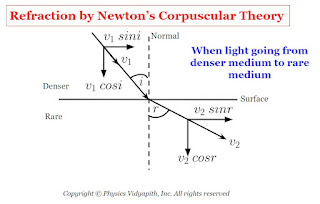 If $i$ and $r$ are the angle of incidence and angle of refraction and $v_{1}$ and $v_{2}$ are the velocity of corpuscle in medium first and second medium. If the parallel component is constant,
$v_{1} \: sin \: i =v_{2} \: sin\: r$
$\frac{sin \: i}{sinr} =\frac{v_{2}}{v_{1}}$
From Figure
$i \lt r$
Therefore
$sin \: i \lt sin\: r$
$v_{2} \lt v_{1}$
Therefore, from the corpuscular theory, velocity light in a denser medium ($v_{1}$) is greater than the velocity light in a rare medium ($v_{2}$).
b.) When the light goes from a rare medium to a denser medium: In this condition when the corpuscle reaches near to the surface, the surface attracts it normally. As a result, the normal component of its velocity increases. Therefore, the corpuscular enters the second medium with an increased normal component and the same parallel component of velocity and moves along a straight line bending towards the normal. 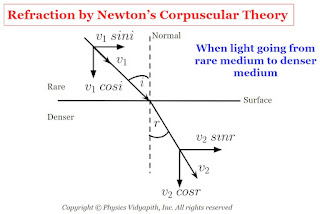 $v_{1} \: sin \: i =v_{2} \: sin\: r$
$\frac{sin \: i}{sinr} =\frac{v_{2}}{v_{1}}$
From Figure
$i \gt r$
Therefore
$ sin \: i \gt sin\: r$
$v_{2} \gt v_{1}$
Therefore, velocity light in a denser medium ($v_{1}$) is greater than the velocity light in a rare medium ($v_{2}$).
B) Failure of the Corpuscles Theory
The following are the main reasons for the failure of this theory:
1. Interference, diffraction, polarisation of light, and the photoelectric effect, etc. can not be explained using this principle. For example, in interference, when two light beams interfere, darkness is produced at the same places. It is not possible that two corpuscles destroy each other.
2. According to this theory, the velocity of light is greater in the denser medium as compared to the rare medium. But Focault's had proved experimentally that the velocity of light is less in denser mediums as compared to the velocity of light in rare mediums.
3. According to this theory, greater the temperature of the source greater the velocity of the corpuscles. Actually, the velocity of light does not depend on the temperature of the source.
4. According to this theory, the mass of the source should decrease as it continuously emits corpuscles but it does not happen in reality.
5. In this theory two opposite assumptions are considered to explain reflection and refraction. To explain reflection and refraction through denser to rarer, the repulsive force by the surface is assumed and to explain refraction from rare to denser, the force of attraction by the surface is assumed. These assumptions are opposite and they don't have any scientific base.


Nuclear force and its properties
Nuclear Force
Properties of Nuclear Force
There are the following properties of nuclear force is given below.
(i) These are strong nuclear forces otherwise protons cannot exist in the nucleus.
(ii) The intensity of these forces is very large. The intensity of nuclear force is maximum among, so far known forces.
(iii) It is not electrical in nature. If we assume them electrical forces, then the protons cannot reside in nucleus.
(iv) These forces do not depend on charge. The force acting between the nucleons (such as proton-proton, neutron-neutron and proton-neutron) is of same nature.
(v) These are not gravitational forces because the mass of the particles inside the nucleus is very small, while the magnitude of nuclear force is very large.
(vi) These forces are short range forces. They are confined inside the nucleus (i. e., $10^{-15} m$ equal to the diameter of nucleus). There is no existence of these forces outside the nucleus.
A forces that act between the nucleons (i.e proton and neutron) inside the nucleus. This force is called the nuclear force.These forces are responsible to keep the nucleons bound inside the nucleus.
Limitations of Bohr's Model
Although Bohr's model of hydrogen atom and hyarogen like atom was successful in explaining the stability and spectrum even then it has few limitations. which are as
follows:
(1) This model could not explain the spectrum of atom having more than one electron.
(2) This model could not explain the relative intensity of spectral lines. (i. e., few transitions are more acceptable than others why?)
(3) When a spectral line is observed by spectroscope of high resolution power, more than one lines are observed. This is known as fine structure of spectral line. Bohr model could not explain this.
(4) Splitting of spectral lines in external magnetic field (Zeeman's effect) and in external electric field (Stark's effect) could not be explained by this model.
(5) This model could not explain the distribution of electrons in different orbit.
Few limitations of Bohr's model are removed in Somer-field's model of atom. (In this model, the orbit of electron was considered as elliptical instead of circular ). But this model
also has its limitations. Vector atomic model, which is based on quantum mechanics, explains clearly the structure of atom.
Comparison of Isothermal and Adiabatic Processes for an Ideal Gas
Isothermal Process:
1.) In this process temperature remains constant i.e.$(\Delta T= 0)$.
2.) In this process internal energy remains constant i.e. $(\Delta U= 0)$.
3.) This process takes place very slowly.
4.) In this process the system is surrounded by a perfectly conducting material, whose conductivity is infinite.
5.) This process obeys Boyle's law i.e. $(PV= constant)$.
6.) In this process the slope of isothermal curve $=-\frac{P}{V}$
7.) In this process specific heat of gas should be infinite.
Adiabatic Process:
1.) In this process exchange of heat does not take place i.e. $(\Delta Q= 0)$ but temperature changes.
2.) In this process internal energy changes.
3.) This process takes place very rapidly.
4.) In this process the system is surrounded by a perfectly insulating material, whose conductivity is zero.
5.) This process obeys Poisson's law i.e. $(PV^{\gamma} = constant)$.
6.) In this process the slope of adiabatic curve $=- \gamma \frac{P}{V}$
7.) In this process specific heat of gas should be zero.
Popular Posts
-
 Angle of Acceptance → "If incident angle of light on the core for which the incident angle on the core-cladding interface equals t...
 -
 Principle: The principle of the compound microscope is based on the magnification of an image by using two lenses. Construction: A comp...
 -
Description: Unit of Energy The SI unit of energy is the Joule (J) , named after the English physicist James Prescott Joule. 1 Joule is...
-
 Derivation→ Let us consider, The charge on a parallel-plate capacitor = $q$ The area of parallel-plate = $A$ The dis...
 -
Gaussian Surface and its Properties: The Gaussian surface is a hypothetical or imaginary closed three-dimensional surface. This surface i...
-
 A.) Electric field intensity at different points in the field due to the uniformly charged solid conducting sphere: Let us consider, A s...
 -
 Derivation→ Let us consider, a current-carrying conductor $XY$ having length $l$ in which current $i$ is flowing from $X$ to $Y$. Now,...
 -
 Population of energy level: The number of atoms per unit volume in any energy level is called the population of that energy level. The...
 -
Let a plane wavefront be incident normally on slit $S_{1}$ and $S_{2}$ of equal $e$ and separated by an opaque distance $d$.The diffracted l...
-
Principle of Ruby Laser → Ruby laser is the first working laser that was invented by T.H.Maima in 1960. It is a three-level solid-stat...

