Physical Significance:
The physical significance of Maxwell's equations obtained from integral form are given below:
Maxwell's First Equation:
1. The total electric displacement through the surface enclosing a volume is equal to the total charge within the volume.
2. It represents Gauss Law.
3. This law is independent of time.
Charge acts as source or sink for the lines of electric force.
Maxwell's Second Equation:
1. The total magnetic flux emitting through any closed surface is zero. An isolated magnet do not exist monopoles.
2. There is no source or sink for lines of magnetic force.
3. This is time independent equation.
Maxwell's Third Equation:
1. The electromotive force around the closed path is equal to the time derivative of the magnetic displacement through any surface bounded by the path.
2. This gives relation between electric field $E$ and magnetic induction $B$.
3. This expression is time varying i.e. $E$ is generated by time variation of $B$.
4.This gives relation in variation of E with the time variation of $B$ or $H$.
5. This is a mathematical form of Faraday's law of electromagnetic induction or Lenz's
Law.
Maxwell's Fourth Equation:
1. The magneto-motive force around the closed path is equal to the conduction current
plus displacement current through any surface bounded by the path.
2. This is time dependent wave equation.
3 This is a mathematical form of Ampere circuital law.
4. Magnetic induction $B$ can be generated from $J$ and time variation of magnetic displacement $D$.
5. This relates the space variation of $B$ with time variation of $D$.
Circuit containing Inductor and Capacitor in Series (L-C Series Circuit )
Mathematical Analysis of L-C Series Circuit :
 Let us consider, a circuit containing inductor $L$ capacitor $C$ and these are connected in series. If an alternating voltage source is applied across it then the resultant voltage of the L-C circuit
$V=V_{L} - V_{C} \qquad(1)$
We know that:
$V_{L} = iX_{L}$
$V_{C} = iX_{C}$
So from equation $(1)$
$V= iX_{L} - iX_{C} $
$V=i \left(X_{L} - X_{C} \right) $
$\frac{V}{i}=\left(X_{L} - X_{C} \right) $
$Z=\left(X_{L} - X_{C} \right) \qquad(2)$
Where
$Z \rightarrow$ Impedance of L-C circuit.
$X_{L} \rightarrow$ Inductive Reactance which has value $\omega L$
$X_{C} \rightarrow$ Capacitive Reactance which has value $\frac{1}{\omega C}$
So from equation $(2)$, we get
$Z=\left( \omega L - \frac{1}{\omega C} \right) \qquad(3)$
The phase of resultant voltage:
 The phase of resultant voltage from current is $90^{\circ}$ as shown in the figure above.
The Impedance and Phase at Resonance Condition:($X_{L} = X_{C}$):
At resonance $X_{L} = X_{C} \qquad(5)$
$\omega L = \frac{1}{\omega C}$
$\omega^{2} = \frac{1}{L C}$
$\omega = \sqrt{\frac{1}{L C}}$
$2 \pi f = \sqrt{\frac{1}{L C}}$
$ f = \frac{1}{2 \pi}\sqrt{\frac{1}{L C}}$
Where $f \rightarrow$ Natural frequency of the circuit.
1.) The Impedance of the circuit at resonance condition:
Substitute the resonance condition i.e. $X_{L} = X_{C}$ in equation $(2)$ then the impedance of the L-C Circuit
$Z=0$
The impedance of the L-C circuit at resonance condition is zero.
2.) The Phase of resultant voltage at resonance condition:
There is not any change in the phase of resultant voltage at resonance condition i.e. that will be the same $90^{\circ}$.

$V_{C} = iX_{C}$
$Z \rightarrow$ Impedance of L-C circuit.
$X_{L} \rightarrow$ Inductive Reactance which has value $\omega L$
$X_{C} \rightarrow$ Capacitive Reactance which has value $\frac{1}{\omega C}$

Circuit containing Capacitor and Resistor in Series (C-R Series Circuit )
Mathematical Analysis of C-R Series Circuit :
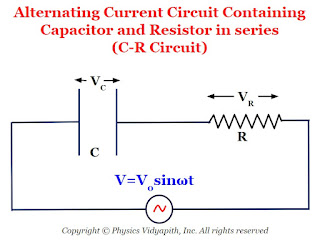 Let us consider, a circuit containing capacitor $C$ resistor $R$ and these are connected in series. If an alternating voltage source is applied across it then the resultant voltage of the C-R circuit
$V=\sqrt{ V_{C} ^{2} + V^{2}_{R}} \qquad(1)$
We know that:
$V_{R} = iR$
$V_{C} = iX_{C}$
So from equation $(1)$
$V=\sqrt{\left( iX_{C} \right)^{2} + \left(iR\right)^{2}} $
$V=i\sqrt{\left( X_{C} \right)^{2} + R^{2}} $
$\frac{V}{i}=\sqrt{\left( X_{C} \right)^{2} + R^{2}} $
$Z=\sqrt{\left( X_{C} \right)^{2} + R^{2}} \qquad(2)$
Where
$Z \rightarrow$ Impedance of C-R circuit.
$X_{C} \rightarrow$ Capacitive Reactance which has value $\frac{1}{\omega C}$
So from equation $(2)$, we get
$Z=\sqrt{\left( \frac{1}{\omega C} \right)^{2} + R^{2}} \qquad(3)$
The phase of resultant voltage:
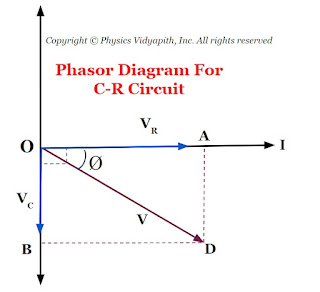 If the phase of resultant voltage from from current is $\phi$ then
$tan \phi = \frac{X_{C} }{R} \qquad(4)$
$tan \phi = \frac{\frac{1}{\omega C}}{R} $
$tan \phi = \frac{1}{\omega C R} $
$\phi = tan^{1} \left(\frac{1}{\omega C R}\right) $

$V_{C} = iX_{C}$
$Z \rightarrow$ Impedance of C-R circuit.
$X_{C} \rightarrow$ Capacitive Reactance which has value $\frac{1}{\omega C}$

Circuit containing Inductor and Resistor in Series (L-R Series Circuit )
Mathematical Analysis of L-R Series Circuit :
 Let us consider, a circuit containing inductor $L$ resistor $R$ and these are connected in series. If an alternating voltage source is applied across it then the resultant voltage of the L-R circuit
$V=\sqrt{ V_{L} ^{2} + V^{2}_{R}} \qquad(1)$
We know that:
$V_{R} = iR$
$V_{L} = iX_{L}$
So from equation $(1)$
$V=\sqrt{\left( iX_{L} \right)^{2} + \left(iR\right)^{2}} $
$V=i\sqrt{\left( X_{L} \right)^{2} + R^{2}} $
$\frac{V}{i}=\sqrt{\left( X_{L} \right)^{2} + R^{2}} $
$Z=\sqrt{\left( X_{L} \right)^{2} + R^{2}} \qquad(2)$
Where
$Z \rightarrow$ Impedance of L-R circuit.
$X_{L} \rightarrow$ Inductive Reactance which has value $\omega L$
So from equation $(2)$, we get
$Z=\sqrt{\left( \omega L \right)^{2} + R^{2}} \qquad(3)$
The phase of resultant voltage:
 If the phase of resultant voltage from from current is $\phi$ then
$tan \phi = \frac{X_{L} }{R} \qquad(4)$
$tan \phi = \frac{\omega L }{R} $
$\phi = tan^{1} \left(\frac{\omega L }{R}\right) $

$V_{L} = iX_{L}$
$Z \rightarrow$ Impedance of L-R circuit.
$X_{L} \rightarrow$ Inductive Reactance which has value $\omega L$

Circuit containing Inductor, Capacitor, and Resistor in Series (L-C-R Series Circuit )
Mathematical Analysis of L-C-R Series Circuit :
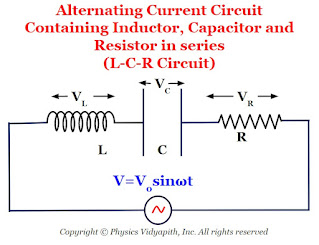 Let us consider, a circuit containing inductor $L$, capacitor $C$, and resistor $R$ and these are connected in series. If an alternating voltage source is applied across it then the resultant voltage of the L-C-R circuit
$V=\sqrt{\left( V_{L} -V_{C} \right)^{2} + V^{2}_{R}} \qquad(1)$
We know that:
$V_{R} = iR$
$V_{L} = iX_{L}$
$V_{C} = iX_{C}$
So from equation $(1)$
$V=\sqrt{\left( iX_{L} - iX_{C} \right)^{2} + (iR)^{2}} $
$V=i\sqrt{\left( X_{L} - X_{C} \right)^{2} + R^{2}} $
$\frac{V}{i}=\sqrt{\left( X_{L} - X_{C} \right)^{2} + R^{2}} $
$Z=\sqrt{\left( X_{L} - X_{C} \right)^{2} + R^{2}} \qquad(2)$
Where
$Z \rightarrow$ Impedance of L-C-R circuit.
$X_{L} \rightarrow$ Inductive Reactance which has value $\omega L$
$X_{C} \rightarrow$ Inductive Reactance which has value $\frac{1}{\omega C}$
So from equation $(2)$, we get
$Z=\sqrt{\left( \omega L - \frac{1}{\omega C} \right)^{2} + R^{2}} \qquad(3)$
The phase of resultant voltage:
 If the phase of resultant voltage from from current is $\phi$ then
$tan \phi = \frac{X_{L} - X_{C}}{R} \qquad(4)$
$tan \phi = \frac{\omega L - \frac{1}{\omega C}}{R} $
$ \phi = tan^{-1} \left( \frac{\omega L - \frac{1}{\omega C}}{R} \right) $
The Impedance and Phase at Resonance Condition:($X_{L} = X_{C}$):
At resonance $X_{L} = X_{C} \qquad(5)$
$\omega L = \frac{1}{\omega C}$
$\omega^{2} = \frac{1}{L C}$
$\omega = \sqrt{\frac{1}{L C}}$
$2 \pi f = \sqrt{\frac{1}{L C}}$
$ f = \frac{1}{2 \pi}\sqrt{\frac{1}{L C}}$
Where $f \rightarrow$ Natural frequency of the circuit
1.) The Impedance of the circuit at resonance condition:
Substitute the resonance condition i.e. $X_{L} = X_{C}$ in equation $(2)$ then the impedance of the L-C-R Circuit
$Z=R$
The impedance of the L-C-R circuit at resonance condition is equal to the resistance of the resistor applied in a circuit.
2.) The Phase of resultant voltage at resonance condition:
$tan\phi =0$
$tan\phi = tan 0^{\circ}$
$\phi=0^{\circ}$
The phase of resultant voltage at resonance condition is zero. i.e. the direction of resultant voltage in the direction of current in the circuit.
Note: There are following cases arise in the L-C-R circuit at resonance condition
Case -1:
If $X_{L} \gt X_{C}$, the $tan \phi$ is positive, i.e. $\phi$ is positive. In this case, the voltage leads to the current. Therefore, the circuit is more inductive rather than capacitive or resistive.
Case -2:
If $X_{L} \lt X_{C}$, the $tan \phi$ is negative, i.e. $\phi$ is negative. In this case, the voltage lags behind the current. Therefore, the circuit has a more capacitance-dominated circuit.
Case -3:
If $X_{L} = X_{C}$, the $tan \phi$ is zero, i.e. $\phi$ is negative. In this case, the voltage and the current are in phase. Therefore, the circuit is purely resistive.

$V_{L} = iX_{L}$
$V_{C} = iX_{C}$
$Z \rightarrow$ Impedance of L-C-R circuit.
$X_{L} \rightarrow$ Inductive Reactance which has value $\omega L$
$X_{C} \rightarrow$ Inductive Reactance which has value $\frac{1}{\omega C}$

Popular Posts
-
 Derivation→ Let us consider, The charge on a parallel-plate capacitor = $q$ The area of parallel-plate = $A$ The dis...
 -
 Derivation→ Let us consider, a current-carrying conductor $XY$ having length $l$ in which current $i$ is flowing from $X$ to $Y$. Now,...
 -
 A.) Electric field intensity at different points in the field due to the uniformly charged solid conducting sphere: Let us consider, A s...
 -
 Calculation of Motion of a body in a vertical Circle: Let us consider, A body that has mass $m$ moving in a vertical circle of radius $r$....
 -
 Alternating Current Circuit containing Resistance (R-Circuit): Let us consider, An alternating current circuit containing resistance $R$ on...
 -
 Alternating Current Circuit Containing Inductance only (L-Circuit): Let us consider, An alternating current circuit containing a coil of i...
 -
Derivation→ Let us consider, The length of the conductor = $l$ The cross-section area of the conductor = $A$ The potential differe...
-
A diffraction grating (or $N$-slits) consists of a large number of parallel slits of equal width and separated from each other by equal opaq...
-
Prove that: Group velocity is equal to Particle Velocity Solution: We know that group velocity $V_{g}=\frac{d\omega}{dk}$ $V_{g}=...
-
Derivation of interference of light due to a wedge-shaped thin film: Interference of light due to wedge-shaped thin film The wedge...

