In electromagnetic waves, the electric field vector and magnetic field vector are mutually perpendicular to each other (Proof)
The general solution of the wave equation for the electric field vector and magnetic field vector are respectively given below
$\overrightarrow{E}= E_{\circ} e^{i(\overrightarrow{k}. \overrightarrow{r} - \omega t)} \qquad(1)$
$\overrightarrow{B}= B_{\circ} e^{i(\overrightarrow{k}. \overrightarrow{r} - \omega t)} \qquad(2)$
Here $E_{\circ}$ and $B_{\circ}$ are the complex amplitude of electric field vector $\overrightarrow{E}$ and magnetic field vector $\overrightarrow{B}$ respectively and $\overrightarrow{k}$ is the propagation constant.
Now
$\overrightarrow{\nabla} \times \overrightarrow{E}= \left( \hat{i} \frac{\partial}{\partial x} + \hat{i} \frac{\partial}{\partial x} +\hat{i} \frac{\partial}{\partial x} \right). \left( \hat{i}E_{x} + \hat{j}E_{y} + \hat{k}E_{z} \right) $
$\overrightarrow{\nabla} \times \overrightarrow{E} = \begin{vmatrix}
\hat{i} & \hat{j} & \hat{k} \\
\frac{\partial}{\partial x} & \frac{\partial}{\partial y} & \frac{\partial}{\partial z} \\
E_{x} & E_{y} & E_{z} \\
\end{vmatrix}$
$\overrightarrow{\nabla} \times \overrightarrow{E} = \hat{i} \left[ \frac{\partial E_{z}}{\partial y} -\frac{\partial E_{y}}{\partial z} \right] - \hat{j} \left[ \frac{\partial E_{z}}{\partial x} -\frac{\partial E_{x}}{\partial z} \right] + \hat{k} \left[ \frac{\partial E_{y}}{\partial x} -\frac{\partial E_{x}}{\partial y } \right] \qquad(3)$
Here $E_{x}$, $E_{y}$ and $E_{z}$ are the component of electric field vector $\overrightarrow{E}$ in $x$, $y$, and $z$ direction. So the component form of the equation $(1)$
$\overrightarrow{E_{x}}= E_{\circ x} e^{i(\overrightarrow{k}. \overrightarrow{r} - \omega t)}$
$\overrightarrow{E_{y}}= E_{\circ y} e^{i(\overrightarrow{k}. \overrightarrow{r} - \omega t)}$
$\overrightarrow{E_{z}}= E_{\circ z} e^{i(\overrightarrow{k}. \overrightarrow{r} - \omega t)}$
We know that:
$\overrightarrow{k}.\overrightarrow{r}=\left( \hat{i}k_{x} + \hat{j}k_{y} + \hat{k}k_{z} \right). \left( \hat{i}x + \hat{j}y +\hat{k}z \right)$
$\overrightarrow{k}.\overrightarrow{r}=x k_{x} + yk_{y} + zk_{z} $
So above equation can be written as:
$\overrightarrow{E_{x}}= E_{\circ x} e^{[i(x k_{x} + yk_{y} + zk_{z}) - \omega t)]} \qquad(4)$
$\overrightarrow{E_{y}}= E_{\circ y} e^{[i(x k_{x} + yk_{y} + zk_{z}) - \omega t)]} \qquad(5)$
$\overrightarrow{E_{z}}= E_{\circ z} e^{[i(x k_{x} + yk_{y} + zk_{z}) - \omega t)]} \qquad(6)$
Now find that derivative from the equation $(4)$, equation $(5)$, and equation $(6)$ then substitute these values in equation $(3)$, So we get
$\left[ \frac{\partial E_{z}}{\partial y} -\frac{\partial E_{y}}{\partial z} \right] = \frac{\partial E_{z}}{\partial y} - \frac{\partial E_{y}}{\partial z} $
$\left[ \frac{\partial E_{z}}{\partial y} -\frac{\partial E_{y}}{\partial z} \right] = \frac{\partial}{\partial y} \left( E_{\circ z} e^{[i(x k_{x} + yk_{y} + zk_{z}) - \omega t)]} \right) -\frac{\partial}{\partial z} \left( E_{\circ y} e^{[i(x k_{x} + yk_{y} + zk_{z}) - \omega t)]} \right) $
$\left[ \frac{\partial E_{z}}{\partial y} -\frac{\partial E_{y}}{\partial z} \right] = \left(i k_{y} E_{z} - i k_{z} E_{y} \right) $
$\left[ \frac{\partial E_{z}}{\partial y} -\frac{\partial E_{y}}{\partial z} \right] = i \left( k_{y} E_{z} - k_{z} E_{y} \right) \qquad(7)$
Similarly
$\left[ \frac{\partial E_{z}}{\partial x} -\frac{\partial E_{x}}{\partial z} \right] = i \left( k_{x} E_{z} - k_{z} E_{x} \right) \qquad(8)$
$\left[ \frac{\partial E_{y}}{\partial x} -\frac{\partial E_{x}}{\partial y} \right] = i \left( k_{x} E_{y} - k_{y} E_{x} \right) \qquad(9)$
Now substitute the value of equation $(7)$, equation $(8)$, and equation $(9)$ in equation $(3)$
$\overrightarrow{\nabla} \times \overrightarrow{E} = i \left[\hat{i} \left( k_{y} E_{z} - k_{z} E_{y} \right) - \hat{j} \left( k_{x} E_{z} - k_{z} E_{x} \right) _ \hat{k} \left( k_{x} E_{y} - k_{y} E_{x} \right) \right]$
$\overrightarrow{\nabla} \times \overrightarrow{E} = i \begin{vmatrix}
\hat{i} & \hat{j} & \hat{k} \\
k_{x} & k_{y} & k_{z} \\
E_{x} & E_{y} & E_{z} \\
\end{vmatrix}$
$\overrightarrow{\nabla} \times \overrightarrow{E} = i \left( \overrightarrow{k} \times \overrightarrow{E} \right) \qquad(10)$
According to Maxwell's third equation
$\overrightarrow{\nabla} \times \overrightarrow{E}= - \frac{\partial \overrightarrow{B}}{\partial t}$
$\overrightarrow{\nabla} \times \overrightarrow{E}= - \frac{\partial}{\partial t} \left( B_{\circ} e^{i(\overrightarrow{k}. \overrightarrow{r} - \omega t)} \right) \quad \left\{From \: equation \: (2)\right\}$
$\overrightarrow{\nabla} \times \overrightarrow{E}= i \omega \overrightarrow{B} \qquad(11)$
From equation $(10)$ and equation $(11)$
$i \left( \overrightarrow{k} \times \overrightarrow{E} \right) = i \omega \overrightarrow{B}$
$ \left( \overrightarrow{k} \times \overrightarrow{E} \right) = \omega \overrightarrow{B} \qquad(12)$
$\therefore$ Magnetic field vector $(\overrightarrow{B})$ is perpendicular to both electric field vector $(\overrightarrow{E})$ and propagation of wave vector $(\overrightarrow{k})$.
Similarly, from $\overrightarrow{\nabla} \times \overrightarrow{B}$, we get
$ \left( \overrightarrow{k} \times \overrightarrow{B} \right) = -\frac{\omega}{c} \overrightarrow{E} \qquad(13)$
Thus, In an electromagnetic wave, the electric field and magnetic field vector are perpendicular to each other and also to the direction of propagation of the wave.
Transverse Nature of Electromagnetic Wave
Electromagnetic waves are transverse in nature: (Proof)
The general solution of the wave equation for the electric field and magnetic field are respectively given below
$\overrightarrow{E}= E_{\circ} e^{i(\overrightarrow{k}. \overrightarrow{r} - \omega t)} \qquad(1)$
$\overrightarrow{B}= B_{\circ} e^{i(\overrightarrow{k}. \overrightarrow{r} - \omega t)} \qquad(2)$
Here $E_{\circ}$ and $B_{\circ}$ are the complex amplitude of electric field vector $\overrightarrow{E}$ and magnetic field vector $\overrightarrow{B}$ respectively and $\overrightarrow{k}$ is the propagation constant.
Now
$\overrightarrow{\nabla}. \overrightarrow{E}= \left( \hat{i} \frac{\partial}{\partial x} + \hat{i} \frac{\partial}{\partial x} +\hat{i} \frac{\partial}{\partial x} \right). \left( \hat{i}E_{x} + \hat{j}E_{y} + \hat{k}E_{z} \right) $
$\overrightarrow{\nabla}. \overrightarrow{E}= \frac{\partial}{\partial x} \left(E_{x} \right)+ \frac{\partial}{\partial y} \left(E_{y} \right) + \frac{\partial}{\partial z} \left(E_{z} \right) \qquad(3)$
Here $E_{x}$, $E_{y}$ and $E_{z}$ are the component of electric field $\overrightarrow{E}$ in $x$, $y$, and $z$ direction. So the component form of the equation $(1)$
$\overrightarrow{E_{x}}= E_{\circ x} e^{i(\overrightarrow{k}. \overrightarrow{r} - \omega t)}$
$\overrightarrow{E_{y}}= E_{\circ y} e^{i(\overrightarrow{k}. \overrightarrow{r} - \omega t)}$
$\overrightarrow{E_{z}}= E_{\circ z} e^{i(\overrightarrow{k}. \overrightarrow{r} - \omega t)}$
Here
$\overrightarrow{k}.\overrightarrow{r}=\left( \hat{i}k_{x} + \hat{j}k_{y} + \hat{k}k_{z} \right). \left( \hat{i}x + \hat{j}y +\hat{k}z \right)$
$\overrightarrow{k}.\overrightarrow{r}=x k_{x} + yk_{y} + zk_{z} $
So above equation can be written as:
$\overrightarrow{E_{x}}= E_{\circ x} e^{[i(x k_{x} + yk_{y} + zk_{z}) - \omega t)]} \qquad(4)$
$\overrightarrow{E_{y}}= E_{\circ y} e^{[i(x k_{x} + yk_{y} + zk_{z}) - \omega t)]} \qquad(5)$
$\overrightarrow{E_{z}}= E_{\circ z} e^{[i(x k_{x} + yk_{y} + zk_{z}) - \omega t)]} \qquad(6)$
Now find that derivative of the equation $(4)$ along the direction of $x$ then
$\frac{\partial E_{x}}{\partial x} = i k_{x} E_{\circ x} e^{[i(x k_{x} + yk_{y} + zk_{z}) - \omega t)]} $
$\frac{\partial E_{x}}{\partial x} = i k_{x} E_{x} $
Similarly, the derivative of the equation $(5)$, and equation $(6)$ along the direction of $y$ and $z$ then
$\frac{\partial E_{y}}{\partial y} = i k_{y} E_{y} $
$\frac{\partial E_{z}}{\partial z} = i k_{z} E_{z} $
Now substitute the value of $\frac{\partial E_{x}}{\partial x}$, $\frac{\partial E_{y}}{\partial y}$, and $\frac{\partial E_{z}}{\partial z}$ in equation $(3)$
$\overrightarrow{\nabla}. \overrightarrow{E}= i k_{x} E_{x} + i k_{y} E_{y} + i k_{z} E_{z}$
$\overrightarrow{\nabla}. \overrightarrow{E}= i \left( k_{x} E_{x} + k_{y} E_{y} + k_{z} E_{z} \right)$
$\overrightarrow{\nabla}. \overrightarrow{E}= i \left( \hat{i}k_{x} + \hat{j}k_{y} + \hat{k}k_{z} \right). \left( \hat{i}E_{x} + \hat{j}E_{y} + \hat{k} E_{z} \right)$
$\overrightarrow{\nabla}. \overrightarrow{E}= i \left( \overrightarrow {k} . \overrightarrow {E} \right) \qquad(7)$
From Maxwell's first equation in free space:
$\overrightarrow{\nabla}. \overrightarrow{E}= 0 \qquad(8)$
From equation $(7)$ and equation $(8)$
$i \left( \overrightarrow {k} . \overrightarrow {E} \right)=0$
$ \overrightarrow {k} . \overrightarrow {E} = 0$
From the above equation, we can conclude that the electric field is perpendicular to the direction of propagation of the wave i.e. $\overrightarrow {E}\perp \overrightarrow {k}$
Similarly, The same result is obtained from $\overrightarrow{\nabla}. \overrightarrow {B}$ i.e. $ \overrightarrow {k} . \overrightarrow {B} = 0$, So we can conclude that the magnetic field is also perpendicular to the direction of propagation i.e. $\overrightarrow {B}\perp \overrightarrow {k}$
Thus, "The electromagnetic waves are transverse in nature"
Diamagnetic Substances and Its properties
Diamagnetic Substances :
Those substances, which are placed in the external magnetic field then they weakly magnetize in the opposite direction of the external magnetic field, are called diamagnetic substances.
The susceptibility $\chi_{m} $ of diamagnetic substances is small and negative. Further, When diamagnetic substance placed in magnetic field then the flux density of the diamagnetic substance is slightly less than that in the free space. Thus, the relative permeability of diamagnetic substance $\mu_{r}$, is slightly less than 1.
Properties of Diamagnetic substances:
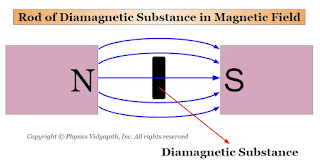
1. When a rod of a diamagnetic material is suspended freely between external magnetic poles (i.e. Between North and South Poles) then its axis becomes perpendicular to the external magnetic field $B$ (Figure). The poles produced on the two sides of the rod are similar to the poles of the external magnetic field.
 2. In a non-uniform magnetic field, a diamagnetic substance tends to move from the stronger magnetic field to the weaker magnetic field. If a diamagnetic liquid is taken in a watch glass placed on two magnetic poles very near to each other, then the liquid is depressed in the middle as shown in figure below(Figure) where the field is strongest. Now, if the distance between the poles is increased, the liquid rises in the middle, because now the field is strongest near the poles.
 3. If the solution of diamagnetic substance is poured into a U-tube and apply the strong magnetic field into one arm of this U-tube then the level of the solution in that arm is depressed. As shown in the figure below:
 4. When diamagnetic gas molecules are passed between the poles of a magnet then diamagnetic gas molecules are spread across the field.
5. The susceptibility of a diamagnetic substance is independent of temperature.
Explanation of Diamagnetism on the Basis of Atomic Model:
The property of diamagnetism is generally found in those substances whose atoms (or ions or molecules) have an 'even' number of electrons. These even numbers of electron form pairs. In each pair of electrons, the spin of one electron is opposite to the other. So, the magnetic moment of one electron is opposite to the others because of that, the effect of magnetic dipole moments are neutralized by each other. As such, the net magnetic dipole moment of an atom (or ion or molecule) of a diamagnetic substance is zero.
When a diamagnetic substance is placed in an external magnetic field $B$ then this external magnetic field modifies the motion of the electrons in the atoms (or ions or molecules). Due to this, In each pair of electrons, the spin of one electron is become fast (Lenz's Law) and the other is slow due to that , the net magnetic dipole moment of the paired electron does not zero. Thus, a small magnetic dipole moment is induced in each atom of the substance (or ion or molecule) which is directly proportional to the magnetic field $B$ and opposite to its direction. Hence, the diamagnetic substance is magnetized opposite to the external magnetic field $B$, and the field lines become less dense inside the diamagnetic substance compared to those outside.
 If the temperature of the diamagnetic substance is changed, there is no effect on its diamagnetic property. Thus, diamagnetism is temperature-independent.


Distinction between Spontaneous and Stimulated Emission of Radiation
Some of the differences between spontaneous and stimulated emission of radiation are
given as follows:
1. In spontaneous emission, an atom in excited state falls to the ground state on its own without any incident photon while in stimulated emission transition takes place by stimulating photons or by an external agency.
2. In stimulated emission for each incident photon there are two outgoing photons in
the same direction while in spontaneous emission the emitted photons move
randomly in any direction.
3. The photons emitted in spontaneous emiss ion have a random phase and hence are
incoherent while in stimulated emission the emitted photons are in phase and
hence are coherent.
4. The rate of spontaneous emission is proportional to only the number of atoms in
the excited state while the rate of stimulated emission is proportional to the
number of atoms left in the excited state as well as on the energy density of the
incident radiation.
5. In stimulated emission of radiation an amplified beam is achieved while in
spontaneous emission there is no such amplification.
6. The light emitted through the spontaneous emission is not monochromatic while
in stimulated transition monochromatic radiation is obtained.
7. Spontaneous emission is not controllable from outside while stimulated emission is
controllable from outside.
8. In spontaneous emission, the net intensity is proportional to the number of
radiating atoms while in stimulated emission it is proportional to the square of the
number of radiation atoms.
Absorption of all the energy of a incident photon by a free electron
A free electron cannot absorb all the energy of a Photon in mutual interaction.
Minimum Energy Or Zero Point Energy of a Particle in an one dimensional potential box or Infinite Well
Zero Point Energy of a Particle in an Infinite Well Potential Well:
The normalized wave function or eigenwave function:
$\psi_{n}(x) = \sqrt{\frac{2}{L}} sin \left( \frac{n\pi x}{L} \right)$
The probability density
$| \psi_{n}(x)|^{2} = \frac{2}{L} sin^{2} \left( \frac{n\pi x}{L} \right)$
The energy of a particle in a one-dimensional box or infinite potential well:
$E_{n}=\frac{n^{2}h^{2}}{8 mL^{2}}$
Where $n$ is called the quantum number and $n=1,2,3,4..........$ For $n=0, \psi_{n}(x)=0$ and $| \psi_{n}(x)|^{2}=0$. This shows that for $n=0$ $| \psi_{n}(x)|^{2}=0$ will be zero everywhere in the box which means that the probability of finding the particle inside the box is zero. i.e. particle is not present at all inside the box. Thus $n=0$ is not possible.
If $n\neq 0$ then $E \neq 0$. This means that the minimum energy of the particle in the box will not be zero. The minimum energy value will be obtained for the next lowest value of $n$ i.e. for $n=1$, which is
$E_{1}=\frac{h^{2}}{8 mL^{2}}$
This minimum energy of the particle is often called zero point energy which is finite inside the box. According to classical mechanics, the minimum value $E=0$ is also permissible.
Popular Posts
-
 Derivation→ Let us consider, The charge on a parallel-plate capacitor = $q$ The area of parallel-plate = $A$ The dis...
 -
 Derivation→ Let us consider, a current-carrying conductor $XY$ having length $l$ in which current $i$ is flowing from $X$ to $Y$. Now,...
 -
 A.) Electric field intensity at different points in the field due to the uniformly charged solid conducting sphere: Let us consider, A s...
 -
 Alternating Current Circuit Containing Inductance only (L-Circuit): Let us consider, An alternating current circuit containing a coil of i...
 -
Derivation of Einstein Coefficient Relation→ Let us consider the $N_{1}$ and $N_{2}$ is the mean population of lower energy state and upp...
-
 Description: The different series of hydrogen spectra can be explained by Bohr's theory. According to Bohr's theory, If the ioni...
 -
 Electric Potential due to an Electric Dipole: The electric potential due to an electric dipole can be measured at different points: ...
 -
 Description: The motion of any particle is depends upon the force applying on it. In the magnetic field, the motion of charge is perp...
 -
Prove that: Group velocity is equal to Particle Velocity Solution: We know that group velocity $V_{g}=\frac{d\omega}{dk}$ $V_{g}=...
-
 In the field of nanomaterials, there are two main approaches to their synthesis and fabrication. A.) Top-Down Approach B.) Bottom-up A...