Zero Point Energy of a Particle in an Infinite Well Potential Well:
The normalized wave function or eigenwave function:
$\psi_{n}(x) = \sqrt{\frac{2}{L}} sin \left( \frac{n\pi x}{L} \right)$
The probability density
$| \psi_{n}(x)|^{2} = \frac{2}{L} sin^{2} \left( \frac{n\pi x}{L} \right)$
The energy of a particle in a one-dimensional box or infinite potential well:
$E_{n}=\frac{n^{2}h^{2}}{8 mL^{2}}$
Where $n$ is called the quantum number and $n=1,2,3,4..........$ For $n=0, \psi_{n}(x)=0$ and $| \psi_{n}(x)|^{2}=0$. This shows that for $n=0$ $| \psi_{n}(x)|^{2}=0$ will be zero everywhere in the box which means that the probability of finding the particle inside the box is zero. i.e. particle is not present at all inside the box. Thus $n=0$ is not possible.
If $n\neq 0$ then $E \neq 0$. This means that the minimum energy of the particle in the box will not be zero. The minimum energy value will be obtained for the next lowest value of $n$ i.e. for $n=1$, which is
$E_{1}=\frac{h^{2}}{8 mL^{2}}$
This minimum energy of the particle is often called zero point energy which is finite inside the box. According to classical mechanics, the minimum value $E=0$ is also permissible.
Bohr's Theory of Hydrogen-Like Atoms
A hydrogen-like atom consists of a very small positively-charged nucleus and an electron revolving in a stable circular orbit around the nucleus.
 The radius of electrons in stationary orbits:
Let the charge, mass, velocity of the electron and the radius of the orbit is respectively $e$, $m$, and $v$ and $r$. The $+ze$ is the positive charge on the nucleus where $Z$ is the atomic number of the atom. As We know that when an electron revolves around the nucleus then the centripetal force on an electron is provided by the electrostatic force of attraction between the nucleus and an electron, we have
$\frac{mv^{2}}{r}=\frac{1}{4 \pi \epsilon_{\circ}} \frac{(Ze)(e)}{r^{2}}$
$mv^{2}=\frac{Ze^{2}}{4 \pi \epsilon_{\circ} r} \qquad(1)$
According to the first postulate of Bohr's model of the atom, the angular momentum of the electron is
$mvr=n \frac{h}{2 \pi} \qquad(2)$
Where $n \: (=1,2,3,.....)$ is quantum number.
Now squaring equation $(2)$ and dividing by equation $(1)$, we get
$r=n^{2} \frac{h^{2} \epsilon_{\circ}}{\pi m Z e^{2}} \qquad(3)$
The above equation is for the radii of the permitted orbits. From the above equation, this concluded that
$r \propto n^{2}$
Since, $n =1,2,3,.....$ it follows that the radii of the permitted orbits increased in the ratio $1:4:9:16:,.....$ from the first orbit.
Bohr's Radius:
For Hydrogen Atom $(z=1)$, The radius of the atom of the first orbit $(n=1)$ will be
$r_{1}= \frac{h^{2} \epsilon_{\circ}}{\pi m e^{2}}$
This is called Bohr's radius and its value is $0.53 A^{\circ}$. Since $r \propto n^{2}$, the radius of the second orbit of the hydrogen atom will be $( 4 \times 0.53 A^{\circ}) $ and that of the third orbit $9 \times 0.53 A^{\circ}$
The velocity of electrons in stationary orbits:
The velocity of the electron in permitted orbits can be obtained by the formula of equation $(2)$
$v=n\frac{h}{2 \pi m r}$
Now put the value of $r$ in above eqaution from equation $(3)$, we get
$v=\frac{Ze^{2}}{2 h \epsilon_{\circ}} \left( \frac{1}{n} \right) \quad(4)$
Thus $v \propto \frac{1}{n}$
This shows that the velocity of the electron is maximum in the lowest orbit $n=1$ and as goes on higher orbits velocity decreases.
For Hydrogen Atom $(z=1)$, The velocity of electron to move in the first orbit $(n=1)$ is
$v_{1}=\frac{e^{2}}{2h\epsilon_{\circ}}$
Its value is $2.19 \times 10^{6} m/sec$
Note:
$\frac{v_{1}}{c}= \frac{2.19 \times 10^{6}}{3 \times 10^{8}} =\frac{1}{137}$
Thus, $\frac{v_{1}}{c}$ or $\frac{e^{2}}{2h\epsilon_{\circ}}$ is a pure number. It is called the "Fine Structure Constant" and is denoted by $\alpha$
The energy of electrons in stationary orbits:
The total energy $E$ of a moving electron in an orbit is the sum of kinetic energies and potential energies. The kinetic energy of moving the electron in a stationary orbit is:
$K=\frac{1}{2} m v^{2}$
Now susbtitute the value of $v$ from equation $(1)$, we get
$K=\frac{ze^{2}}{8 \pi \epsilon_{\circ} r}$
The potential energy of a moving electron in an orbit of radius $r$ due to the electrostatic attraction between nucleus and electron is given by
$U=\frac{1}{4 \pi \epsilon_{\circ}} \frac{(Ze)(-e)}{r}$
$U=-\frac{Ze^{2}}{4 \pi \epsilon_{\circ} r} $
The total energy of the electron is
$E=K+U$
$E=\frac{ze^{2}}{8 \pi \epsilon_{\circ} r} -\frac{Ze^{2}}{4 \pi \epsilon_{\circ} r} $
$E=-\frac{ze^{2}}{8 \pi \epsilon_{\circ} r}$
Subtituting the value of $r$ in above equation from equation $(3)$, we get
$E=-\frac{mz^{2}e^{4}}{8 \epsilon^{2}_{\circ} h^{2}} \left( \frac{1}{n^{2}} \right) \qquad(5)$
This is the equation for the energy of the electron in the $n^{th}$ orbit.
Suppose, Excited state energy is $E_{2}$ and lower state energy is $E_{1}$. So the energy difference between these two states is:
$E_{2}- E_{1}= \frac{mz^{2}e^{4}}{8 \epsilon^{2}_{\circ} h^{2}} \left( \frac{1}{n_{1}^{2}} -\frac{1}{n_{2}^{2}} \right) \qquad(6)$
According to the third postulate of Bohr's Atomic model, the frequency $\nu$ of the emitted electromagnetic wave:
$\nu=\frac{E_{2}- E_{1}}{h}$
$\nu=\frac{mz^{2}e^{4}}{8 \epsilon^{2}_{\circ} h^{3}} \left( \frac{1}{n_{1}^{2}} -\frac{1}{n_{2}^{2}}\right)$
The corresponding wavelength $\lambda$ of the emitted electromagnetic radiation is given by
$\frac{c}{\lambda}=\frac{mz^{2}e^{4}}{8 \epsilon^{2}_{\circ} h^{3}} \left( \frac{1}{n_{1}^{2}} -\frac{1}{n_{2}^{2}}\right)$
$\frac{1}{\lambda}=\frac{mz^{2}e^{4}}{8 \epsilon^{2}_{\circ} c h^{3}} \left( \frac{1}{n_{1}^{2}} -\frac{1}{n_{2}^{2}}\right) \qquad(7)$
Where $\frac{1}{\lambda}$ is called "wave number" (i.e. number of waves per unit length). In the last equation$(7)$, the quantity $\frac{m e^{4}}{8 \epsilon^{2}_{\circ} c h^{3}}$ is a constant an it is known as "Rydberg Constant (R)". That is
$R = \frac{me^{4}}{8 \epsilon^{2}_{\circ} c h^{3}} \qquad(8)$
So equation $(7)$ can be written as
$\frac{1}{\lambda}=z^{2} R \left( \frac{1}{n_{1}^{2}} -\frac{1}{n_{2}^{2}}\right) \qquad(9)$
This is Bohr's formula for hydrogen and hydrogen-like atoms $(He^{+}, Li^{++},.......)$.
For hydrogen $Z=1$
$\frac{1}{\lambda}= R \left( \frac{1}{n_{1}^{2}} -\frac{1}{n_{2}^{2}}\right) \qquad(10)$
The value of the Rydberg Constant is
$R = \frac{me^{4}}{8 \epsilon^{2}_{\circ} c h^{3}} = 1.090 \times 10^{7} m^{-1}$
This value fairly agrees with empirical value $(1.097 \times 10^{7} m^{-1})$ obtained experimentally by Balmer.
The total energy in terms of Rydberg's Constant:
The $E$ expression can be written in terms of Rydberg's constant $R$ in a simplified form. So from equation $(5)$ and $(8)$ we get
$E=-Z^{2}\frac{Rhc}{n^{2}} \qquad(11)$
Putting the known values of $R$, $h$ and $c$ taking $1 eV =1.6 \times 10^{-19} \: J$ then we get
$E=-Z^{2}\frac{13.6}{n^{2}} \: eV \qquad(12)$
For a Hydrogen atom, $Z=1$
$E=-\frac{13.6}{n^{2}} \: eV \qquad(12)$
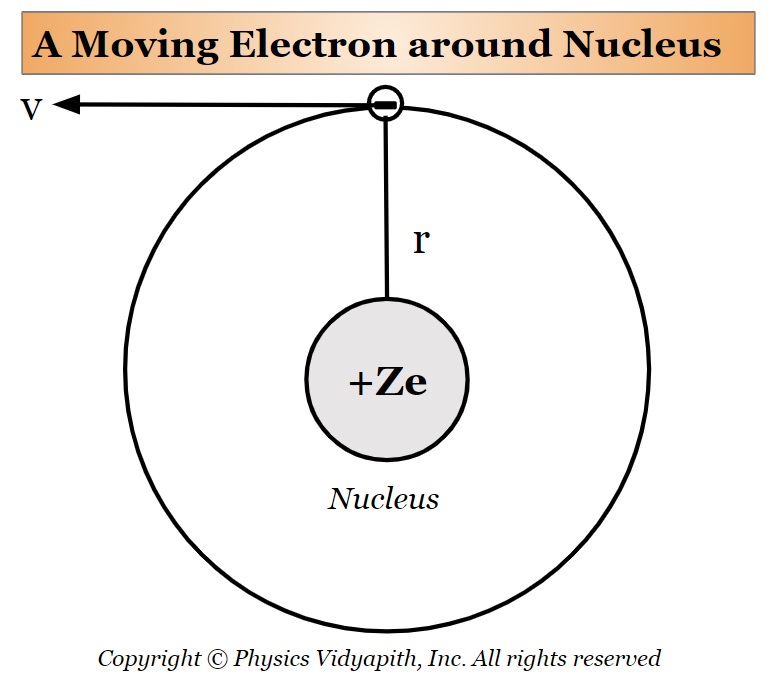
Bohr's Model of Atom
Bohr's Atomic Model Postulates:
Prof Neil in 1913 Bohr solve the difficulties of Ernest Rutherford's atomic model by applying Planck's quantum theory, For this, he proposed the following three Postulates:
1.) Electrons can revolve only in those orbits in which their angular momentum is an integral multiple of $\frac{h}{2 \pi}$. These orbits have discrete energy and definite radii. So it is called the "stable orbits". If the mass of the electron is $m$ and it is revolving with velocity $v$ in an orbit of radius $r$, then its angular momentum will be $mvr$. According to Bohr's postulate,
$mvr=\frac{nh}{2\pi}$
Where $h$ is Planck's universal constant
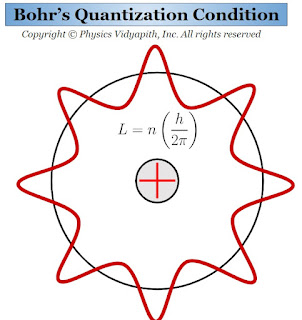 This Bohr's equation is called the "Bohr's quantization Condition"
2.) When the electrons revolve in stable orbits then they do not radiate the energy in spite of their acceleration toward the center of the orbit. Hence atom remains stable and is said to exist in a stationary state.
3.) When the atoms receive energy from outside, then one (or more) of their outer electrons leaves their orbit and goes to some higher orbit. These states of the atoms are called the "excited states".
The electrons in the higher orbit stay only for $10^{-8} \: sec$ and return back to anyone lower orbit. While returning back of electrons to lower orbits, they radiate energy in the form of electromagnetic waves.
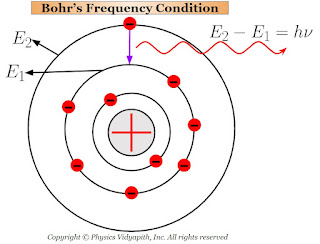 This radiated energy can be calculated by the energy difference of the electron between the two orbits (i.e. one is higher orbit and the other is lower orbit). If the energy of electron in the higher orbit is $E_{2}$ and that in the lower orbit is $E_{1}$ then net energy difference between the orbits:
$E=E_{2} - E_{1}$
$h \nu=E_{2} - E_{1} \qquad \left( \because E=h\nu \right)$
$\nu=\frac{E_{2} - E_{1}}{h}$
This Bohr's equation is called the "Bohr's frequency condition".


Bohr's Quantization Condition
The Quantization Condition in Bohr Theory of Hydrogen Atom:
 $L=\frac{nh}{2 \pi}$
For the angular momentum L, the electron moves arbitrarily only in a stationary circular orbit. According to De Broglie's hypothesis, this condition can be easily obtained. For this purpose, there are following assumptions given below:
1.) The motion of the electron in a stationary circular orbit is represented by a standing matter-wave. If the wavelength of the wave is $\lambda$ then the De Broglie relation
$\lambda=\frac{h}{mv} \qquad(1)$
Where
$m \rightarrow$ The mass of the electron and
$v \rightarrow$ The Velocity in the orbit.
2.) The circular orbit contains an integral number of wavelengths, i.e.
$2 \pi r_{n}= n \lambda $
$\frac{2 \pi r_{n}}{\lambda}= n \qquad(2)$
Where $n=1,2,3............$ and $r_{n}$ is the radius of the orbit.
Substituting the value of $\lambda$ in equation$(2)$
$\frac{2 \pi r_{n} m v}{h} =n$
$mvr_{n} =\frac{nh}{2\pi}$
$L=\frac{nh}{2\pi}$
Which is Bohr's quantization condition.

$m \rightarrow$ The mass of the electron and
$v \rightarrow$ The Velocity in the orbit.
Drawbacks of Old Quantum Theory
Planck's quantum hypothesis with its application and extension to explain the black body radiation like the photo-electric effect, the Compton effect, the variation of specific heat of solid with temperature and the spectrum of hydrogen is now called the Old quantum theory. Through these phenomena are successfully explained by the theory, there are numerous drawbacks of the theory. A few of them are as follows.
1.) Bohr's quantization rules are arbitrary. The theory does not provide a physical explanation for the assumptions.
2.) The old quantum theory cannot be applied to explain the spectra of helium and of more complex atoms.
3.) It can provide only a qualitative and incomplete explanation of the intensities of the spectral lines.
4.) It can not explain the dispersion of light.
5.) The theory of non-harmonic vibrations of systems cannot be applied to explain the vibrations of systems.
One dimensional Step Potential Barrier for a Particle

$\psi_{1} (x) = A e^{ik_{1}x} + B e^{-ik_{1}x} \qquad \left\{ from \: eqaution \: (3) \right\}$
$\psi_{2} (x) = C e^{- \beta \: x} \qquad \left\{ from \: eqaution \: (5) \right\}$
$S_{i} =(Incident \: wave \: function)(Complex \: conjugate \: of \: incident \: wave \: function) \frac{\hbar k_{1}}{m}$
$S_{r} =(Reflected \: wave \: function)(Complex \: conjugate \: of \: reflected \: wave \: function) \frac{\hbar k_{1}}{m}$
$B = \left(\frac{k_{1} - i \beta}{k_{1} + i \beta} \right)A \qquad \left\{ From \: equation \: (9) \right\}$
$S_{t}= -\frac{i \hbar}{2m} \left[C^{*} e^{-\beta x} \frac{\partial C e^{-\beta x}}{\partial x} - C e^{-\beta x} \frac{\partial C^{*} e^{-\beta x}}{\partial x} \right]$
$S_{t}= -\frac{i \hbar}{2m} \left[CC^{*} e^{-\beta x} \frac{\partial e^{-\beta x}}{\partial x} - CC^{*} e^{-\beta x} \frac{\partial e^{-\beta x}}{\partial x} \right]$
$S_{t}= -\frac{i \hbar}{2m} \left[CC^{*} e^{-\beta x} (-\beta) e^{-\beta x} - CC^{*} e^{-\beta x} (-\beta) e^{-\beta x} \right]$
$S_{t}= -\frac{i \hbar}{2m} \left[-CC^{*} e^{-2\beta x} (\beta) + CC^{*} e^{-2\beta x} (\beta) \right]$
$\psi_{1} (x) = A e^{ik_{1}x} + B e^{-ik_{1}x} \qquad \left\{ From \: equation (3) \right\}$

$\psi_{1} (x) = A e^{ik_{1}x} + B e^{-ik_{1}x} \qquad \left\{ from \: eqaution \: (3) \right\}$
$\psi_{2} (x) = G e^{ i k_{2} \: x} \qquad \left\{ from \: eqaution \: (28) \right\}$
$S_{i} =(Incident \: wave \: function)(Complex \: conjugate \: of \: incident \: wave \: function) \frac{\hbar k_{1}}{m}$
$S_{r} =(Reflected \: wave \: function)(Complex \: conjugate \: of \: reflected \: wave \: function) \frac{\hbar k_{1}}{m}$
Popular Posts
-
 Angle of Acceptance → "If incident angle of light on the core for which the incident angle on the core-cladding interface equals t...
 -
 Principle: The principle of the compound microscope is based on the magnification of an image by using two lenses. Construction: A comp...
 -
Description: Unit of Energy The SI unit of energy is the Joule (J) , named after the English physicist James Prescott Joule. 1 Joule is...
-
 Derivation→ Let us consider, The charge on a parallel-plate capacitor = $q$ The area of parallel-plate = $A$ The dis...
 -
Gaussian Surface and its Properties: The Gaussian surface is a hypothetical or imaginary closed three-dimensional surface. This surface i...
-
 A.) Electric field intensity at different points in the field due to the uniformly charged solid conducting sphere: Let us consider, A s...
 -
 Derivation→ Let us consider, a current-carrying conductor $XY$ having length $l$ in which current $i$ is flowing from $X$ to $Y$. Now,...
 -
 Population of energy level: The number of atoms per unit volume in any energy level is called the population of that energy level. The...
 -
Let a plane wavefront be incident normally on slit $S_{1}$ and $S_{2}$ of equal $e$ and separated by an opaque distance $d$.The diffracted l...
-
Principle of Ruby Laser → Ruby laser is the first working laser that was invented by T.H.Maima in 1960. It is a three-level solid-stat...

