Maxwell's Equations:
Maxwell's equation of the electromagnetic wave is a collection of four equations i.e. Gauss's law of electrostatic, Gauss's law of magnetism, Faraday's law of electromotive force, and Ampere's Circuital law. Maxwell converted the integral form of these equations into the differential form of the equations. The differential form of these equations is known as Maxwell's equations.
Current density $(\overrightarrow{J}) = \sigma \overrightarrow{E} $
Volume charge distribution $(\rho)=0$
Permittivity of Conducting Media= $\epsilon$
Permeability of Conducting Media=$\mu$
Now, On solving Maxwell's equation for conducting media i.e perfect dielectric and lossless media, gives the electromagnetic wave equation for conducting media. The electromagnetic wave equation has both an electric field vector and a magnetic field vector. So Maxwell's equation for conducting medium gives two equations for electromagnetic waves i.e. one is for electric field vector($\overrightarrow{E}$) and the second is for magnetic field vector ($\overrightarrow{H}$).
Electromagnetic wave equation for conducting media in terms of $\overrightarrow{E}$:
The value of $\frac{1}{\sqrt{\mu \epsilon}}= v$. Where $v$ is the speed of the electromagnetic wave in the conducting medium. So the above equation is often written as
When an ideal fluid (i.e incompressible and non-viscous Liquid or Gas) flows in streamlined motion from one place to another, then the total energy per unit volume (i.e Pressure energy + Kinetic Energy + Potential Energy) at each and every of its path is constant.
$P+\frac{1}{2}\rho v^{2} + \rho gh= constant$
Derivation of Bernoulli's Theorem Equation:
Let us consider that an incompressible and non-viscous liquid is flowing in streamlined motion through a tube $XY$ of the non-uniform cross-section.
Now Consider:
The Area of cross-section $X$ = $A_{1}$
The Area of cross-section $Y$ = $A_{2}$
The velocity per second (i.e. equal to distance) of fluid at cross-section $X$ = $v_{1}$
The velocity per second (i.e. equal to distance) of fluid at cross-section $Y$ = $v_{2}$
The Pressure of fluid at cross-section $X$ = $P_{1}$
The Pressure of fluid at cross-section $Y$ = $P_{2}$
The height of cross-section $X$ from surface = $h_{1}$
The height of cross-section $Y$ from surface = $h_{2}$
The work done per second by force on the liquid Entering the tube at $X$:
$W_{1}$ = Force $ \times $ Distance covered in one second
$W_{1}= P_{1} \times A_{1} \times v_{1} \quad \left( Force =Pressure \times Area \right)$
Similarly
The work done per second by force on the liquid leaving the tube at $Y$:
Now substitute the given values in the equation of power:
$P=\frac{5 \times 10 \times 10}{10}$
$P=50 \: Joule/sec=50 W$
Q.2 A man whose mass is $50 \: Kg$ climbs up $30$ steps of the stairs in $30 \: Sec$. If each step is $20 \: cm$ high, Calculate the power used in climbing the stairs $(g=10 \: m/sec^{2})$
Solution:
Given that:
Mass of a man $(m) = 50 \: Kg$
Climbs up the number of Steps $(N) = 30$
The time is taken to climb up the 30 steps $(t)= 30 \: sec$
The length or height of one step $(l)=20 cm \: = \: 0.20 \: m$
The total length or height of 30 steps $h=30 \times 0.20 \: m$
Q.3 A horse exerts a pull of $300 N$ on a cart so that the horse-cart system moves with a uniform speed of $18 Km/h$ on a level road. Calculate the power in watts developed by the horse and also find its equivalent in horsepower.
Solution:
Given that:
The horse exerts the pull, i.e, force $(F)=300 N$
The unifrm speed of the horse-cart $(v)=18 Km/h$
So the distance moved in $(s)=18 Km=18000m$
The time $(t)=1h= 60 \times 60 sec$
The power developed by the horse$(P)=?$
From the equation of the power, the power developed by a horse in one hour:
$P=\frac{W}{t}$
$P=\frac{F.s}{t}$
Now substitute the given values in the above equation:
$P=\frac{3000 \times 18000}{60 \times 60}$
$P=1500 W$
$P=\frac{1500}{746}$
$P=2 \: hp$
Q.4 A man weighing $60Kg$ climbs up a staircase carrying a load of $20 Kg$ on his head. The staircase has 20 steps, each of height $0.2m$. If he takes $10 sec$ to climb, find his power.
Solution:
Given that:
The weight of man $(m_{1})=60Kg$
The weight of load $(m_{2})=20Kg$
The number of steps in the staircase $(N)=20$
The height of each step $(H)=10s$
The total mass of the man and load $(m)=m_{1}+m_{2}= 60+20=80 Kg$
The total heght of stair case $(h)=N \times H = 20 \times .2= 4 m$
The power of man:
$P=\frac{W}{t}$
$P=\frac{mgh}{t}$
$P=\frac{80 \times 9.8 \times 4}{10}$
$P=313.6 W$
Q.5 A car of mass $2000 Kg$ and it is lifted up a distance of $30m$ by a crane in $1 \: min$. A second crane does the same job as the first crane in $2 \: min$. Do both cranes consume the same or different amounts of fuel? Find the power supplied by each crane? Neglecting power dissipation against friction.
Solution:
Given that:
The mass of car $(m)=2000 Kg $
The lifted up distance $(h)=30m$
The time taken by first crane $(t_{1}= 1\: min)$
The time taken by second crane $(t_{2}= 2\: min)$
The work done by each crane:
$W=mgh$
$W=2000 \times 9.8 \times 30$
$W=5.88 \times 10^{5} J$
As both the cranes do the same amount of work, both consume the same amount of fuel.
The power supplied by the first crane:
$P_{1}=\frac{mgh}{t_{1}}$
$P_{1}=\frac{2000 \times 9.8 \times 30}{60}$
$P_{1}=9800 W$
The power supplied by the second crane:
$P_{2}=\frac{2000 \times 9.8 \times 30}{1.2}$
$P_{2}=4900 W$
Q.6 The human heart discharges $75 \: mL$ of blood at every beat against a pressure of $0.1 m$ of Hg. Calculate the power of the heart assuming that the pulse frequency is $80$ beats per minute. Density of $Hg=13.6 \times 10^{3} Kg/m^{3}$.
Solution:
Given that:
The volume of blood discharge per beat $(V)=75 \: mL = 75 \times 10^{-6} m^{-3} $
The pressure of blood $(P)=0.1 m \: of \: Hg$ i.e.
Q.7 A machine gun fires $60$ bullets per minute with a velocity of $700 m/sec$. If the mass of each bullet is $50 g$, then find the power developed by the gun.
Solution:
Given that:
The mass of one bullet is $M=50 g$
The number of bullets $N=60$
The mass of $60$ bullets $m=M \times N= 50\times 60 = 300g= 3Kg$
The velocity of the bullet $v=700 m/sec$
The time take to fire $60$ bullets $t=1 \: min = 60 sec$
Derivation of variation of mass with velocity:
Consider two systems of reference (frame of reference) $S$ and $S’$. The frame $S’$ is moving with constant velocity $v$ relative to frame $S$.
Let two bodies of masses $m_{1}$ and $m_{2}$ be traveling with velocities $u’$ and $-u’$ parallel to the x-axis in the system $S’$. Suppose the two bodies collide and after collision coalesce into one body.
The principles of conservation of mass and of momentum also hold good in relativity same as in classical mechanics. So now apply the principle of conservation of momentum.
Apply the law of addition of velocities, the velocities $u_{1}$ and $u_{1}$ in the system $S$ corresponding to $u’$ and $-u’$ in frame $S’$ are given by $\rightarrow$
$u_{1}= \frac{u'+v}{1+\frac{u'v}{c^{2}}}\quad or \quad u_{2}= \frac{-u'+v}{1-\frac{u'v}{c^{2}}}\qquad(2)$
Now substitute the value of $u_{1}$ and $u_{1}$ in equation $(1)$
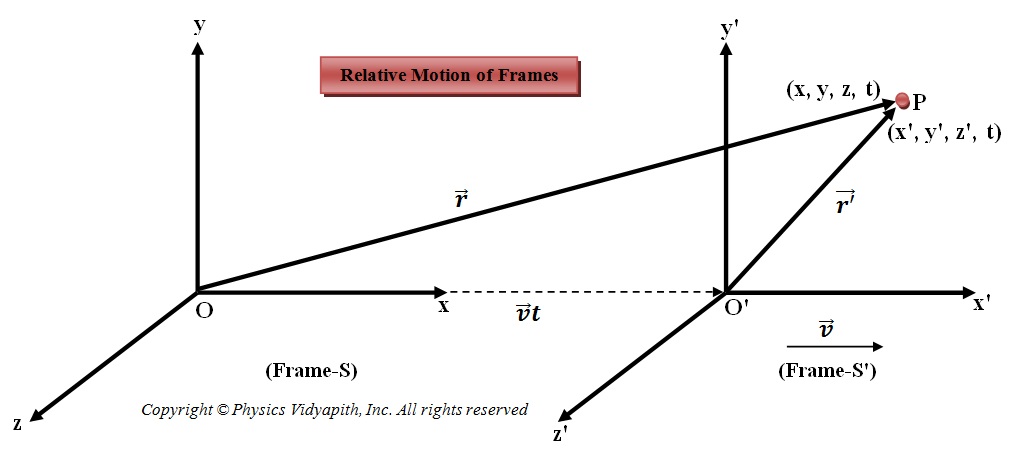
A point or a particle at any instant, in space has different cartesian coordinates in the different reference systems. The equation which provide the relationship between the cartesian coordinates of two reference system are called Transformation equations.
Galilean Transformation Equation:
Let us consider, two frames $S$ and $S'$ in which frame $S'$ is moving with constant velocity $v$ relative to an inertial frame $S$. Let
The origin of the two frames coincide at $t=0$
The coordinate axes of frame $S'$ are parallel to that of the frame $S$ as shown in the figure below
The velocity of the frame $S'$ relative to the frame $S$ is $v$ along x-axis;
The position vector of a particle at any instant $t$ is related by the equation
The equation $(1)$ and equation $(2)$ express the transformation of coordinates from one inertial frame to another. Hence they are referred to as Galilean transformation.
The equation $(1)$ and equation $(2)$ depending on the relative motion of two frames of reference, but it also depends upon certain assumptions regarding the nature of time and space. It is assumed that the time t is independent of any particular frame of reference. i.e. If $t$ and $t'$ be the times recorded by observers $O$ and $O'$ of an event occurring at $P$ then
$ t=t'\qquad (3)$
Now add the above assumption with transformation equation $(3)$ so the Galilean transformation equations are
The other assumption, regarding the nature of space, is that the distance between two points (or two particles) is independent of any particular frame of reference. For example if a rod has length $L$ in the frame $S$ with the end coordinates $(x_{1}, y_{1}, z_{1})$ and $(x_{2}, y_{2}, z_{2})$ then
So from equation $(5)$, equation $(6)$ and equation $(7)$, we can write as:
$L=L'$
Thus, the length or distance between two points is invariant under Galilean Transformation.
The hypothesis of Galilean Invariance:(Principle of Relativity)
The hypothesis of Galilean invariance is based on experimental observation and is stated as follows:
The basic laws of physics are identical in all reference system which move with uniform velocity with respect to one another.
OR in other words
The basics laws of physics are invariant in inertial frame.
Modify the hypothesis of Galilean Invariance by giving the following statement-
The basic law of physics are invariant in form in two reference system which are connected by Galilean Transformation
Failure of Galilean Relativity OR Galilean Transformation:
There are the following points that could not explain by Galilean transformation:
Galilean Transformation failed to explain the actual result of the Michelson-Morley experiment.
It violates the postulates of the Special theory of relativity.
According to Maxwell's electromagnetic theory, the speed of light in a vacuum is $c$ $(3\times10^{8} m/sec)$ in all directions. Let us consider a frame of reference relative to which the speed of light is $c$ in all directions, According to Galilean transformation the speed of light in any other inertial system, which is in relative motion with respect to the former, will be different in a different direction. For example- If an observer is moving with speed $v$ opposite or along with the propagation of light, The speed of light $c_{0}$ in the frame of the observer is given by
Length Contraction (Lorentz-Fitzgerald Contraction):
Lorentz- Fitzgerald, first time, proposed that When a body moves comparable to the velocity of light relative to a stationary observer, then the
length of the body decreases along the direction of velocity. This decrease in length in the direction of motion is called 'Length Contraction'.
Expression for Length Contraction:
Let us consider two frames $S$ and $S'$ in which frame $S'$ is moving with constant velocity $v$ relative to frame $S$ along the positive x-axis direction. Let a rod is associated with frame $S'$. The rod is at rest in frame $S'$ so the actual length $l_{0}$ is measured by frame $S'$. So
$ l_{0}=x'_{2}-x'_{1}\quad\quad (1)$
Where $x'_{2}$ and $x'_{1}$ are the x-coordinate of the ends of the rod in frame $S'$.
According to Lorentz's Transformation
$ x'_{1}=\alpha (x_{1}-vt)\quad\quad (2)$
$ x'_{2}=\alpha (x_{2}-vt)\quad\quad (3)$
Now put the value of $x'_{1}$ and $x'_{2}$ in equation $(1)$, then
Here $l$ is the length of the rod measured in frame $S$.
Here The factor $\sqrt{1-\frac{v^{2}}{c^{2}}}$ is less than unity. It means
that
$ \sqrt{1-\frac{v^{2}}{c^{2}}}< 1 $
so
$l< l_{0}$
So the length of the rod in frame $S$ will be less than the proper length or
actual length which is measured in frame $S'$.
Case:
If $v=c$, Then $l=0$, i.e. a rod moving with the velocity of light will
appear as a point to a stationary observer. So from the above discussion, we
can conclude that in relativity there is no absolute length'.
**What is the proper length?
The length of the rod is measured by a stationary observer relative to the length of the rod in the frame.
Time Dilation (Apparent Retardation of Clocks):
Let us consider two frames $S$ and $S'$ in which frame $S'$ is moving with constant velocity $v$ relative to frame $S$ along the positive x-axis direction.
Let two events occur in frame $S$ which is at rest at time $t_{1}$ and $t_{2}$. These two event measured in frame $S'$ at time $t'_{1}$ and
$t'_{2}$. So time interval between these two events in frame $S'$ is
Here the factor $\sqrt{1-\frac{v^{2}}{c^{2}}}$ is less then unity. i.e
$ \sqrt{1-\frac{v^{2}}{c^{2}}}< 1$
Then
$t> t_{0}$
So the time interval between two events in frame $S'$ will be longer than the time interval taken in frame $S$.
The time dilation is a real effect. All clocks will appear running slow for
an observer in relative motion. It is incorrect to say that the clock in
moving frame $S'$ is slow as compared to the clock in stationary frame $S$. The
correct statement would be that All clocks will run slow for an observer in
relative motion.
Case:
If $v=c$, then $t=∞ $ i.e. When a clock moving with the speed of light appears to be completely stopped to an observer in a stationary frame of reference.
** Proper and Non-Proper Time:
The time interval between two events that occur at the same position recorded by a clock in the frame in which the events occur (or frame at rest) is called 'proper time'.
The time interval between the same two events recorded by an observer in a frame that is moving with respect to the clock is known as 'Non -proper time or relativistic time'.
Experimental Verification of Time Dilation:
The direct experimental confirmation of time dilation is found in an experiment on cosmic ray particles called mesons. μ-mesons are created at
high altitudes in the earth's atmosphere (at the height of about 10 km) by the interaction of fast cosmic-ray photons and are projected towards the earth's surface with a very high speed of about $2.994\times10^{8}$ m/s which is $0.998$ of the speed of light $c$. μ-mesons are unstable and decay into electrons or positrons with an average lifetime of about $2.0\times10^{-6}$sec. Therefore, in its lifetime a μ-mesons can travel a
distance.
Now the question arises how μ-mesons travel a distance of 10 km to reach the earth's surface. This is possible because of the time dilation effect. In fact, μ-mesons have an average lifetime $t_{0}=2.0\times10^{-6}$ sec in their own frame of reference. In the observer's frame of reference on the earth's surface, the lifetime of the μ-mesons is lengthened due to relativity effects to the value $t$ given as,