Derivation of Lorentz Transformation's Equations

Derivation:

Let us consider two inertial frames $S$ and $S'$ in which frame $S'$ is moving with constant velocity $v$ along the positive x-axis direction relative to the frame $S$. Let $t$ and $t'$ be the time recorded in two frames. Let the origin $O$ and $O'$ of the two reference systems coincide at $t=t'=0$.

Now suppose, a source of light is situated at the origin $O$ in the frame $S$, from which a wavefront of light is emitted at time $t=0$. When the light reaches point $P$, the time required by a light signal in travelling the distance OP in the Frame $S$ is
Diagram of Inertial Motion with Respect to Speed of Light
$ t=\frac{OP}{c}$

$ t=\frac{\left (x^{2}+y^{2}+z^{2} \right )}{c}$

$ x^{2}+y^{2}+z^{2}=c^{2}t^{2}\qquad (1)$

The equation $(1)$ represents the equation of wavefront in frame $S$. According to the special theory of relativity, the velocity of light will be $c$ in the second frame $S'$. Hence in frame $S'$ the time required by the light signal in travelling the distance $O'P$ is given by

$ t'=\frac{O'P}{c}$

$ x'^{2}+y'^{2}+z'^{2}=c^{2}t^{2}\qquad (2)$

According to the Galilean transformation equation:

$ \begin{Bmatrix} x'=x-vt\\ y'=y\\ z'=z\\ t'=t \end{Bmatrix}$

Now substitute these values in equation $(2)$ then we get

$ (x-vt)^{2}+y^{2}+z^{2}=c^{2}t^{2}$

$ x^{2}+v^{2}t^{2}-2xvt+y^{2}+z^{2}-c^{2}t^{2}=0$

The above equation is certainly not same as the equation $(1)$ because it contains an extra term $(-2xvt+v^{2}t^{2})$. Thus the Galilean transformation fails.

Further $t=t'$ because $\left( t=\frac{OP}{c} \: and \: t'=\frac{O'P}{c} \right)$ which does not agree with Galilean transformation equations.

The extra term $(-2xvt+v^{2}t^{2})$ indicates that transformations in $x$ and $t$ should be modified so that this extra term is cancelled. So modification in transformation

$ x'=\alpha (x-vt) \quad for \: x'=0,\: x=vt$

$ t'=\alpha (t+fx)$

Where $α$, $α'$ and $f$ are constant to be determined for Galilean Transformations $α= α'=1$ and $f=0$. Now substituting these modified values in equation $(2)$ so

$ \alpha ^{2}(x-vt)^{2}+y^{2}+z^{2}=c^{2}\alpha'^{2}(t+fx)^{2}$

$ \alpha ^{2}(x^{2}+v^{2}t^{2}-2xvt)+y^{2}+ z^{2} =c^{2}\alpha{'}^{2}(t^{2}+f^{2}x^{2}+2fxt)$

$\alpha^{2}x^{2}+\alpha^{2}v^{2}t^{2}-2xvt\alpha^{2}+y^{2}+ z^{2} =c^{2} \alpha'^{2}t^{2}+c^{2} \alpha'^{2}f^{2}x^{2}+c^{2} \alpha'^{2}(2fxt)$

$ x^{2}(\alpha^{2}-c^{2} \alpha'^{2}f^{2})- 2xt(v\alpha^{2}+c^{2}\alpha '^{2}f)+y^{2}+ z^{2} =c^{2}t^{2}\left ( \alpha'^{2}-\frac{\alpha ^{2}v^{2}}{c^{2}} \right )\qquad(3)$

This result obtained from applying transformations from frame $S'$ to $S$ must be identical to equation $(1)$. Therefore

$ \alpha ^{2}-c^{2}\alpha '^{2}f^{2}=1\qquad (i)$

$ v\alpha ^{2}+c^{2}\alpha '^{2}f=0\qquad (ii)$

$ \alpha '^{2}-\frac{\alpha ^{2}v^{2}}{c^{2}}=1\qquad (iii)$

After solving equation $(i)$ equation $(ii)$ and equation $(iii)$, we get

$ \alpha =\alpha '=\frac{1}{\sqrt{1-\frac{v^{2}}{c^{2}}}}$ $ f=-\frac{v}{c^{2}}$

Thus, The new transformation equation is invariant at the velocity of light $c$. These are:

$ \begin{Bmatrix} x'=\frac{x-vt}{\sqrt{1-\frac{v^{2}}{c^{2}}}}\\ y'=y\\ z'=z\\ t'=\frac{(t-\frac{vx}{c^{2}})}{\sqrt{1-\frac{v^{2}}{c^{2}}}} \end{Bmatrix}$

These equations are called Lorentz Transformations because they were first obtained by Dutch Physicist H. Lorentz.

The above transformation equation shows that frame $S'$ is moving in positive x-direction with velocity $v$ relative to the frame $S$. But if we say that frame $S$ is moving with $v$ velocity relative to frame $S'$ along negative x-direction then the transformation is:

$ \begin{Bmatrix} x=\frac{x'+vt'}{\sqrt{1-\frac{v^{2}}{c^{2}}}}\\ y=y'\\ z=z'\\ t=\frac{(t'+\frac{vx'}{c^{2}})}{\sqrt{1-\frac{v^{2}}{c^{2}}}} \end{Bmatrix}$

These are known as inverse Lorentz Transformations equations.


Force between multiple charges (Superposition principle of electrostatic forces)

Principle of Superposition for Electric force:

If a system contains a number of interacting charges, then the net force on anyone charge equals the vector sum of all the forces exerted on it by all the other charges. This is the principle of Superposition for electric force.

If a system contains n point charges $ q_{1},q_{2},q_{3}........q_{n}$. Then according to the principle of superposition, the force acting on the charge $q_{1}$ due to all the other charges

$\overrightarrow{F_{1}}=\overrightarrow{F_{12}}+\overrightarrow{F_{13}}+\overrightarrow{F_{14}}+...+\overrightarrow{F_{1n}} \qquad (1)$

Where $\overrightarrow{F_{12}}$ is the force on charge $q_{1}$ due to charge $q_{2}$, $\overrightarrow{F_{13}}$ that is due to $q_{3}$ and $\overrightarrow{F_{1n}}$ that due to $q_{n}$.

If the distance between the charges $q_{1}$ and $q_{2}$ is $\widehat{r}_{12}$ (magnitude only) and $\widehat{r}_{21}$ is unit vector from charge $q_{2}$ to $q_{1}$, then

$\overrightarrow{F_{12}}=\frac{1}{4\pi \epsilon _{0}}\frac{q_{1}q_{2}}{r_{12}^{2}}\:\hat{r_{21}} \qquad (2)$

Similarly, the forces on charge $q_{1}$ due to other charges are given by

$ \overrightarrow{F_{13}}=\frac{1}{4\pi \epsilon _{0}}\:\frac{q_{1}q_{3}}{r_{13}^{2}}\:\hat{r_{31}}\qquad (3)$

$.............................$

$.............................$

$ \overrightarrow{F_{1n}}=\frac{1}{4\pi \epsilon _{0}}\:\frac{q_{1}q_{n}}{r_{1n}^{2}}\:\hat{r_{n1}}\qquad (n)$

Hence, putting the value of $\overrightarrow{F_{12}},\overrightarrow{F_{13}},\overrightarrow{F_{14}}......\overrightarrow{F_{1n}}$, in equation $(1)$, the total force on charge $q_{1}$ due to all other charges is given by

$ \overrightarrow{F_{1}}=\frac{1}{4\pi \epsilon _{0}}[\:\frac{q_{1}q_{2}}{r_{12}^{2}}\:\hat{r_{21}}+\frac{q_{1}q_{3}}{r_{13}^{2}}\:\hat{r_{31}}+....\\ \quad\quad\quad ..+\frac{q_{1}q_{n}}{r_{1n}^{2}}\:\hat{r_{n1}}]$

The same procedure can be applied to finding the force on any other charge due to all the remaining charges. For example, the force on $q_{2}$ due to all the other charges is given by

$ \overrightarrow{F_{2}}=\frac{1}{4\pi \epsilon _{0}}[\:\frac{q_{2}q_{1}}{r_{21}^{2}}\:\hat{r_{12}}+\frac{q_{2}q_{3}}{r_{23}^{2}}\:\hat{r_{32}}+... \\ \quad\quad\quad ..+\frac{q_{2}q_{n}}{r_{2n}^{2}}\:\hat{r_{n2}}\:]$

Some Observations Points of Coulomb's Law:

There are the following point has been observed in Coulomb's law, that are
  1. Coulomb's force between the two charges is directly proportional to the product of the magnitude of the charge.

    $ F\propto q_{1}q_{2}$

  2. Coulomb's force between the two charges is inversely proportional to the square of the distance between the two charges.

    $F\propto \frac{1}{r^{2}}$

  3. The electrostatic force acts between the line joining the charges. In two charges, one charge is assumed to be at rest for the calculation of the force on the second charge. So It is also known as a central force.

  4. The magnitude of the electrostatic force is equal and the direction of force is opposite. So the electrostatic force is also known as the action and reaction pair.

  5. The electrostatic force between two charge does not affect by the presence and absence of any other charges but the net force increase on the source charge.

Definition and derivation of the phase velocity and group velocity of wave

Wave:
A wave is defined as a disturbance in a medium from an equilibrium condition that propagates from one region of the medium to other regions.

When such type of wave propagates in the medium a progressive change in phase takes place from one particle to the next particle.

Propagation of Wave: Wave propagation in the medium occurs with two different kinds of velocity. i.e. phase velocity and group velocity.

1. Phase Velocity:
The velocity with which plane of constant the phase of a wave propagates through the medium at a certain frequency is called the phase velocity or wave velocity.

A plane wave traveling in the positive x-direction is represented by

$y=A \: sin \omega (t-\frac{x}{v})$

Where $ \omega $ – angular frequency

$y=A \: sin(\omega t-\frac{\omega x}{v})$

$y=A \: sin(\omega t-kt) \qquad(1)$

For plane-wave $(\omega t-kx)$ is the phase of wave motion. For the plane of constant phase (wavefront). We have

$( \omega t-kx) = constant (\phi) \qquad(2)$

Differentiate with respect to time $(t)$ of the above equation

$ \omega -k.\frac{dx}{dt}=0$

$\frac{dx}{dt}=\frac{ \omega}{k}\qquad(3)$

$V_{p}=\frac{ \omega}{k} \qquad \left [ \because V_{p}= \frac{dx}{dt} \right ]$

Where $V_{p}$ - Phase Velocity of a wave

Question- Show that the phase velocity of matter-wave always exceeds the velocity of light.

Answer- Method-I

$V_{p}=\frac{ \omega }{k}$

$V_{p}=\frac{2\pi \nu }{\frac{2\pi }{\lambda }}$

$V_{p} = \frac{2 \pi h \nu}{\frac{2 \pi h}{\lambda }}$

$V_{P} = \frac{E}{P}$

$V_{P} =\frac{mc^{2}}{mv}$

$V_{P} =\frac{c^{2}}{v}$

Method-II:

$V_{P}=\nu \lambda$

$V_{P}=\frac{mc^{2}}{h} \frac{h}{mv}$

$V_{P}=\frac{c^{2}}{v}$

Where $v$ is the velocity of matter particles.

Wave packet→
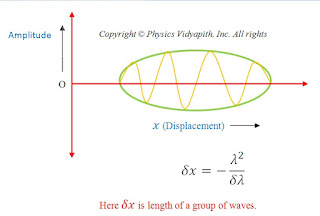
A wave packet is an envelope or packet which contains the number of plane waves having different wavelengths or wavenumbers. These numbers of waves superimpose on each other and form constructive and destructive interference over a small region of space and a resultant wave obtain. The spread of amplitude of the resultant wave with distance determines the size of the wave packet. A wave packet is also called a wave group.
Diagram of a wave packet

Group Velocity→
The velocity of propagation of wave packet through space is known as group velocity.

Group Velocity also represents the velocity of energy flow or transmission of information in a traveling wave or wave packet. It is represented by $V_{g}$. So

$V_{g} = \frac{d\omega }{dk}$


Expression for group velocity $(V_{g})$→

Let two plane simple harmonic waves of the same amplitude and slightly different wavelength traveling simultaneously in the positive x-direction in a dispersive medium be represented by –

$y_{1} = A\: sin{(\omega t-kx)} \qquad (1)$

$y_{2}= A\:sin[(\omega +\delta \omega )t-(k+\delta k)x] \qquad (2)$

From the superposition principle the resultant displacement of waves

$y=y_{1}+y_{2}\qquad (3)$

$y=A \: sin(\omega t-kx)+ A \: sin[(\omega +\delta \omega)t-(k+\delta k)x]$

$y=A[sin(\omega t-kx)+ sin{(\omega +\delta \omega )t-(k+\delta k )x}]$

$y=2Asin(\omega t-kx)cos\frac{1}{2}(t\delta \omega –x\delta k) \qquad (4)$

This is the analytical equation for the group of waves. This equation represents the following points –
  1. The sine factors represent a carrier wave that travels with the phase velocity.

  2. The amplitude of the resultant wave is


$R=2A cos \frac{1}{2}(t \delta\omega-x \delta k) \qquad (5)$

(A) For maximum amplitude

$ cos\frac{1}{2}(\delta\omega t-x\delta k)=1 \qquad (6) $

Then the resultant amplitude of the wave packet will be

$R_{m}=2A \qquad $ {from equation $(5)$ }

Where $R_{m}$ - Resultant maximum amplitude

From equation$(6)$-

$cos\frac{1}{2}(t\delta\omega –x\delta k)=1$

$cos\frac{1}{2}(t\delta\omega –x\delta k)=cos0$

$\frac{1}{2}(t\delta\omega –x\delta k)=0$

$\frac{x}{t}=\frac{\delta\omega }{\delta k}$

$V_{g}=\frac{\delta\omega }{\delta k}$

OR

$V_{g}=\frac{d\omega}{dk}$

Thus maximum amplitude i.e. the center of the wave packet moves with velocity $\frac {d\omega}{dk}$ or group velocity.

(B) For minimum amplitude

Let a wave packet that has minimum (zero) amplitude on two successive points $x_{1}and x_{2}$. So for minimum amplitude at point $x_{1}$ –

$cos\frac{1}{2}(t.\delta \omega –x_{1}.\delta k)=0$

$cos\frac{1}{2}(t.\delta \omega –x_{1}.\delta k)=cos(2n+1)\frac{\pi }{2}$

$\frac{1}{2}(t.\delta \omega –x_{1}.\delta k)=(2n+1)\frac{\pi }{2}$

$t.\delta \omega – x_{1}.\delta k=(2n+1)\pi \qquad(1)$

Similarly minimum amplitude at the second successive point $x_{2}$-

$t\delta \omega –x_{2}.\delta k =(2n-1)\pi \qquad(2)$

Now subtract the equation $(2)$ in equation $(1)$

$(t.\delta \omega – x_{1}.\delta k) – (t.\delta \omega - x_{2}.\delta k)= (2n+1)\pi–(2n-1)\pi $

$(x_{2}-x_{1}).\delta k=2\pi$

$x_{2}-x_{1}=\frac{2\pi}{\delta k}$

$x_{2}-x_{1}=\frac{2\pi}{d(\frac{2\pi}{\lambda})} $

$\delta x=\frac{-\lambda ^{2}}{\delta  \lambda }$

Here $\delta x$ -Length of the wave packet

The above equation also can be written as-

$ dx=\frac{-\lambda^{2}}{d \lambda }$

Prove that

$V_{g}= -\lambda^{2} \frac{d\nu }{d\lambda}$

Where $\nu $ is the frequency and $\lambda $ is the wavelength.

Proof:

We know that

$V_{g}=\frac{d\omega }{dk}$

$V_{g}=\frac{d(2\pi\nu )}{d(\frac{2\pi }{\lambda })} \qquad \left( \because \omega= 2\pi \nu \: and \: k=\frac{2\pi}{\lambda } \right)$

$V_{g}=\frac{2\pi d\nu }{2\pi d( \frac{1}{ \lambda })}$

$V_{g}=-\lambda ^{2}\frac{d\nu }{d\lambda }$

Note: A moving particle cannot be equal to a single wave train. The speed of a single wave train is called the phase velocity so moving particles are equivalent to a group of waves or wave packets.

Product of phase velocity and group velocity is equal to square of speed of light

Prove that $\rightarrow$
The Product of phase velocity and group velocity is equal to the square of the speed of light i.e. $\left( V_{p}.V_{g}=c^{2} \right)$

Proof → We know that

$V_{p}=\nu \lambda \qquad(1)$

And de Broglie wavelength-

$\lambda =\frac{h }{mv}\qquad(2)$

According to Einstein's mass-energy relation-

$E=mc^{2}$

$h\nu=mc^{2}$

$\nu=\frac{mc^{2}}{h}\qquad(3)$

Now put the value of $\lambda $ and $\nu $ in equation$(1)$

$V_{p}= [\frac{mc^{2}}{h}] [\frac{h}{mv}]$

$V_{p}=\frac{C^{2}}{v}$

Since group velocity is equal to particle velocity i.e. $V_{g}=v$. So above equation can be written as

$V_{p}=\frac{C^{2}}{V_{g}}$

$V_{p}.V_{g}=C^{2}$

Note →

➢ $V_{g}=V_{p}$ for a non-dispersive medium ( in a non-dispersive medium all the waves travel with phase velocity).

➢ $V_{g}< V_{p}$ for normal dispersive medium

➢ $V_{g}> V_{p}$ for anomalous dispersive media.

Dispersive medium → The medium in which the phase velocity varies with wavelength or frequency is called a dispersive medium. In such a medium, waves of different wavelengths travel with different phase velocities.

Non-dispersive medium → The medium in which the phase velocity does not vary with wavelength or frequency is called a Non-dispersive medium.

Dispersive waves → Those waves in the medium for which phase velocity varies with wavelength or frequency are called dispersive waves.

Non-dispersive waves → Those waves in which phase velocity does not vary with wavelength are called non-dispersive waves. So phase velocity independent of wavelength.

Energy distribution spectrum of black body radiation

Description→ The energy distribution among the different wavelengths in the spectrum of black body radiation was studied by Lummer and Pringsheim in 1899. There are the following important observations of the study.
  1. The energy distribution in the radiation spectrum of the black body is not uniform. As the temperature of the body rises the intensity of radiation for each wavelength increases.

  2. At a given temperature, the intensity of radiation increases with increases in wavelength and becomes maximum at a particular wavelength with further in increases wavelength the intensity of radiation decreases.

  3. Energy distribution in the spectrum of black body
    Energy distribution in the spectrum of black body radiation
  4. The points of maximum energy shift towards the shorter wavelength as the temperature increases i.e. $\lambda _{m} \times T=constant$. It is also known as Wein’s displacement law of energy distribution.

  5. For a given temperature the total energy of radiation is represented by the area between the curve and the horizontal axis and the area increases with increases of temperature, being directly proportional to the fourth power of absolute temperatures.
    The total amount of heat radiated by a perfectly black body per unit area per unit time is directly proportional to the fourth power of its absolute temperature $(T)$.

    $E = \sigma T^{4}$

    Where $\sigma$ = Stefan constant having value $\left ({5}\cdot{67}\times{10}^{-8}Wm^{-2}K^{4}\right )$

    This is called Stefan-Boltzmann's law of energy distribution.

Derivation of torque on an electric dipole in an uniform and a non-uniform electric field

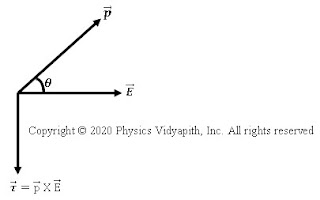
Torque on an electric dipole in a uniform electric field: Let us consider, An electric dipole AB, made up of two charges $+q$ and $-q$, is placed at a very small distance $l$ in a uniform electric field $\overrightarrow{E}$. If $\theta$ is the angle between electric field intensity $\overrightarrow{E}$ and electric dipole moment $\overrightarrow{p}$ then the magnitude of electric dipole moment →

$\overrightarrow{p}=q\times\overrightarrow{l}\qquad(1)$

Force exerted on charge $+q$ by electric field $\overrightarrow{E}$ →

$\overrightarrow{F_{+q}}=q\overrightarrow{E}\qquad(2)$

Here in the above equation(2), the direction of $\overrightarrow{F_{+q}}$ is along the direction of $\overrightarrow{E}$

Force exerted on charge $-q$ by electric field $\overrightarrow{E}$ →

$\overrightarrow{F_{-q}}= q\overrightarrow{E}\qquad(3)$

Here in the above equation(3) the direction of $\overrightarrow{F_{-q}}$ is in the opposite direction of $\overrightarrow{E}$

So, the net force of on an electric dipole→

$\overrightarrow{F}=\overrightarrow{F_{+q}} - \overrightarrow{F_{-q}}\qquad (4)$

Now substitute the value of equation $(2)$ and equation $(3)$ in above equation $(4)$. So net force→

$\overrightarrow{F}=0\qquad (5)$
Torque on Electric Dipole
Hence, the net translating force on an electric dipole in a uniform electric field is zero. But these two force is equal in magnitude, opposite in direction, and act at different point of the dipole so these force form a coupling force that exerts a torque on an electric dipole→

Torque = force x Perpendicular distance between the two forces

$\overrightarrow{\tau}=(qE).l\:sin\theta\quad\quad\quad\quad(6)$

$ \overrightarrow{\tau}=pE\:sin\theta$

$\overrightarrow{\tau}=\overrightarrow{p}\times\overrightarrow{E}$

Case(I)→ If the dipole is placed perpendicular to the electric field i.e. $\theta=90^{\circ}$, the torque acting on it will be maximum. i.e.

$ \tau_{max}=pE $

Case(II)→ If the dipole is placed parallel to the electric field i.e. $\theta=0^{\circ}$ or $\theta=180^{\circ}$, the torque acting on it will be minimum. i.e.

$ \tau_{min}=0$
Direction of torque
Direction of torque
Electric Dipole Moment:

We know that the torque

$ \overrightarrow{\tau}=pE\:sin\theta$

If $E=1$ and $\theta=90^{\circ}$ Then

$ \tau_{max} =p$

Hence Electric dipole moment is the torque acting on the dipole placed perpendicular to the direction of uniform electric field intensity.

Torque on an electric dipole in a non-uniform electric field:

In a non-uniform electric field, the $+q$ and $-q$ charges of a dipole experience different forces (not equal in magnitude and opposite in direction) at a slightly different position in the electric field, and hence a net force $\overrightarrow{F}$ act on the dipole in a non-uniform field. A net torque acts on the dipole which depends on the location of the dipole in the non-uniform field.

$\overrightarrow{\tau}=\overrightarrow{p}\times\overrightarrow{E}(\overrightarrow{r})$

Where $\overrightarrow{r}$ is the position vector of the center of the dipole.
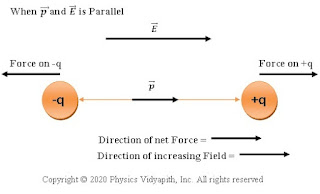
When p  and E  is Parallel
When p and E are Parallel
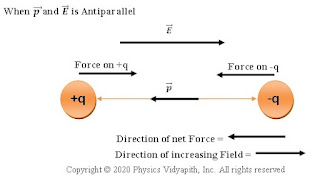
In the non-uniform field, If the direction of the dipole moment $\overrightarrow{p}$ is parallel to electric field intensity $\overrightarrow{E}$ or antiparallel to electric field intensity $\overrightarrow{E}$ the net torque on the dipole is zero because the force on charges becomes linear.
When p  and E  is antiparallel
When p and E are antiparallel
However, If $\overrightarrow{p}$ is parallel to $\overrightarrow{E}$, a net force on the dipole in the direction of increasing $\overrightarrow{E}$. When $\overrightarrow{p}$ is antiparallel to $\overrightarrow{E}$, a net force on the dipole in the direction of decreasing $\overrightarrow{E}$. As shown in the figure above.

Popular Posts