Definition:
The total mechanical energy associated with an orbiting satellite around the planet is the sum of kinetic energy (i.e., due to orbital motion) and potential energy (i.e., the gravitational potential energy of the satellite).
Derivation of the total mechanical energy of the orbiting satellite around the planet:
Let us consider
The mass of the satellite = $m$
The mass of the planet = $M$
The distance between satellite to a planet from the center of the planet = $r$
The radius of planet =$R$
The potential energy of the satellite is
$U=-\frac{G \: M \: m}{r} \qquad(1)$
The kinetic energy of the satellite is
$K=\frac{1}{2}m v_{e}^{2}$
$K=\frac{1}{2} m \left[ \sqrt{\frac{G M}{r}} \right]^{2} \quad \left( \because v_{e}^{2}=\sqrt{\frac{G \: M}{r}} \right)$
$K=\frac{1}{2} \left( \frac{G M m}{r} \right) \qquad(2)$
The total energy (i.e. mechanical energy) of the satellite is
$E= K+U$
Now put the value of kinetic and potential energy from equation $(1)$ and equation $(2)$ in the above equation
$E= \frac{1}{2} \left[ \frac{G M m}{r} \right]+ \left[ -\frac{G M m}{r} \right]$
$E= -\frac{1}{2} \left[ \frac{G M m}{r} \right]$
$E= -\frac{1}{2} \left[ \frac{G M m}{R+h} \right] \left( \because r=R+h \right)$
The above equation shows that the total mechanical energy associated with orbiting satellite is negative.
The total mechanical energy associated with the orbiting satellite around the Earth:
Put $M=M_{e}$ and $R=R_{e}$ then
$E= -\frac{1}{2} \left[ \frac{G M_{e} m}{R_{e}+h} \right] \left( \because r=R_{e}+h \right)$
$E= -\frac{1}{2} \left[ \frac{g R_{e}^{2} m}{R_{e}+h} \right] \left( \because GM_{e}=g R_{e}^{2} \right)$
If the satellite revolves around near the Earth (i.e., $h=0$) then the total mechanical energy of the satellite
$E= -\frac{1}{2} \left[ \frac{g R_{e}^{2} m}{R_{e}+0} \right]$
$E= -\frac{1}{2} \left[ \frac{g R_{e}^{2} m}{R_{e}} \right]$
$E= -\frac{1}{2} \left[ g R_{e} m \right]$
Binding Energy of the Satellite:
The minimum amount of mechanical energy required to free the revolving satellite around the planet from its orbit is called the binding energy of the revolving satellite.
We know that, the revolving satellite's total mechanical energy in an orbit of the planet is
$E= -\frac{1}{2} \left[ \frac{G M m}{R+h} \right]$
At infinite distance between a satellite to a planet, the total mechanical energy of the satellite is zero. Therefore, if an orbiting satellite is provided postive energy that is equal to the total mechanical energy, its total mechanical energy becomes zero, and the satellite escapes from the planet's orbit. This total positive mechanical energy is called the gravitational binding energy of the satellite. i.e.
$E= +\frac{1}{2} \left[ \frac{G M m}{R+h} \right]$
The gravitational binding energy associated with orbiting satellite around the earth
$E= +\frac{1}{2} \left[ \frac{G M_{e} m}{R_{e}+h} \right]$
If a satellite revolves around near Earth ($h=0$), then the binding energy
$E= +\frac{1}{2} \left[ \frac{G M_{e} m}{R_{e}} \right]$
Expression for Orbital velocity of Satellite and Time Period
Orbital Velocity of Satellite:
Expression for Orbital Velocity of Satellite:

Let us consider:
The mass of the satellite = $m$
The mass of planet= $M$
The radius of Planet =$R$
The satellite is moving about the planet at height=$h$
The satellite is moving about the planet with orbital velocity=$v_{\circ}$
The distance from the center of the planet to satellite=$r$
The force of gravitation between the planet and the satellite
$F=G \frac{M \: m}{r^{2}} \qquad(1)$
This force work act as a centripetal force to revolve the satellite around the planet i.e.
$F=\frac{m v_{\circ}^{2}}{r} \qquad(2)$
From the above equation $(1)$ and equation $(2)$, we get
$\frac{m v_{\circ}^{2}}{r} = G \frac{M \: m}{r^{2}}$
$v_{\circ}= \sqrt{\frac{G \: M }{r}}$
Where $r=R+h$ then
$v_{\circ}= \sqrt{\frac{G \: M }{R+h}} \qquad(3)$
This is the equation of the orbital velocity of the satellite.
If any satellite revolves around the earth then the orbital velocity
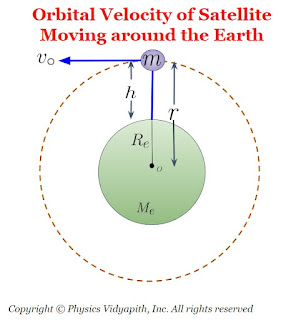
$v_{\circ}= \sqrt{\frac{G \: M_{e} }{R_{e}+h}}$
$v_{\circ}= \sqrt{\frac{gR_{e}^{2}}{R_{e}+h}} \qquad \left( \because G \: M_{e} = gR_{e}^{2} \right)$
$v_{\circ}= R_{e} \sqrt{\frac{g}{R_{e}+h}} $
This is the equation of the orbital velocity of a satellite revolving around the earth.
If the satellite is orbiting very close to the surface of the earth ( i.e $h=0$) then the orbital velocity
$v_{\circ}= R_{e} \sqrt{\frac{g}{R_{e}+0}} $
$v_{\circ}= \sqrt{g R_{e}} $
Now subtitute the value of radius of earth (i.e $R_{e}=6.4 \times 10^{6} \: m$) and gravitational accelertaion ($g=9.8 \:m/sec^{2}$) then orbital velocity
$v_{\circ}=7.92 \: Km/sec$
The time period of Revolving Satellite:
Let us consider the time period of the revolving satellite is $T$ Then
$T= \frac{Distance \: covered \: by \: Satellite \: in \: one \: revolution}{Orbital \: Velocity}$
$T= \frac{2 \pi r}{v_{\circ}}$
$T= \frac{2 \pi \left( R+h \right)}{v_{\circ}}$
$T= \frac{2 \pi \left( R+h \right)}{v_{\circ}}$
Now subtitute the value of orbital velocity $v_{\circ}$ from equation $(3)$ in above equation then
$T= \frac{2 \pi \left( R+h \right)}{\sqrt{\frac{G \: M }{R+h}}}$
$T= 2 \pi \sqrt{ \frac{ \left( R+h \right)^{3}}{G M}}$
This is the equation of the time period of the revolution of satellites.
If a satellite revolves around the earth then the time period
$T= 2 \pi \sqrt{ \frac{ \left( R_{e}+h \right)^{3}}{G M_{e}}}$
$T= 2 \pi \sqrt{ \frac{ \left( R_{e}+h \right)^{3}}{g R_{e}^{2}}} \qquad \left( \because G \: M_{e} = gR_{e}^{2} \right)$
This is the equation of the time period of revolution of satellite revolving around the earth.
If the satellite revolves very nearly around the earth (i.e $h=0$) then the time period of the satellite from the above equation
$T= 2 \pi \sqrt{ \frac{ \left( R_{e}+0 \right)^{3}}{g R_{e}^{2}}} $
$T= 2 \pi \sqrt{ \frac{ R_{e}}{g}} $
$T= 84.6 \: min $
When any satellite moves about the planet in a particular orbit then the velocity of the satellite is called the orbital velocity of the satellite.


The time taken by satellite to complete on revolution around the planet is called the time period of the satellite.
Derivation of Gravitational Potential Energy due to Point mass and on the Earth
Definition of Gravitational Potential Energy:
$U=W_{\infty \rightarrow r}$
Derivation of Gravitational Potential energy due to a Point mass:

Let us consider,
The mass of the point object (i.e point mass)=$m$
The mass of the object that produces the gravitational field = $M$
If the point mass $m$ is at a distance $x$ then the gravitational force between the objects is
$F=G \frac{M \: m}{x^{2}} \qquad(1)$
If the point mass moves a very small distance element $dx$ that is at distance $x$ from point $O$ then the work done to move the point object from point $B$ to $A$
$dw=F.dx$
Now substitute the value of $F$ from equation $(1)$ in above equation
$dw=G \frac{M \: m}{x^{2}}.dx$
Therefore, the work done to bring the point mass from infinity to point $P$ that is at distance $r$ from point $O$ then work done to move the point object from infinity ($\infty$) to point $P$
$\int_{0}^{W} dw = \int_{\infty}^{r} G \frac{M \: m}{x^{2}}.dx $
$ [w]_{0}^{W} = G\: M\: m \int_{\infty}^{r} \frac{1}{x^{2}}.dx $
$ [W-0] = G\: M\: m [-\frac{1}{x} ]_{\infty}^{r} $
$ W = G\: M\: m [\left(-\frac{1}{r}\right) - \left(-\frac{1}{\infty}\right)]$
$ W = -\frac{G\: M\: m }{r} \qquad \left( \because \frac{1}{\infty} =0 \right)$
$ W = -\frac{G\: M\: m }{r} $
This work done by the force is stored in the form of potential energy i.e
$U=W$
$U=-\frac{G\: M\: m }{r}$
Thus the above equation represents the gravitational potential energy of an object at point $P$
Gravitational Potential Energy on Earth:

Let us consider,
The mass of Earth = $M_{e}$
The radius of earth = $R_{e}$
The mass of the object = $m$
The distance from centre $O$ of the earth to point $P$ = $r$
The distance from the surface of the earth to point $P$ = $h$
If the object is at a distance $x$ then the gravitational force is
$F=G \frac{M_{e} \: m}{x^{2}} \qquad(1)$
If the object moves a very small distance element $dx$ that is at distance $x$ from centre point $O$ of the earth then the work done to move an object from point $B$ to $A$
$dw=F.dx$
Now substitute the value of $F$ from equation $(1)$ in above equation
$dw=G \frac{M_{e} \: m}{x^{2}}.dx$
Therefore, the work done to bring the object from infinity to point $P$ that is at distance $r$ from centre point $O$ of the earth then the work done to move an object from infinity ($\infty$) to point $P$
$\int_{0}^{W} dw = \int_{\infty}^{r} G \frac{M_{e} \: m}{x^{2}}.dx $
$ [w]_{0}^{W} = G\: M_{e}\: m \int_{\infty}^{r} \frac{1}{x^{2}}.dx $
$ [W-0] = G\: M_{e}\: m [-\frac{1}{x} ]_{\infty}^{r} $
$ W = G\: M_{e}\: m [\left(-\frac{1}{r}\right) - \left(-\frac{1}{\infty}\right)]$
$ W = -\frac{G\: M_{e}\: m }{r} \qquad \left( \because \frac{1}{\infty} =0 \right)$
$ W = -\frac{G\: M_{e}\: m }{r} $
The above equaton shows that the work done by force is stored in the form of gravitational potential energy i.e.
$U=W$
$ U = -\frac{G\: M_{e}\: m }{r}$
Where $r=R_{e}+h$, then above equation can be written as
$U = -\frac{G\: M_{e}\: m }{R_{e}+h} \qquad(2)$
This is the equation of the gravitational potential energy at point $P$. The other form of the above equation i.e
$U = -\frac{g R_{e}^{2} \: m }{R_{e}+h} \qquad \left( \because GM_{e}= g R_{e}^{2} \right)$
If the object is placed on the surface of the earth then $h=0$. So gravitational potential energy on the surface of the earth
$U=-\frac{G \: M_{e} \: m}{R_{e}}$
This is the equation of the gravitational potential energy of an object placed on the surface of the earth.
$U=-\frac{g R_{e}^{2} m}{R_{e}} \qquad \left( \because GM_{e}= g R_{e}^{2} \right)$
$U=-g R_{e} m$
This is another form of the gravitational potential energy of an object placed on the surface of the earth.
Note:
We know that the gravitational potential energy at any point from above the surface of the earth
$U = -\frac{G\: M_{e}\: m }{R_{e}+h} $
$U = V m \qquad \left( \because V= -\frac{G\: M_{e}\: }{R_{e}+h} \right)$
$U = Gravitational \: Potential \times \: mass \: of \: an \: object$
When an object is brought from infinity to a point in the gravitational field then work done acquired by the gravitational force is stored in the form of potential energy which is called gravitational potential energy.Let us consider, An object of mass $m$ brought from infinity to a point in the gravitational field. If work done acquired by force is $W$ then gravitational potential energy

The mass of the point object (i.e point mass)=$m$
The mass of the object that produces the gravitational field = $M$

The radius of earth = $R_{e}$
The mass of the object = $m$
The distance from centre $O$ of the earth to point $P$ = $r$
The distance from the surface of the earth to point $P$ = $h$
$U=-\frac{G \: M_{e} \: m}{R_{e}}$
Derivation of Gravitational Potential due to Point mass and on the Earth
Definition of Gravitational Potential:
$V=-\frac{W}{m}$
Derivation of Gravitational Potential due to a Point mass:

Let us consider,
The mass of the point object (i.e point mass)=$m$
The mass of the object that produces the gravitational field = $M$
If the point mass $m$ is at a distance $x$ then the gravitational force between the objects is
$F=G \frac{M \: m}{x^{2}} \qquad(1)$
If the point mass moves a very small distance element $dx$ that is at distance $x$ from point $O$ then the work done to move the point object from point $B$ to $A$
$dw=F.dx$
Now substitute the value of $F$ from equation $(1)$ in above equation
$dw=G \frac{M \: m}{x^{2}}.dx$
Therefore, the work done to bring the point mass from infinity to point $P$ that is at distance $r$ from point $O$ then work done to move the point object from infinity ($\infty$) to point $P$
$\int_{0}^{W} dw = \int_{\infty}^{r} G \frac{M \: m}{x^{2}}.dx $
$ [w]_{0}^{W} = G\: M\: m \int_{\infty}^{r} \frac{1}{x^{2}}.dx $
$ [W-0] = G\: M\: m [-\frac{1}{x} ]_{\infty}^{r} $
$ W = G\: M\: m [\left(-\frac{1}{r}\right) - \left(-\frac{1}{\infty}\right)]$
$ W = -\frac{G\: M\: m }{r} \qquad \left( \because \frac{1}{\infty} =0 \right)$
$ W = -\frac{G\: M\: m }{r} $
$\frac{W}{m} = -\frac{G\: M }{r} $
$ V = -\frac{G\: M}{r} \qquad \left( \because V=\frac{W}{m} \right)$
$ V = -\frac{G\: M}{r}$
Thus the above equation represents the gravitational potential at point $P$
Gravitational Potential on Earth:
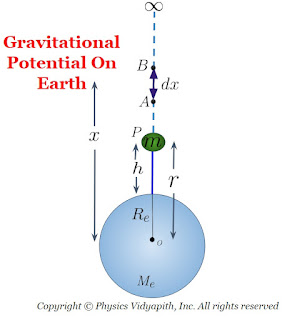
Let us consider,
The mass of Earth = $M_{e}$
The radius of earth = $R_{e}$
The mass of the object = $m$
The distance from centre $O$ of the earth to point $P$ = $r$
The distance from the surface of the earth to point $P$ = $h$
If the object is at a distance $x$ then the gravitational force is
$F=G \frac{M_{e} \: m}{x^{2}} \qquad(1)$
If the object moves a very small distance element $dx$ that is at distance $x$ from centre point $O$ of the earth then the work done to move an object from point $B$ to $A$
$dw=F.dx$
Now substitute the value of $F$ from equation $(1)$ in above equation
$dw=G \frac{M_{e} \: m}{x^{2}}.dx$
Therefore, the work done to bring the object from infinity to point $P$ that is at distance $r$ from centre point $O$ of the earth then the work done to move an object from infinity ($\infty$) to point $P$
$\int_{0}^{W} dw = \int_{\infty}^{r} G \frac{M_{e} \: m}{x^{2}}.dx $
$ [w]_{0}^{W} = G\: M_{e}\: m \int_{\infty}^{r} \frac{1}{x^{2}}.dx $
$ [W-0] = G\: M_{e}\: m [-\frac{1}{x} ]_{\infty}^{r} $
$ W = G\: M_{e}\: m [\left(-\frac{1}{r}\right) - \left(-\frac{1}{\infty}\right)]$
$ W = -\frac{G\: M_{e}\: m }{r} \qquad \left( \because \frac{1}{\infty} =0 \right)$
$ W = -\frac{G\: M_{e}\: m }{r} $
$\frac{W}{m} = -\frac{G\: M_{e} }{r} $
$ V = -\frac{G\: M_{e}}{r} \qquad \left( \because V=\frac{W}{m} \right)$
$ V = -\frac{G\: M_{e}}{r}$
Where $r=R_{e}+h$, then above equation can be written as
$V=-\frac{G \: M_{e}}{R_{e}+h} \qquad(2)$
This is the equation of gravitational potential at point $P$. The other form of the above equation i.e
$V=-\frac{g R_{e}^{2}}{R_{e}+h} \qquad \left( \because GM_{e}= g R_{e}^{2} \right)$
If the object is placed on the surface of the earth then $h=0$. So gravitational potential on the surface of the earth
$V=-\frac{G \: M_{e}}{R_{e}}$
This is the equation of gravitational potential on the surface of the earth. The other form of the above equation is
$V=-\frac{g R_{e}^{2}}{R_{e}} \qquad \left( \because GM_{e}= g R_{e}^{2} \right)$
$V=-g R_{e}$
When an object is brought from infinity to a point in the gravitational field then work done acquired by the gravitational force is called gravitational potential.Let us consider, An object of mass $m$ brought from infinity to a point in the gravitational field. If work done acquired by force is $W$ then gravitational potential

The mass of the point object (i.e point mass)=$m$
The mass of the object that produces the gravitational field = $M$

The radius of earth = $R_{e}$
The mass of the object = $m$
The distance from centre $O$ of the earth to point $P$ = $r$
The distance from the surface of the earth to point $P$ = $h$
Gravitational field, Intensity of Gravitational field and its expression
Definition of Gravitational Field:
Gravitational Field Intensity:
The Expression for gravitational field intensity:
Let us consider
The mass of a lighter object that experience the force = $m$
The mass of a heavy object that produces the gravitational field= $M$
The distance between the objects = $r$
The gravitational force between the objects is
$F=G\frac{M\:m}{r^{2}} \qquad(1)$
Now the force per unit mass i.e Gravitational field intensity
$E=-\frac{F}{m} \qquad (2)$
Here the negative indicates that the direction of force is opposite to $\hat{r}$
The vector form of the gravitational field intensity
$\overrightarrow{E}=-\frac{F}{m} \hat{r}$
Where $\hat{r} \left (=\frac{\overrightarrow{r}}{r} \right)$ is the unit vector along the $\overrightarrow{r}$
Now substitute the value of $F$ in the above equation $(2)$. Therefore we get,
$E=-G \frac{M\:m}{m r^{2}}$
$E=- \frac{G \: M}{r^{2}}$
The vector form of the above equation
$\overrightarrow{E}=- \frac{G \: M}{r^{2}} \hat{r}$
The region around an object in which another object experiences a gravitational force then the region of that object is called the gravitational field.
The force applied per unit mass of an object that is placed in the gravitational field is called the intensity of the gravitational field.$\overrightarrow{E}=- \frac{G \: M}{r^{2}} \hat{r}$
The mass of a lighter object that experience the force = $m$
The mass of a heavy object that produces the gravitational field= $M$
The distance between the objects = $r$
Deduction of Newton's Law of gravitation from Kepler's Law
Deduction of Newton's Law of gravitational force from Kepler's Law:
Let us consider:
The mass of a planet = $m$
The radius of the circular path of a planet=$r$
The mass of the sun = $M$
The velocity of the planet = $v$
The time of the revolution=$T$
The attraction force between the planet and the sun is achieved by the centripetal force i.e
$F=\frac{m v^{2}}{r} \qquad(1)$
The orbital velocity of the planet:
$v=\frac{Circumference \: of \: the \: circular \: path}{Time \: period}$
$v=\frac{2\pi r}{T} \qquad(2)$
From equation $(1)$ and equation $(2)$, we get
$F=\frac{m}{r} \left( \frac{2\pi r}{T} \right)^{2}$
$F=\frac{4 \pi^{2} mr}{T^{2}} \qquad(3)$
According to Kepler's third law i.e
$T^{2}=Kr^{3} \qquad(4)$
From equation$(3)$ and equation$(4)$, we get
$F=\frac{4 \pi^{2}mr}{Kr^{3}}$
$F=\frac{4 \pi^{2}}{K}\frac{mr}{r^{3}}$
$F=\frac{4 \pi^{2}}{K}\frac{m}{r^{2}} \qquad(5)$
The source of this force is the sun. So R.H.S of equation $(5)$ should be related to the sun. Since $m$ and $r$ are related to the planet. So the quantity $\frac{4 \pi^{2}}{K}$ should be related to some constant of the sun. Let $\frac{4 \pi^{2}}{K}$ be proportional to the mass of the sun. i.e
$\frac{4 \pi^{2}}{K m} \propto M$
$\frac{4 \pi^{2}}{K m} = G M $
Here $G$ is the proportionality constant and it is called the universal gravitation constant. Now substitute the $\frac{4 \pi^{2}}{K m} = G M$ in equation $(5)$. then we get
$F=G \frac{M m}{r^{2}}$
The above equation represents the force of attraction between the sun and the planet. It is also known as Newton's law of gravitational force.
The mass of a planet = $m$
The radius of the circular path of a planet=$r$
The mass of the sun = $M$
The velocity of the planet = $v$
The time of the revolution=$T$
Popular Posts
-
 Derivation→ Let us consider, The charge on a parallel-plate capacitor = $q$ The area of parallel-plate = $A$ The dis...
 -
 Derivation→ Let us consider, a current-carrying conductor $XY$ having length $l$ in which current $i$ is flowing from $X$ to $Y$. Now,...
 -
 A.) Electric field intensity at different points in the field due to the uniformly charged solid conducting sphere: Let us consider, A s...
 -
Principle of Ruby Laser → Ruby laser is the first working laser that was invented by T.H.Maima in 1960. It is a three-level solid-stat...
-
 Description: The motion of any particle is depends upon the force applying on it. In the magnetic field, the motion of charge is perp...
 -
 Derivation of electric field intensity due to the uniformly charged wire of infinite length: Let us consider a uniformly-charged (positi...
 -
Prove that: Group velocity is equal to Particle Velocity Solution: We know that group velocity $V_{g}=\frac{d\omega}{dk}$ $V_{g}=...
-
Let $S$ be a point monochromatic source of light of wavelength $\lambda$ placed at the focus of collimating lens $L_{1}$. The light beam is ...
-
Let a plane wavefront be incident normally on slit $S_{1}$ and $S_{2}$ of equal $e$ and separated by an opaque distance $d$.The diffracted l...
-
 Principle: The principle of the compound microscope is based on the magnification of an image by using two lenses. Construction: A comp...


