Principle and Proof of Law of Conservation of Energy

Law of Conservation of Energy: According to this principle
The energy is neither created nor destroyed. The energy can be changed from one form to another form. i.e. when there is not any external influence is applied on the particle then the total energy of the particle is always conserved.

Proof of Conservation's Law of Energy: Let us consider, A particle is freely falling from height $h$ under the gravitational acceleration $g$. So the total energy of the particle at different points :
A Free Falling particle under the gravity
Calculation of Total Energy at Point $A$:

The initial velocity of the particle at point $A$ is $(v_{A})=0$

The kinetic energy of the particle at point $A$ is $(K_{A})=\frac{1}{2}mv_{A}^{2}$

$K_{A}=0\qquad \left( \because v_{A}=0 \right)$

The potential energy of the particle at point $A$ is $(U_{A})=mgh$

The total energy of a particle at point $A$ is $(E_{A})=K_{A}+U_{A}$

Now substitute the value of $K_{A}$ and $U_{A}$ in the above equation. Now the above equation can be written as:

$E_{A}=0+mgh$

$E_{A}=mgh \qquad(1)$

Calculation of Total Energy at Point $B$: If a particle travels the distance $x$ and reaches point $B$ then velocity at point $B$ can be calculated by the equation of motion. i.e.

$v_{B}^{2}=v_{A}^{2}+2gx$

But the initial velocity of the particle is zero. i.e $v_{A}=0$ then the above equation can be written as

$v_{B}^{2}=0+2gx$

$v_{B}^{2}=2gx$

The kinetic energy of the particle at point $B$ is $(K_{B})=\frac{1}{2}mv_{B}^{2}$

Now substitute the value of $v_{B}^{2}$ in the above equation. Now the above equation can be written as:

$K_{B}=\frac{1}{2}m \left( 2g x \right)$

$K_{B}=mgx $

The height of the particle at point $B$ is $(h-x)$ then the potential energy at point $B$ is $(U_{B})=mg(h-x)$

The total energy of a particle at point $B$ is $(E_{B})=K_{B}+U_{B}$

Now substitute the value of $K_{B}$ and $U_{B}$ in the above equation. Now the above equation can be written as:

$E_{B}=mgx+mg(h-x)$

$E_{B}=mgh \qquad(2)$

Calculation of Total Energy at Point $C$: Now the particle reaches point $C$ by traveling distance $h$ from the initial point $A$. This point $C$ is just before the collision from the surface. So the velocity of the particle at point $C$.

$v_{C}^{2}= v_{A}^{2}+2gh$

$v_{C}^{2}= 0+2gh \qquad \left( v_{A}=0 \right)$

$v_{C}^{2}= 2gh$

The kinetic energy of the particle at point $C$ is $(K_{C})=\frac{1}{2}mv_{C}^{2}$

Now substitute the value of $v_{C}^{2}$ in the above equation. Now the above equation can be written as:

$K_{C}=\frac{1}{2}(2mgh)$

$K_{C}=mgh$

At point $C$ the particle is just above the surface so the height $h$ of the object will be zero. i.e. $h=0$

The potential energy at point $C$ is $(U_{C})=0$

The total energy of the particle at point $C$ is $(E_{C})=K_{C}+U_{C}$

Now substitute the value of $K_{C}$ and $U_{C}$ in the above equation. Now the above equation can be written as:

$E_{C}=mgh+0$

$E_{C}=mgh \qquad(3)$

From the above equation $(1)$, equation $(2)$ and equation $(3)$, we get

$E_{A}=E_{B}=E_{C}$

Now we can conclude that the total energy of the particle is always conserved when there is no external influence applied. This is proof of the law of conservation of Energy.

Definition and Practical Applications of Centripetal Force

Definition of Centripetal Force:
When a particle moves in a circular path then a force act, toward the centre of the circle, on a particle. This type of force is called the centripetal force.

This force is also known as a radial force because the direction of force is toward the centre of the circle.
Diagram of Centripetal Force
Let us consider, A particle of mass $m$ moving around a circular path of radius $r$ with linear velocity $v$. So the force on a particle:

$F=ma$

Where $a$ is centripetal acceleration i.e. $a=\frac{v^{2}}{r}$. So the force on a particle can be written as

$F=m\frac{v^{2}}{r}$

$F=\frac{mv^{2}}{r}$

$F=m\frac{(r \omega)^{2}}{r} \qquad \left( \because v=r \omega \right)$

$F=mr\omega^{2}$

$F=mr\left(\frac{2\pi}{T}\right)^{2} \qquad \left( \because \omega=\frac{2\pi}{T} \right)$

$F=mr\frac{4\pi^{2}}{T^{2}}$

$F= \frac{4 \pi^{2} m r}{T^{2}} $

$F=4 \pi^{2} m r n^{2} \qquad \left( \because n=\frac{1}{T} \right)$

Practical Applications of Centripetal Force:

1. The planets revolve around the sun and the necessary centripetal force is achieved by gravitational force between the sun and the planet. as shown in the figure below
Planetary Motion
2. The electrons revolve around the nucleus of the atom and the necessary centripetal force is achieved by the force of attraction on the revolving electrons and protons in the nucleus. as shown in the figure below
Motion of Electron
3. In this case, When a piece of stone is tied to the end of a string whose other end is held in the hand then the required centripetal force, to revolve the stone in a circular path, is achieved by the tension of the string.

4. When a motor car is moving in a curved path then the necessary centripetal force is achieved by friction between the wheels and the road.

5. Rounding a Level Curve Road: When a vehicle goes in round a curved road, it requires some centripetal force. While rounding the curve, the wheels of the vehicle have a tendency to leave the curved path and regain the straight line path. The force of friction between the wheels and the road opposes this tendency of the wheels. This frictional force acts towards the centre of the circular track and provides the required centripetal force.
Rounding a Level Curved Road
The forces acting on moving vehicles on the curved road are

  • Weight $mg$ of the vehicle act vertically downward

  • Normal reaction $R_{1}$ and $R_{2}$ from both sides of the wheels act vertically upward from the horizontal surface

  • The frictional force $F_{1}$ and $F_{2}$ from both sides of wheels of the vehicle

  • Hence, the centripetal force is provided by friction force only, therefore

    $\frac{mv^{2}}{r} \leq F_{1}+F_{2}$

    Where $F_{1}=\mu R_{1}$ and $F_{2}=\mu R_{2}$, then

    $\frac{mv^{2}}{r} \leq \mu R_{1}+\mu R_{2}$

    $\frac{mv^{2}}{r} \leq \mu \left( R_{1}+ R_{2} \right)$

    $\frac{mv^{2}}{r} \leq \mu R \qquad \left( R= R_{1}+ R_{2} \right)$

    $\frac{mv^{2}}{r} \leq \mu mg \qquad \left(R=mg \right)$

    $\frac{v^{2}}{r} \leq \mu g $

    $v^{2} \leq \mu r g$

    $v \leq \sqrt{\mu r g}$

    Here, $\mu$ is the frictional coefficient.

    This is the maximum velocity of the vehicle for rounding on a level curved road without sliding. But the value is very low as it depends on the friction coefficient.

    6. Banking of roads: The phenomenon of raising the outer age of the curved road above the inner age is called the banking of roads. When a vehicle moves on the curved path at a reasonable speed without slipping then sufficient centripetal force is required to move in a curved path which is achieved by banking of the road.

    In the case of the Banking of roads, The centripetal force is not provided by friction between the wheels and the road.

    Calculation of the angle of banking:

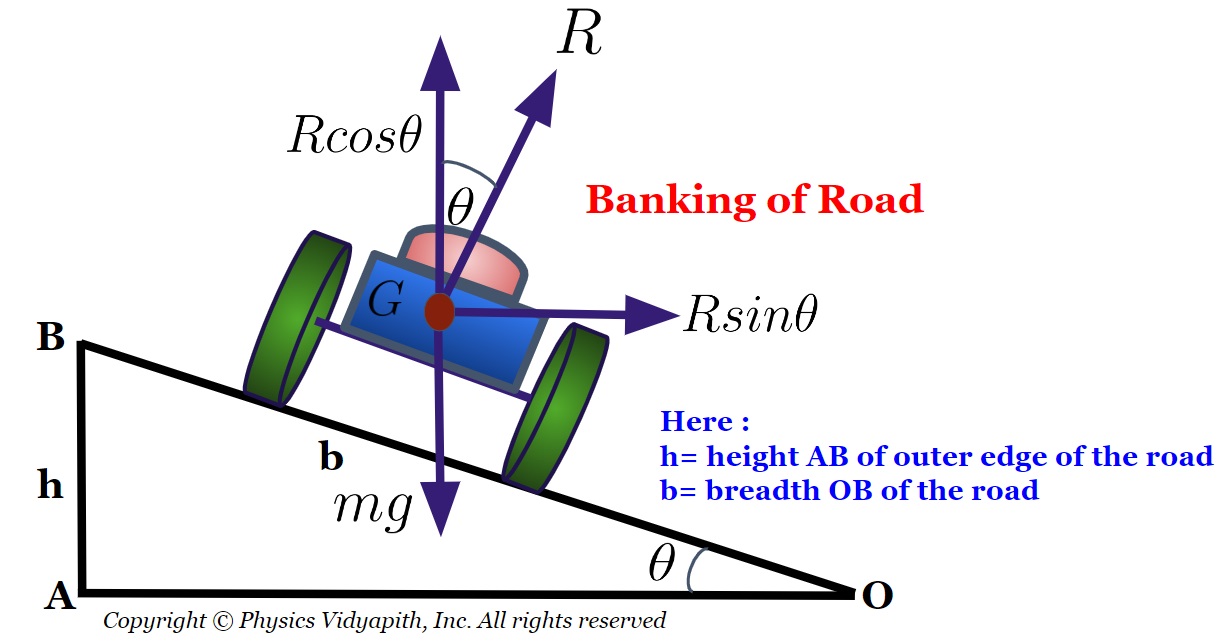
    Let us consider, A vehicle of mass $m$ moving around the curved path of radius $r$ with velocity $v$ on a road banking through an angle $\theta$. The forces applying to the vehicle are:
    Banking of Road
    A.) The weight $mg$ act vertically downward.

    B.) Normal reaction $R$ of the ground acts perpendicular to the banked road and can be resolved into two components. i.e. Verticle component $R sin\theta$ and Horizontal component $R cos\theta$.

    C.) The horizontal component $R cos\theta$ is balanced by the weight $mg$ of the vehicle. i.e.

    $R cos\theta= mg \qquad (1)$.

    D.) The vertical component of normal reaction $R sin\theta$ acts along the horizontal towards the centre of the circular path and it provides the centripetal force. i.e.

    $R sin\theta=\frac{mv^{2}}{r} \qquad (2)$

    Now divide equation $(2)$ and equation $(1)$

    $\frac{R sin\theta}{R cos\theta}= \frac{\frac{mv^{2}}{r}}{mg}$

    $\frac{ sin\theta}{ cos\theta}=\frac{v^{2}}{rg} $

    $ tan\theta=\frac{v^{2}}{rg} \qquad(3)$

    $ \theta=tan ^{-1} \left( \frac{v^{2}}{gr} \right)$

    If $h$ is the height $AB$ of the outer edge of the road above the inner edge and $b$ is the breadth $OB$ of the road then from the figure:

    $OA=\sqrt {(OB)^{2}-(AB)^{2}}$

    $OA=\sqrt {b^{2}-h^{2}}$

    $tan\theta=\frac{AB}{OA}$

    $tan\theta=\frac{h}{\sqrt {b^{2}-h^{2}}} \qquad (4)$

    From equation $(3)$ and equation $(4)$

    $tan\theta=\frac{v^{2}}{rg}=\frac{h}{\sqrt {b^{2}-h^{2}}}$

    From the above equation, we can calculate $h$. Usually $h << b$. Therefore, $h^{2}$ is negligibly small compared to $b^{2}$. The above equation can be written as:

    $tan\theta=\frac{v^{2}}{rg}=\frac{h}{b}$

    Roads are usually banked for the average speed of the vehicle passing over them. However, If the speed of a vehicle is somewhat less or more than this, the self-adjusting static friction will operate between the tyres and the road, and the Vehicle will not skid.

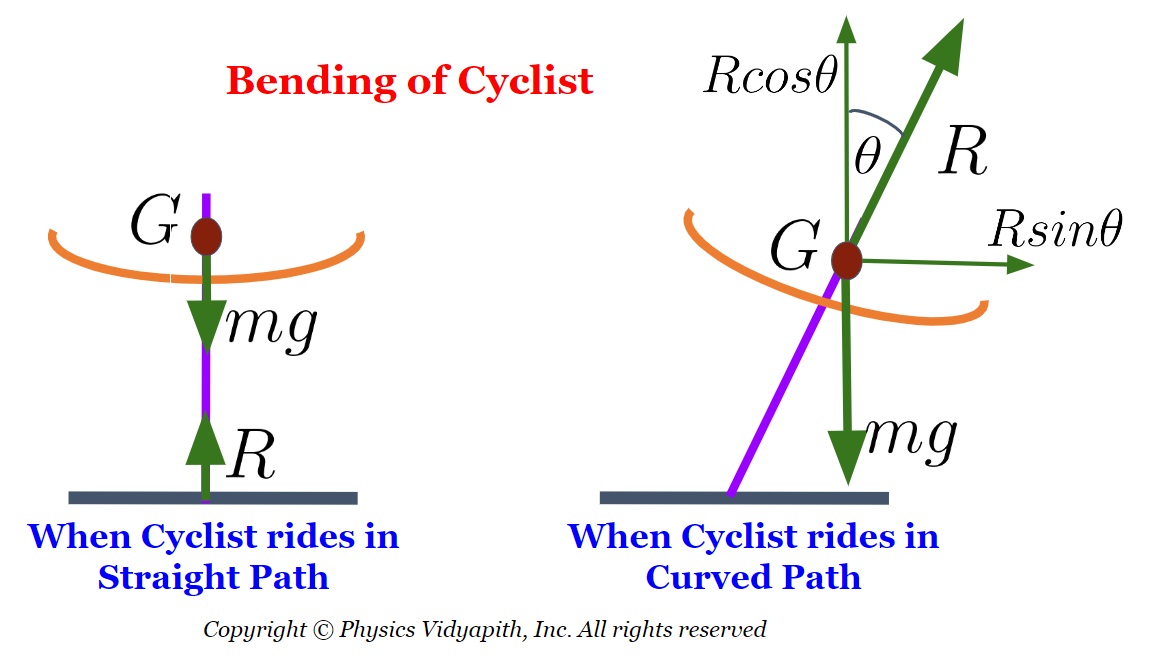
    7. Bending of Cyclist: When a cyclist takes a turn on the curved path then the cyclist has to bend the cycle a little inwards from his vertical position to achieve the necessary centripetal force.

    Calculation of the angle of bending:

    Let us consider, The cyclist of mass $m$ moving around the curved path of radius $r$ with velocity $V$. The force acting on the cyclist:
    Bending of Cyclist
    A.) The weight $mg$ act vertically downward.

    B.) Normal reaction $R$ of the ground act on the cyclist at an angle $\theta$ with the verticle and can be resolved into two components. i.e. Verticle component $R sin\theta$ and Horizontal component $R cos\theta$.

    C.) The horizontal component $R cos\theta$ is balanced by the weight $mg$ of the cyclist. i.e.

    $R cos\theta= mg \qquad (1)$.

    D.) The vertical component $R sin\theta$ acts along the horizontal towards the centre of the circular path and it provides the centripetal force. i.e.

    $R sin\theta=\frac{mv^{2}}{r} \qquad (2)$

    Now divide equation $(2)$ and equation $(1)$

    $\frac{R sin\theta}{R cos\theta}= \frac{\frac{mv^{2}}{r}}{mg}$

    $\frac{ sin\theta}{ cos\theta}=\frac{v^{2}}{gr}$

    $ tan\theta=\frac{v^{2}}{gr}$

    $ \theta=tan ^{-1} \left( \frac{v^{2}}{gr} \right)$

    Definition and Derivation of Centripetal Acceleration

    Definition:
    When a particle moves in a circular path then acceleration act on the particle which has a direction toward the center of the circle. This acceleration is called centripetal acceleration.

    Derivation of Centripetal Acceleration: Let us consider, A particle that has mass $m$ moving with velocity $v$ in a circular path of radius $r$.

    If a particle is moving from point $P_{1}$ to point $P_{2}$ by covering distance $\Delta s$ on the circumference of the circle by making an angular displacement of $\theta$ at the center $O$ of the circle. The direction of velocity of the particle at point $P_{1}$ and $P_{2}$ is $\overrightarrow{v_{1}}$ and $v_{2}$.

    Now take the change in velocity from point $P_{1}$ to $P_{2}$ by vector subtraction method as shown in figure below:
    Diagram for the derivation of Centripetal Acceleration
    To find the expression for the centripetal acceleration, Now take two similar triangles $\Delta OP_{1}P_{2}$ and $\Delta ABC$ from the figure:

    $\frac{OP_{1}}{AB}=\frac{P_{1}P_{2}}{BC}$

    Now substitute the values from the figure in the above equation i.e.

    $\frac{r}{v}=\frac{\Delta s}{\Delta v}$

    $\Delta v = \frac{v}{r} \Delta s $

    Now divide by $\Delta t$ into both sides the above equation can be written as

    $\frac{\Delta v}{\Delta t}=\frac{v}{r} \frac{\Delta s}{\Delta t}$

    If $\Delta t$ is tends to zero i.e. $\Delta t \rightarrow 0$ then

    $\underset{\Delta t \rightarrow 0}{Lim} \: \frac{\Delta v}{\Delta t}=\frac{v}{r} \: \underset{\Delta t \rightarrow 0}{Lim} \: \frac{\Delta s}{\Delta t}$

    Where
    $\underset{\Delta t \rightarrow 0}{Lim} \: \frac{\Delta v}{\Delta t} \rightarrow$ Instantaneous Acceleration. It is also known as Centripetal Acceleration $(a)$

    $\underset{\Delta t \rightarrow 0}{Lim} \: \frac{\Delta s}{\Delta t} \rightarrow$ Instantaneous Velocity $(v)$

    Now the above equation can be written as

    $a = \frac{v^{2}}{r} $

    $a = \frac{(r\omega)^{2}}{r} \quad \left( \because v=r\omega \right)$

    $a = r \omega ^{2} $

    Relation between angular acceleration and linear acceleration

    Equation for the relation between linear acceleration and angular acceleration:

    Deduce the equation from the General Method:

    We know that angular acceleration is

    $\alpha=\frac{\Delta \omega}{\Delta t} \qquad (1)$

    $\alpha=\frac{\Delta (v/r)}{\Delta t} \qquad \left( \because \omega=\frac{v}{r} \right)$

    $\alpha=\frac{1}{r} \frac{\Delta v}{\Delta t}$

    If $\Delta t \rightarrow 0$, then the above equation can be written as

    $\alpha=\frac{1}{r} \: \underset{\Delta t \rightarrow 0}{Lim} \frac{\Delta v}{\Delta t}$

    Where
    $\underset{\Delta t \rightarrow 0}{Lim} \: \frac{\Delta v}{\Delta t} \rightarrow$  Instantaneous Acceleration $(a)$

    $\alpha=\frac{a}{r}$

    Deduce the equation from the Differential Method

    We know that angular acceleration is

    $\alpha=\frac{d \omega}{dt} \qquad (1)$

    $\alpha=\frac{d (v/r)}{dt} \qquad \left( \because \omega=\frac{v}{r} \right)$

    $\alpha=\frac{1}{r} \frac{dv}{dt} \qquad (2)$

    Where
    $\frac{dv}{dt}$ = Instantaneous Acceleration $(a)$

    Now equation $(2)$ can be written as

    $\alpha=\frac{a}{r}$

    Relation between angular velocity and linear velocity

    Mathematical Relation between angular velocity $(\omega)$ and linear velocity$(v)$:
    Relation between angular  velocity (v) and linear velocity (⍵)
    We know that the angular displacement of the particle is

    $\Delta \theta= \frac{\Delta s}{r} \qquad(1)$

    Where $r$ = The radius of a circle.

    Now divide by $\Delta t$ on both side of equation $(1)$

    $\frac{\Delta \theta}{\Delta t}=\frac{1}{r} \frac{\Delta s}{\Delta t} $

    If $\Delta t \rightarrow 0$, then the above equation can be written as

    $\underset{\Delta t \rightarrow 0}{Lim}\: \frac{\Delta \theta}{\Delta t}=\frac{1}{r}\: \underset{\Delta t \rightarrow 0}{Lim} \: \frac{\Delta s}{\Delta t} \qquad(2)$

    Where
    $\underset{\Delta t \rightarrow 0}{Lim}\: \frac{\Delta \theta}{\Delta t}$ = Instantaneous Angular Velocity $(\omega)$

    $\underset{\Delta t \rightarrow 0}{Lim} \: \frac{\Delta s}{\Delta t}$= Instantaneous Linear Velocity $(v)$

    Now equation $(2)$ can be written as

    $\omega=\frac{1}{r}v$

    $v=r\omega$

    The above equation shows that linear or tangential velocity depends on the angular velocity and radius of the circular path. This means that if the radius of the circular path increases with the same angular velocity, then the linear velocity will also increase.

    Conservation's Law of linear momentum and its Derivation

    Derivation of Conservation's law of Linear momentum from Newton's Second Law and Statement: Let us consider, A particle that has mass $m$ and is moving with velocity $v$ then According to Newton's second law the applied force on a particle is

    Derivation From General Form Derivation from Differential Form
    $F=ma$

    $F=m \frac{\Delta v}{\Delta t}$

    $F= \frac{\Delta (mv)}{\Delta t}$

    $F= \frac{\Delta P}{\Delta t} \qquad \left( \because P=mv \right)$

    If the applied force on a body is zero then

    $\frac{\Delta P}{\Delta t}=0$

    $\Delta P=0$

    Here $\Delta P$ is change in momentum
    of the particle .i.e

    $P_{2}-P_{1}=0$

    $P_{2}=P_{1}$

    $P=Constant$
    $F=ma$

    $F=m \frac{dv}{dt}$

    $F= \frac{dmv}{dt}$

    $F= \frac{dP}{dt} \qquad \left( \because P=mv \right)$

    If the applied force on a body is zero then

    $\frac{dP}{dt}=0$

    $dP=0$

    On integrating the above equation

    $P=constant$
    From the above equation, we conclude the statement i.e.
    When no external force is applied to a particle, the total momentum of a particle is always conserved.

    Derivation of Conservation's law of Linear momentum from Newton's Third Law and Statement: Let us consider, The two-particle that have mass $m_{1}$ and $m_{2}$ are moving towards each other. If
    Conservation's Law of Linear Momentum From Newton’s Third Law
    The velocity of the particles $m_{1}$ before collision is = $u_{1}$

    The velocity of the particles $m_{2}$ before collision is = $u_{2}$

    The velocity of the particles $m_{1}$ after collision is = $v_{1}$

    The velocity of the particles $m_{2}$ after the collision is = $v_{2}$

    When these particles collide to each other than according to Newton's third law

    $F_{12}=-F_{21}$

    $m_{1}a_{1}=m_{2}a_{2}$

    $m_{1}\frac{\Delta V_{1}}{\Delta t}=m_{2} \frac{\Delta V_{2}}{\Delta t} \quad (1) \qquad \left(\because a=\frac{\Delta V} {\Delta t} \right)$

    Where
    $\Delta V_{1}$= Change in Velocity of mass $m_{1}$ i.e $\left( v_{1}-u_{1} \right)$
    $\Delta V_{2}$= Change in Velocity of mass $m_{2}$ i.e $\left( v_{2}-u_{2} \right)$

    So from equation $(1)$

    $m_{1}\frac{\left( v_{1}-u_{1} \right)}{\Delta t}=m_{2} \frac{\left( v_{2}-u_{2} \right)}{\Delta t}$

    $m_{1}\left( v_{1}-u_{1} \right)=m_{2} \left( v_{2}-u_{2} \right)$

    $m_{1} v_{1}- m_{1} u_{1}=m_{2}v_{2}- m_{2} u_{2}$

    $m_{1} u_{1}+ m_{2} u_{2}=m_{1}v_{1} + m_{2} v_{2}$

    From the above equation, we conclude the statement i.e.

    When two particle collide two each other. If the total momentum of the particles before the collision and total momentum of the particles after is collision is same then it is known as conservation law of linear momentum.

    Popular Posts