Alternating Current Circuit containing Inductance only (L-Circuit)

Alternating Current Circuit Containing Inductance only (L-Circuit): Let us consider, An alternating current circuit containing a coil of inductance $L$ only. This inductor is connected with an alternating EMF i.e electromotive force source i.e.
Alternating Current Circuit Containing Inductance only
$E=E_{\circ}sin\omega t\qquad(1)$

The current $i$ in coil varies continuously then an opposite emf is induced in the coil whose magnitude is $L\frac{di}{dt}$ So the net instantaneous of the circuit:

$E_{\circ}sin\omega t -L\frac{di}{dt}=0$

$E_{\circ}sin\omega t =L\frac{di}{dt}$

$di=\frac{E_{\circ}}{L}sin\omega dt$

Now integrate the above equation then the above equation can be written as

$\int di=\int \frac{E_{\circ}}{L}sin\omega dt$

$\int di= \frac{E_{\circ}}{L} \int sin\omega dt$

$i= \frac{E_{\circ}}{L} \frac{-cos\omega t}{\omega}$

$i= -\frac{E_{\circ}}{\omega L} cos\omega t$

$i= -\frac{E_{\circ}}{X_{L}} cos\omega t$

Where $X_{L}= \omega L$ is known as inductive reactance.

$i= -i_{\circ} cos\omega t$

Where $i_{\circ}=\frac{E_{\circ}}{X_{L}}$ is known as the maximum value of current in the circuit. Now compare this equation to Ohm's law then we find that the term $X_{L}=\omega L$ has the dimensions of resistance. It defines the 'effective opposition' of the coil to the flow of alternating current. it is known as the 'reactance of the coil' or 'inductive reactance' and it is denoted by $X_{L}$. The inductive reactance $X_{L}$ is zero for DC at which frequency is zero.

$i= -i_{\circ} sin \left(\frac{\pi}{2}- \omega t \right)$

$i= i_{\circ} sin \left(\omega t - \frac{\pi}{2} \right) \qquad(2)$

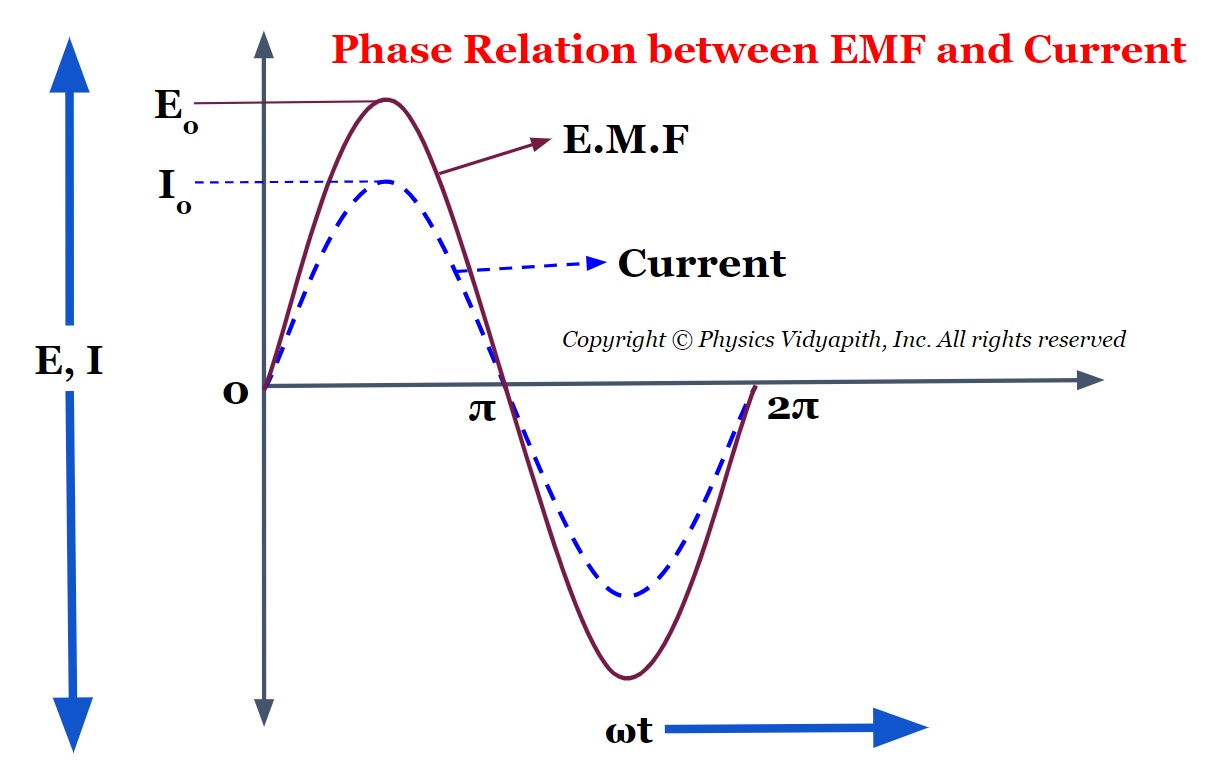
Now compare equation $(1)$ and equation $(2)$ which shows that an alternating circuit containing an inductor only, the current lags behind the emf by a phase angle of $\frac{\pi}{2}$ or $90^\circ$ (or the emf leads the current by a phase angle of $\frac{\pi}{2}$). The phase diagram between EMF and the current of an inductor is shown below-
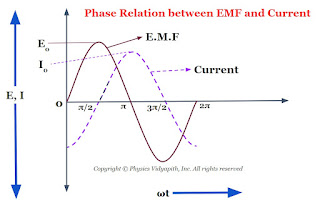
Phase Relation between EMF and Current of an Inductor
The phasor diagram between the EMF and current of an inductor is also shown in the given figure below-
Phasor Diagram between EMF and Current of an Inductor

Electric field Intensity (Definition) and Electric field Intensity due to point charge

Definition of Electric Field Intensity:

The force acting on the per unit test charge in electric field is called the Electric field intensity. It is represented by $'E'$.

Let us consider that a test-charged particle of $q_{0}$ Coulomb is placed at a point in the electric field and a force $F$ acting on them so the electric field intensity at that point

$ \overrightarrow{E}=\frac{\overrightarrow{F}}{q_{0}}$

SI Unit:$\quad Newton/Coulomb$ $ (N/C)$ $\quad Kg-m^{2}/sec^{3} A$

Dimension: $\left [ML^{2}T^{-3}A^{-1} \right ]$

Physical Significance of Electric Field:

The force experienced by a charge is different at different points in space. So electric field intensity also varies from point to point. In general, Electric field intensity is not a single vector quantity but it is a set of infinite vector and each point in space have a unique electric field intensity. So electric field is an example of the vector field.

Electric Field Intensity due to a Point Charge:

Let us consider that an isolated point charge of $+q$ Coulomb is placed at a point $O$ in a medium whose dielectric constant is $K$. If a test charge particle of $q_{0}$ Coulomb is placed at a point $P$ in the electric field at a distance $r$ from point $O$. So the electric field intensity (magnitude form) at point $P$
Electric field intensity due to a point charge
$E=\frac{F}{q_{0}}\qquad (1)$

According to Coulomb's Law:

$F=\frac{1}{4\pi \varepsilon _{0}K}\frac{qq_{0}}{r^{2}}\qquad (2)$

From equation $(1)$ and equation $(2)$, we can write

$E=\frac{1}{4\pi \varepsilon _{0}K}\frac{q}{r^{2}} \qquad (3)$

For air or vacuum $K=1$, Then from equation $(3)$

$E=\frac{1}{4\pi \varepsilon _{0}}\frac{q}{r^{2}} \qquad (4)$

Where

$\frac{1}{4\pi \varepsilon _{0}}=9\times10^{9} N-m^{2}/C^{2}$

From equation $(4)$

$E=9\times 10^{9} \frac{q}{r^{2}}\qquad (5)$

In Vector Notation:

$\overrightarrow{E}=\frac{1}{4\pi \varepsilon _{0}K}\frac{q}{r^{2}}r\hat{}$

If a system containing $'n'$ point charge $q_{1},q_{2},q_{3},..........q_{n}$ then electric field intensity due to the system of charge particle will be equal to the vector sum of the intensities i.e.

$\overrightarrow{E}=\overrightarrow{E_{1}}+\overrightarrow{E_{2}}+\overrightarrow{E_{3}}+....+\overrightarrow{E_{n}}$

$\overrightarrow{E}=\frac{1}{4\pi \varepsilon _{0}K}\sum_{i=0}^{n}\frac{q_{i}}{r_{i}^{2}}r_{i}\hat{}$

Where $r_{i}$ is the distance from point $'P'$ to charge $q_{i}$.

Refraction of light and its Properties

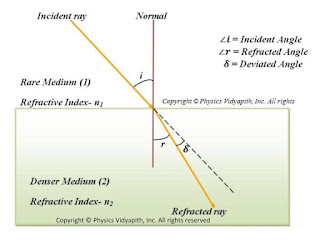
Definition of Refraction of light→ When a light goes from one medium to another medium then light bends from the path. This bending of the light phenomenon is knowns as the refraction of light.

When light goes from a rarer medium to a denser medium, light bends toward the normal as shown in the figure below:
Propagation of light from rare medium to denser medium
Propagation of light from rarer medium to denser medium
When light goes from a denser medium to a rarer medium, the light goes away from normal as shown in the figure below.
Propagation of light from denser medium to rarer medium

Properties of refraction of light→

  1. The incident ray, normal ray, and refracted ray lie on the same point.
  2. According to Snell's law - The ratio of the sine of the incident angle to the sine of the refractive angle is always constant. This constant value is known as the refractive index of the medium.

$\frac{sin \: i}{sin \: r}=constant(_{1}n_{2}) $

$\frac{sin \: i}{sin \: r}= (_{1}n_{2})$

$\frac{sin \: i}{sin \:r}=\frac{n_{2}}{n_{1}}$

Where $_{1}n_{2}$ is the refractive index of medium $(2)$ with respect to medium $(1)$ .

Absolute refractive index→

The ratio of the speed of light in a vacuum to the speed of light in a medium is called the absolute refractive index of the medium.

$refractive\: index(n)=\frac{speed\: of\:light\: in\: vacuum(c)}{speed \:of \:light\: in\: medium(v)}$

$n=\frac{c}{v}$

Note

According to Snell's law -

$\frac{sin \: i}{sin \: r}=\frac{n_{2}}{n_{1}} \quad\quad (1)$

$\frac{sin \: i}{sin \: r}=\frac{\frac{c}{v_{1}}}{\frac{c}{v_{2}}} \quad\quad \left \{ \because n=\frac{c}{v} \right \}$

$\frac{sin i}{sin r}=\frac{v_{1}}{v_{2}} \qquad (2)$

When the light goes from one medium to another medium frequency of the light does not change but the wavelength of the light changes. So above given equation can be written as

$\frac{sin \: i}{sin \: r}=\frac{\nu \lambda_{1}}{\nu \lambda_{2}} \quad\quad \left \{ \because v=\nu \lambda \right \} $

$\displaystyle \frac{sin \: i}{sin \: r}=\frac{\lambda_{1}}{ \lambda_{2}} \qquad (3)$

From equation $(1)$ ,equation $(2)$, and equation $(3)$ we can write the equation

$\frac{sin \: i}{sin \: r}=\frac{n_{2}}{n_{1}} =\frac{v_{1}}{v_{2}}= \frac{\lambda_{1}}{ \lambda_{2}}$

Conditions for a light ray to pass undeviated on refraction of light→

A ray of light passes undeviated from medium $1$ to medium $2$ in either of the following two conditions:

  1. When the angle of incidence at the boundary of two media is zero $\angle i =0^{\circ} so \ \angle r= 0^{\circ}$.
  2. When the refractive index of the medium (2) and medium (1) is the same i.e. $i=r$.

Factors affecting the refractive index of the medium→

The refractive index of a medium depends on basically following three factors:

1. Nature of the medium (on the basis of speed of light)→ Less the speed of light in the medium as compared to that in the air more is the refractive index of the medium. $\left ( n=\frac{c}{v}\right)$

Speed of light in glass- $v_{glass} = 2\times 10^{6} ms^{-1}$

$\mu_{glass} = 1\cdot 5$

Speed of light in water- $v_{water} = 2\cdot25\times10^8ms^{-1}$

$\mu_{water} = 1\cdot33$

2. Physical conditions such as temperature→ With the increase in temperature, the speed of light in the medium, so the refractive index of the medium decreases.

3. The colour or wavelength of light→ The speed of light of all colours is the same in the air ( or vacuum), but in any other transparent medium, the speed of light is different for different colours. In a given medium the speed of red light is maximum and that of the violet light is least, therefore the refractive index of that medium is maximum for violet is and least for red light i.e. $\left ( \ n_{violet}> n_{red}\right )$. The wavelength of visible light increase from violet to red end, so the refractive index of a medium decreases with the increases in wavelength.

Alternating Current Circuit containing Resistance only (R-Circuit)

Alternating Current Circuit containing Resistance (R-Circuit): Let us consider, An alternating current circuit containing resistance $R$ only. This resistance $R$ is connected with an alternating EMF i.e electromotive force source i.e.
Alternating Current Circuit Containing Resistance only
$E=E_{\circ}sin\omega t\qquad(1)$

The potential difference across the circuit

$E=iR$

Then from equation $(1)$

$iR=E_{\circ}sin\omega t $

$i=\frac{E_{\circ}}{R}sin\omega t $

$i=i_{\circ}sin\omega t \qquad(2) $

Where $i_{\circ}$ is the peak value or amplitude of the current in the circuit which has value $i_{\circ}=\frac{E_{\circ}}{R}$.

Now compare the equation $(1)$ and equation $(2)$ which shows that if a circuit is containing a resistor only then the current is always in phase with the applied EMF i.e electromotive force. The phase diagram between EMF and the current of resistance is shown below-
Phase relation between EMF and Current
The phasor diagram between the EMF and current of resistance is also shown in the given figure below-
Phasor Diagram between EMF and Current

Derivation of Addition of Velocity in Special Relativity

Addition of Velocities:

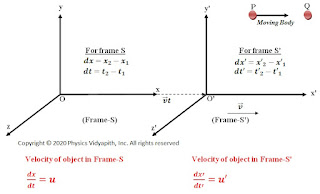
Let us consider two frames $S$ and $S'$, frame $S'$ is moving with constant velocity $v$ relative to frame $S$ along the positive direction of the X-axis.

Let us express the velocity of the body in these frames. Suppose that body moves a distance $dx$ in time $dt$ in frame $S$ and through a distance $dx'$ in the time $dt'$ in the system $S'$ from point $P$ to $Q$. Then
Addition of velocity

$\frac{dx}{dt} = u\qquad \frac{dx'}{dt'}= u'\qquad (1)$

From Lorentz's inverse transformation

$x=\alpha\left ( x'+vt' \right )\qquad(2)$

$t=\alpha '\left ( t'+\frac{v\cdot x'}{c^{2}} \right )\qquad(3)$

Differentiate the equation $(2)$ and equation $(3)$ with respect to $t'$

$\frac{dx}{dt'}= \alpha \left ( \frac{dx'}{dt'}+v \right )\qquad(4)$

$\frac{dt}{dt'}= \alpha ' \left ({1}+\frac{v}{c^{2}} \cdot \frac{dx'}{dt'} \right )\quad (5)$

Now divide the equation $(4)$ by equation $(4)$. So

$\frac{\frac{dx}{dt'}}{\frac{dt}{dt'}} = \left ( \frac{\frac{dx'}{dt}+v}{1+\frac{v}{c^{2}}\cdot \frac{dx'}{dt'} } \right ) \qquad $

From Lorentz Transformation $\alpha =\alpha '$. So above equation can be written as:

$\frac{dx}{dt} = \frac{u' +v}{1+ \frac{u'v}{c^{2}}}$

From equation $(1)$. The above equation can be written as:

$u = \frac{u' +v}{1+ \frac{u'v}{c^{2}}} $

This equation represents the relativistic law of addition of velocities with respect to an observer at frame-$S$ whereas in classical mechanics it is simply $u = u'+v$. There is the following point observed from the addition of the velocities equation.
  1. When $u'$ and $v$ are the smaller as compare to $c$, then $\frac{v\cdot u'}{c^{2}}$ can be negligible so

    $u = u'+v$

    which is classical formula.

  2. When $u' = c$Then $u =\frac{c+v}{1+\frac{v}{c}}$ So,

    $u=c$

    Therefore a object moves with velocity of light $c$ with respect to other, then their relative velocity is always $c$.

  3. When $v=u'=c$Then $u =\frac{c+c}{1+\frac{c^{2}}{c^{2}}}=c$ So,

    $u=v$

    This shows that the addition of the velocity of light simply reproduces the velocity of light. It means that the velocity of light in a vacuum is the maximum achievable velocity in nature and no signal and any object can travel faster than the velocity of light in a vacuum.


Work done by a rotating electric dipole in uniform electric field

Derivation of Work done by a rotating electric dipole in uniform electric field :

Let us consider an electric dipole AB, made up of two charges $+q$ and $-q$, placed at a very small distance $l$ in a uniform electric field $\overrightarrow{E}$. If dipole $AB$ rotates at an angle $θ$ from its equilibrium position. If $A'$ and $B'$ are the new positions of a dipole in the electric field. Then the force on a $+q$ charge particle due to the electric field→

$ \overrightarrow{F_{+q}}=q\overrightarrow{E}\qquad (1)$

Then force on $-q$ charge particle due to electric field→

$ \overrightarrow{F_{-q}}=q\overrightarrow{E}\qquad(2)$
Work done by rotating an electric dipole in an External Uniform Electric field
So work done by a force on a $+q$ charge particle to bring it from position $A$ to position $A'$→

$ \overrightarrow{W_{+q}}=\overrightarrow{F_{+q}}·\overrightarrow{AC}$

$ \overrightarrow{W_{+q}}=q\overrightarrow{E}· \overrightarrow{AC}\qquad(3)$

Similarly, work done by the force on $-q$ charge particle to bring from position $B$ to position $B'$→

$ \overrightarrow{W_{-q}}=\overrightarrow{F_{-q}}·\overrightarrow{BD}$

$ \overrightarrow{W_{-q}}=q\overrightarrow{E}· \overrightarrow{BD}\qquad (4)$

So the total work is done by the force on the dipole→

$ \overrightarrow{W}=\overrightarrow{W_{+q}}\:+\:\overrightarrow{W_{-q}}$

$\overrightarrow{W}=q\overrightarrow{E}·(\overrightarrow{AC}+\overrightarrow{BD})\qquad (5)$

From the figure, there is symmetry, so

$ \overrightarrow{AC}=\overrightarrow{BD}$

So from equation $(5)$

$ \overrightarrow{W}=q\overrightarrow{E}·(2\overrightarrow{AC})$

$ \overrightarrow{W}=2q\overrightarrow{E}(\overrightarrow{AO}-\overrightarrow{CO})\qquad (6)$

From figure→

$ \left | \overrightarrow{AO} \right |=\frac{l}{2}$

$ \left | \overrightarrow{CO} \right |=\frac{l}{2}\:cos \theta$

Now substitute the values in equation (6). So equation (6) can be written as in magnitude form →

$ W=2qE(\frac{l}{2}-\frac{l}{2}\:cos\theta )$

$ W=2qE\left(\frac{l}{2}\right)(1-cos\theta )$

$ W=pE(1-cos\theta )$

The above expression shows that work is done on a rotating electric dipole in a uniform electric field.

Case (i):

If $\theta=0^{\circ}$, Then work done will be minimum

$W_{min}=0$

Case (ii):

If $\theta=90^{\circ}$, Then work done

$W=pE$

Case (iii):

If $\theta=180^{\circ}$, Then work done will be maximum

$W_{max}=2pE$

Alternative Method

Let us consider an electric dipole $AB$ rotates from angle $\theta_{1}$ to $\theta_{2}$ by applying torque on an elecric dipole $AB$ in uniform electric field $\overrightarrow{E}$, if change in angle is $d\theta$, then Work done

$dW= \tau d\theta$

$dW= pE sin \theta d\theta \quad \left\{ \because \tau= p E sin\theta \right\}$

Now integrate the above equation from angle $\theta_{1}$ to $\theta_{2}$

$\int dW= \int_{\theta_{1}}^{\theta_{2}} pE sin \theta d\theta$

$\int dW= pE \int_{\theta_{1}}^{\theta_{2}} sin \theta d\theta$

$ W= pE \left[ - cos \theta \right]_{\theta_{1}}^{\theta_{2}}$

$ W= pE \left[ -cos {\theta_{2}} + cos{\theta_{1}}\right]$

$ W= pE \left[ cos {\theta_{1}} - cos{\theta_{2}}\right]$

This is the equation of work done by rotating an electric dipole from angle $\theta_{1}$ to $\theta_{2}$ in a uniform electric field

Popular Posts