Derivation of Addition of Velocity in Special Relativity

Addition of Velocities:

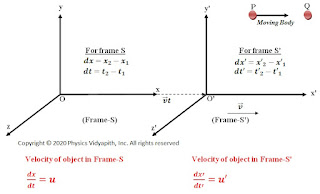
Let us consider two frames $S$ and $S'$, frame $S'$ is moving with constant velocity $v$ relative to frame $S$ along the positive direction of the X-axis.

Let us express the velocity of the body in these frames. Suppose that body moves a distance $dx$ in time $dt$ in frame $S$ and through a distance $dx'$ in the time $dt'$ in the system $S'$ from point $P$ to $Q$. Then
Addition of velocity

$\frac{dx}{dt} = u\qquad \frac{dx'}{dt'}= u'\qquad (1)$

From Lorentz's inverse transformation

$x=\alpha\left ( x'+vt' \right )\qquad(2)$

$t=\alpha '\left ( t'+\frac{v\cdot x'}{c^{2}} \right )\qquad(3)$

Differentiate the equation $(2)$ and equation $(3)$ with respect to $t'$

$\frac{dx}{dt'}= \alpha \left ( \frac{dx'}{dt'}+v \right )\qquad(4)$

$\frac{dt}{dt'}= \alpha ' \left ({1}+\frac{v}{c^{2}} \cdot \frac{dx'}{dt'} \right )\quad (5)$

Now divide the equation $(4)$ by equation $(4)$. So

$\frac{\frac{dx}{dt'}}{\frac{dt}{dt'}} = \left ( \frac{\frac{dx'}{dt}+v}{1+\frac{v}{c^{2}}\cdot \frac{dx'}{dt'} } \right ) \qquad $

From Lorentz Transformation $\alpha =\alpha '$. So above equation can be written as:

$\frac{dx}{dt} = \frac{u' +v}{1+ \frac{u'v}{c^{2}}}$

From equation $(1)$. The above equation can be written as:

$u = \frac{u' +v}{1+ \frac{u'v}{c^{2}}} $

This equation represents the relativistic law of addition of velocities with respect to an observer at frame-$S$ whereas in classical mechanics it is simply $u = u'+v$. There is the following point observed from the addition of the velocities equation.
  1. When $u'$ and $v$ are the smaller as compare to $c$, then $\frac{v\cdot u'}{c^{2}}$ can be negligible so

    $u = u'+v$

    which is classical formula.

  2. When $u' = c$Then $u =\frac{c+v}{1+\frac{v}{c}}$ So,

    $u=c$

    Therefore a object moves with velocity of light $c$ with respect to other, then their relative velocity is always $c$.

  3. When $v=u'=c$Then $u =\frac{c+c}{1+\frac{c^{2}}{c^{2}}}=c$ So,

    $u=v$

    This shows that the addition of the velocity of light simply reproduces the velocity of light. It means that the velocity of light in a vacuum is the maximum achievable velocity in nature and no signal and any object can travel faster than the velocity of light in a vacuum.


Work done by a rotating electric dipole in uniform electric field

Derivation of Work done by a rotating electric dipole in uniform electric field :

Let us consider an electric dipole AB, made up of two charges $+q$ and $-q$, placed at a very small distance $l$ in a uniform electric field $\overrightarrow{E}$. If dipole $AB$ rotates at an angle $θ$ from its equilibrium position. If $A'$ and $B'$ are the new positions of a dipole in the electric field. Then the force on a $+q$ charge particle due to the electric field→

$ \overrightarrow{F_{+q}}=q\overrightarrow{E}\qquad (1)$

Then force on $-q$ charge particle due to electric field→

$ \overrightarrow{F_{-q}}=q\overrightarrow{E}\qquad(2)$
Work done by rotating an electric dipole in an External Uniform Electric field
So work done by a force on a $+q$ charge particle to bring it from position $A$ to position $A'$→

$ \overrightarrow{W_{+q}}=\overrightarrow{F_{+q}}·\overrightarrow{AC}$

$ \overrightarrow{W_{+q}}=q\overrightarrow{E}· \overrightarrow{AC}\qquad(3)$

Similarly, work done by the force on $-q$ charge particle to bring from position $B$ to position $B'$→

$ \overrightarrow{W_{-q}}=\overrightarrow{F_{-q}}·\overrightarrow{BD}$

$ \overrightarrow{W_{-q}}=q\overrightarrow{E}· \overrightarrow{BD}\qquad (4)$

So the total work is done by the force on the dipole→

$ \overrightarrow{W}=\overrightarrow{W_{+q}}\:+\:\overrightarrow{W_{-q}}$

$\overrightarrow{W}=q\overrightarrow{E}·(\overrightarrow{AC}+\overrightarrow{BD})\qquad (5)$

From the figure, there is symmetry, so

$ \overrightarrow{AC}=\overrightarrow{BD}$

So from equation $(5)$

$ \overrightarrow{W}=q\overrightarrow{E}·(2\overrightarrow{AC})$

$ \overrightarrow{W}=2q\overrightarrow{E}(\overrightarrow{AO}-\overrightarrow{CO})\qquad (6)$

From figure→

$ \left | \overrightarrow{AO} \right |=\frac{l}{2}$

$ \left | \overrightarrow{CO} \right |=\frac{l}{2}\:cos \theta$

Now substitute the values in equation (6). So equation (6) can be written as in magnitude form →

$ W=2qE(\frac{l}{2}-\frac{l}{2}\:cos\theta )$

$ W=2qE\left(\frac{l}{2}\right)(1-cos\theta )$

$ W=pE(1-cos\theta )$

The above expression shows that work is done on a rotating electric dipole in a uniform electric field.

Case (i):

If $\theta=0^{\circ}$, Then work done will be minimum

$W_{min}=0$

Case (ii):

If $\theta=90^{\circ}$, Then work done

$W=pE$

Case (iii):

If $\theta=180^{\circ}$, Then work done will be maximum

$W_{max}=2pE$

Alternative Method

Let us consider an electric dipole $AB$ rotates from angle $\theta_{1}$ to $\theta_{2}$ by applying torque on an elecric dipole $AB$ in uniform electric field $\overrightarrow{E}$, if change in angle is $d\theta$, then Work done

$dW= \tau d\theta$

$dW= pE sin \theta d\theta \quad \left\{ \because \tau= p E sin\theta \right\}$

Now integrate the above equation from angle $\theta_{1}$ to $\theta_{2}$

$\int dW= \int_{\theta_{1}}^{\theta_{2}} pE sin \theta d\theta$

$\int dW= pE \int_{\theta_{1}}^{\theta_{2}} sin \theta d\theta$

$ W= pE \left[ - cos \theta \right]_{\theta_{1}}^{\theta_{2}}$

$ W= pE \left[ -cos {\theta_{2}} + cos{\theta_{1}}\right]$

$ W= pE \left[ cos {\theta_{1}} - cos{\theta_{2}}\right]$

This is the equation of work done by rotating an electric dipole from angle $\theta_{1}$ to $\theta_{2}$ in a uniform electric field

Electric field Intensity due a uniformly charged Spherical Shell

Electric field intensity at a different point in the field due to the uniformly charged spherical shell:

Let us consider, a spherical shell of radius $R$ in which $+q$ charge is distributed uniformly on the surface of the sphere. Now find the electric field intensity at different points due to the spherical shell. These different points are:

1.) Electric field intensity at an external point of the spherical shell
2.) Electric field intensity on the surface of the spherical shell
3.) Electric field intensity at an internal point of the spherical shell

1. Electric field intensity at an external point of the spherical shell:

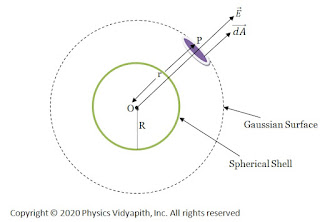
If point $O$ is the center of the spherical shell, The electric field at the outside of the spherical shell can be determined by the following steps →

1.) First, take the point $P$ outside the sphere
2.) Draw a spherical surface of radius r which passes through point $P$.This hypothetical surface is known as the Gaussian surface.
3) Now take a small area $\overrightarrow {dA} $ around point $P$ on the Gaussian surface to find the electric flux passing through it.
4.) Now find the direction between the electric field vector and small area vector.

Due to uniform charge distribution, the electric field intensity will be the same at every point on the Gaussian surface. So from the figure,
Electric field intensity due to the uniformly charged spherical shell
Electric field intensity due to the uniformly charged
The direction of electric field intensity on the Gaussian surface is radially outward which is in the direction of the area vector of the Gaussian surface. i.e. ($\theta=0^{\circ}$).Here $\overrightarrow {dA}$ is small area around point $P$ so the small electric flux $d\phi_{E}$ will pass through this small area $\overrightarrow {dA}$. so this flux can be found by applying the Gauss's law in question given below:

$ d\phi_{E}= \overrightarrow {E}\cdot \overrightarrow{dA}$

$ d\phi_{E}= E\:dA\: cos 0^{\circ} \qquad \left \{\because \theta=0^{\circ} \right \}$

$ d\phi_{E}= E\:dA \qquad (1) \quad \left\{\because cos0=1 \right \}$

The electric flux passing through the entire Gaussian surface, So integrate the equation $(1)$ →

$ \phi_{E}=\oint E\:dA\qquad(2)$

According to Gauss's law:

$ \phi_{E}=\frac{q}{\epsilon_{0}}\qquad (3)$

From equation (1) and equation (2), we can write as

$ \frac{q}{\epsilon_{0}}=\oint E\:dA$

$ \frac{q}{\epsilon_{0}}= E\oint dA$

The area of entire Gaussian spherical is $\oint {dA}=4\pi r^{2}$. Now substitute this value in above equation. So above equation can be written as:

$ \frac{q}{\epsilon_{0}}= E(4\pi r^{2})$

$ E=\frac{1}{4\pi \epsilon_{0}}\frac{q}{r^{2}}$

From the above equation, we can conclude that the behavior of the electric field at the external point due to the uniformly charged spherical shell is the same as, like the entire charge is placed at the center, point charge

If the surface charge density is $\sigma$, Then total charge $q$ on the surface of a spherical shell is →

$ q=4\pi R^{2}\: \sigma$

Substitute this value of charge $q$ in above equation, so we can write the equation as:

$ E=\frac{1}{4\pi \epsilon_{0}}\frac{4\pi R^{2}\: \sigma}{r^{2}}$

$ E=\frac{\sigma}{\epsilon_{0}}\frac{R^{2}}{r^{2}}$

This equation describes the electric field intensity at the external point of the spherical shell.

2. Electric field intensity on the surface of the spherical shell:

If point $P$ is placed on the surface of the spherical shell i.e ($r=R$). so electric field intensity on the surface of the spherical shell can be found by putting $r=R$ in the formula of the electric field intensity at the external point of the spherical shell:

$ E=\frac{1}{4\pi \epsilon_{0}}\frac{q}{R^{2}}$

$ E=\frac{\sigma}{\epsilon_{0}}$

3. Electric field intensity at an internal point of the spherical shell:

If point $P$ is placed inside the spherical shell then the electric field intensity will be zero at that point because the charge is distributed uniformly on the surface of the solid sphere so there will not be any charge on the Gaussian surface and electric flux will be zero inside the solid sphere. i.e.

$ \phi_{E}=\oint E\:dA$

$ 0=E\oint dA \qquad \left \{ \because \phi_{E}=0 \right \}$

$ E=0$

Electric field intensity distribution with distance for Spherical Shell:

Electric field intensity distribution with distance shows that the electric field is maximum on the surface of the sphere and zero inside the sphere. Electric field intensity distribution outside the sphere reduces with the distance according to $E=\frac{1}{r^{2}}$.
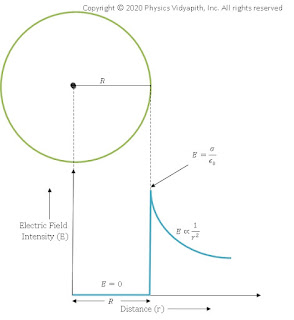
Electric field intensity distribution with distance for Spherical Shell
Electric field intensity distribution with distance

Energy distribution laws of black body radiation

1.) Wein’s laws of Energy distributions→

A.) Wein's Fifth Power law→ The total amount of the energy emitted by a black body per unit volume at an absolute temperature in the wavelength range $\lambda$ and $\lambda + d\lambda$ is given as

$E\lambda \cdot d\lambda= \frac{A}{\lambda^{5}}f\left ( \lambda T \right ) \cdot d\lambda \qquad (1)$

Where $A$ is a constant and $f(\lambda T)$ is a function of the product $\lambda T$ and is given as

$ f\left ( \lambda T\right )=e^-\frac{hc}{\lambda kT}\qquad (2)$

From equation $(1)$ and $(2)$

$E_\lambda \cdot d\lambda = \frac{A}{\lambda ^{5}}e^\frac{-hc}{\lambda kT} \cdot d\lambda$

$E_\lambda \cdot d \lambda = A \lambda ^{-5} e^\frac{-hc}{\lambda kT} \cdot d \lambda$

Wien’s law energy distribution explains the energy distribution at the short wavelength at higher temperatures and fails for long wavelengths.

B.) Wein's Displacement law→ As the temperature of the body is raised the maximum energy shift toward the shorter wavelength i.e.

$\lambda_{m} \times T = Constant $

Where
$\lambda_m$- Wavelength at which the energy is maximum
$T$-Absolute temperature

Thus, if radiation of a particular wavelength at a certain temperature is adiabatically altered to another wavelength then temperature changes in the inverse ratio.

2.) Rayleigh-Jean’s law→ The total amount of energy emitted by a black body per unit volume at an absolute temperature T in the wavelength range $\lambda $ and $\lambda +d\lambda $ is given as

$E_{\lambda}.d\lambda = \frac{8\pi kt}{\lambda ^{4}}.d\lambda$

Where K– Boltzmann’s Constant which has valve $ 1.381\times 10^{23}\frac{J}{K}$

This law, explains the energy distribution at the longer wavelength at all temperatures and fails totally for the shorter wavelength.

Note→ The energy distribution curves of the black body show a peak while going towards the ultraviolet wavelength (shorter $ \lambda $) and then fall while Rayleigh-Jeans law indicates continuous rise only. This is the failure of classical physics.

3.) Stefan-Boltzmann Law→ The total amount of heat radiated by a perfectly black body per unit area per second is directly proportional to the fourth power of its absolute temperature $(T)$. i.e.

$E \propto T^{4}$

$E = \sigma T^{4}$

Where $\sigma$= Stefan’s Constant which has value $5.67\times 10^{-8} W-\frac{K^{4}}{m^{2}}$

It is a black body at absolute temperature $T$ is surrounded by another black body at absolute temperature $T_{0}$, The net amount of heat $E$ lost by the former per second per $cm^{2}$ is→

$E=\sigma (T^{4}-T_{0}^{^{4}})$

Relation between group velocity and phase velocity

We know that phase velocity

$V_{p}=\frac{\omega }{k}$

$\omega =V_{p}.k \qquad(1)$

And group velocity

$V_{g}=\frac{d\omega}{dk} \qquad(2)$

Substitute the value of $\omega$ from equation$(1)$ in equation $(2)$

$V_{g}=\frac{d}{dk}(V_{p}.k)$

$V_{g}=V_{p}+k.\frac{dV_{p}}{dk}$

$V_{p}=V_{p}+k.\frac{dV_{p}}{d\lambda}.\frac{d\lambda }{dk} \qquad (3)$

But

$\lambda=\frac{2\pi }{k}$

The above equation can be obtain from following formula i.e. $k=\frac{2\pi}{\lambda }$

Now put the value of $\lambda$ in equation $(3)$

$V_{g}=V_{p}+k\frac{dV_{p}}{d\lambda}\frac{d}{dk}(\frac{2\pi }{k}$

$V_{g}=V_{p}+k\frac{dV_{p}}{d\lambda}(\frac{-2\pi }{k^{2}}$

$V_{g}=V_{p}-\frac{2\pi}{k}\frac{dV_{p}}{d\lambda }$

$V_{g}=V_{p}-\lambda\frac{dV_{p}}{d\lambda }$

Thus, the above equation represents the relation between group velocity and phase velocity.

Electric Line of Force and its Properties

Electric Field:

That region around any charged particle (source-charge) in which other test charged particle experience an electric force (attraction or repulsion). This region is called electric field of that charged particle.

The size and magnitude of the test charged particle is very small i.e tends to zero which does not modify the electric field of source charged particle. The electric field can only experience, not be seen by eyes. The electric field is defined by imaginary lines which are called electric field lines.

Electric Field Lines:

Electric field lines are imaginary lines that describe the behavior of electric fields. The behavior of the electric field tells about the force acting on free test-charged particles. This force gives the motion to the free test charge particle which is placed in the path of the electric field line. So the test charged particle moves in the direction of the electric field line. Hence, the direction of electric force and electric field lines both are the same. Thus electric field line is also known as electric lines of force.

Electric Lines of Force:

An electric line of force is defined as an imaginary smooth curve drawn in electric field along which a free isolated test charged particle moves. The tangent drawn at any point on the electric line of force gives the direction of the force acting on a test charged particle placed at that point.

Properties of Electric Line of Force:

There are the following properties of the electric line of force:

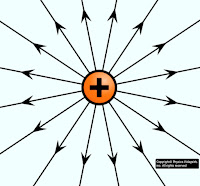
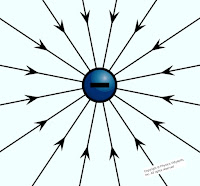
1.) The direction of the electric line of force is outward for positively charged particles, and inward for negatively charged particles.


Electric lines of force going in outward direction from positive charge particle
Electric field line of positive charge

Electric lines of force goes inward direction in negative charge particle
Electric field line of negative charge

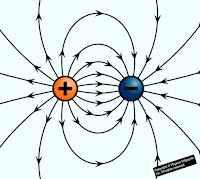
So when two opposite charge are placed near each other, the electric line of force start from a positive charge and end at a negative charge
Electric lines of force of unlike charges
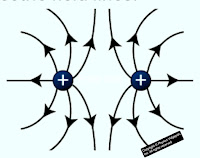
When two same nature charges are placed near each other, the field produced by one charge is equal and opposite to the field produced by the other charges at the midpoint of the line joining the two charges. Therefore, at this point, the resultant electric field is zero. This point is called the neutral point.
Electric line of force of like charges describe the neutral point in the electric field
Electric lines of force of like charges

2.) The tangent drawn at any point on the line of force gives the direction of the force acting on a test-charged particle at that point.

3.) Two electric lines of force can never intersect with each other because if they do so then at the point of intersection two tangents can be drawn which would mean that there are two directions of the force at that point which is impossible.

4.) When electric lines of force are closer to each other, the electric field is stronger in this region. And where The line of force are far away from each other then the electric field is weaker in this region. When the line of force are parallel and in a straight line to each other, the electric field is known as the uniform electric field.

5.) The electric line of force has a tendency to contract in length like a stretched elastic string for the opposite nature of the charged particle. It is due to the attraction force between charged particles.

6.) The electric line of force has a tendency to separate from each other in the direction perpendicular to their length for the same nature of charged particles. It is due to the repulsion force between charged particles.

7.) The electric lines of force can never form closed loops as a line can never start and end on the same charge.

8.) The electric line of force also gives us an indication of the equipotential surface (That surface which has the same potential on each point of the surface).

9.) The electric line of force always flows from higher potential to lower potential.

10.) In a region where there is no electric field, lines are absent so the electric field inside the conductor is zero. Electric lines of force end or start normally from the surface of a conductor.

Popular Posts