If the x-coordinate of the position of a particle is known to an accuracy of $\delta x$, then the x-component of momentum cannot be determined to an accuracy better than $\Delta P_{x}\approx \frac{\hbar }{\Delta x}$.
$\Delta P_{x}. \Delta x\approx \hbar$
The above inequality must be satisfied
$\Delta P_{x}. \Delta x\geqslant \hbar$
Where $\hbar $ - Planck’s Constant
This is the Uncertainty principle with macroscopic objects.
Exact statement of the Uncertainty principle →
The product of the uncertainties in determining the position and momentum of the particle can never be smaller than the number of the order $\frac{\hbar }{2}$.
$\Delta P_{x}. \Delta x\geqslant \frac{\hbar}{2}$
Where $\delta x$ and $\delta P $ are defined as the root mean square deviation from their mean values.
The Uncertainty principle can also describe by the following formula →
$\Delta x.\Delta p_{x}\approx \frac{\hbar}{2}$
$\Delta x.\Delta p_{x}\geqslant \frac{\hbar}{2}$
$\Delta x.\Delta p_{x}\geqslant \frac{h}{4\pi }$
Expression for $y$ and $z$ component →
$\Delta y.\Delta p_{y}\geqslant \frac{h}{4\pi }$
$\Delta z.\Delta p_{z}\geqslant \frac{h}{4\pi }$
The uncertainty relation between energy and time →
$\Delta E.\Delta t\geqslant \frac{h}{4\pi }$
$\Delta E.\Delta t\geqslant \frac{\hbar }{2 }$
The uncertainty relation between momentum and Angular Position→
$\Delta L.\Delta \theta \geqslant \frac{h }{4\pi }$
$\Delta L.\Delta \theta \geqslant \frac{\hbar}{2}$
Mathematical equation of wave function of a free particle in simple harmonic motion
Periodic motion:
If a particle repeats its motion or path at a regular interval of time, it is known as periodic motion.
Simple Harmonic Motion:
Simple harmonic motion (S.H.M.) is a specific type of periodic motion. In the simple harmonic motion, the force (i.e., restoring force) exerted on the particle is directly proportional to its displacement from the equilibrium position and acts in the opposite direction to that displacement.
Wave:
A wave is the combination of infinite simple harmonic motion equations.
Mathematical Equation:
Let us consider a particle that is doing simple harmonic motion in a circular path with radius $A$. Let at any instant $t$ particle move from position $P_{1}$ to $P_{2}$. So vector resolution of position $P_{2}$ is (as shown in the figure below):
Horizontal Component i.e. $x$ component of position vector $P_{2}$:
$x=A sin(\omega t - \phi) \qquad (1)$
Vertical Component i.e. $y$ component of position vector $P_{2}$:
$y=A cos (\omega t - \phi) \quad (2)$
According to Max Born's hypothesis-
"A wave is described by a wave function $\varphi$, which is mathematically expressed in the form of a complex quantity."
So mathematical representation of a wave function
$\varphi= x+iy \qquad (3)$
Now put the value of $x$ and $y$ component in the above equation-
$\varphi= A sin (\omega t - \phi)+ i A cos (\omega t - \phi) $
$\varphi=A [sin (\omega t - \phi)+ i cos (\omega t - \phi) ]$
$\varphi=A e^ {i(\omega t - \phi)} \qquad (4)$
Where $\phi$is the phase of the wave. The value of $\phi$ can be found by the relation between the phase difference and path difference of a plane progressive wave.
$\phi =\frac {2\pi}{\lambda}\cdot x $
$\phi = k\cdot x$
Now put the value of $\phi$ from the above equation into equation $(4)$. So the wave function equation can be written as
$\varphi (x,t) =A e^ {i(\omega t - k \cdot x)} \qquad (5)$
Let us consider a particle having mass $m$ that is in motion along the positive x-direction with momentum $p$ and total energy $E$. So the wave function equation $(5)$ in terms of momentum and total energy
$\psi(x,t)=Ae^{-i\omega (t-\frac{x}{v})} \qquad(6) $
$\psi(x,t )=Ae^{-i(\omega t-kx)}$
$\psi(x,t )=Ae^{i(kx-\omega t)} \qquad(7)$
According to Planck’s hypothesis-
$E=h\nu \qquad(8) $
$E=\frac{h}{2 \pi }\cdot 2 \pi \nu$
$E=\hbar.\omega$
$\omega=\frac{E}{\hbar } \qquad(9)$
According to de Broglie hypothesis-
$\lambda= \frac{h}{p}$
$p =\frac{h}{\lambda }$
$p =\frac{h}{2 \pi }\cdot \frac{2 \pi}{\lambda}$
$p=\hbar\cdot k$
$k=\frac{p}{\hbar}\qquad(10)$
Now put the value of $\omega$ and $k$ from equation $(9)$ and equation $(10)$in equation$(7)$
$\psi (x,t)=Ae^{ i(\frac{p}{\hbar }x-\frac{E}{\hbar }t)}$
$\psi (x,t )=Ae^{\frac{i}{\hbar}(px-Et)}$
The equation for the three-dimensional $(3D)$ wave function of a free particle:
$\psi (\overrightarrow{r},t)=Ae^{\frac{i}{\hbar}(\overrightarrow{p}x-Et)}$
 |
| Simple harmonic motion of a particle |
 |
| Propagation of a wave along the x-axis |
The electric potential energy of a system of Charges
The Potential Energy of a system of two-point like charges→
When the system of two charged particles is configured, in which one charge
is at rest of position and another is brought from infinity to near the first charge then the work done acquire by this charged particle is stored
in the form of electric potential energy between these charges.
Derivation→
Let us consider, If two charge $q_{1}$ and $q_{2}$ in which one charge $q_{1}$ is at the rest of the position at point $P_{1}$ and another charge
$q_{2}$ is brought from infinity to a point $P_{2}$ to configure the system then the electric potential at point $P_{2}$ due to charge particle $q_{1}$ →
 $V=\frac{1}{4\pi\epsilon_{0}}\frac{q_{1}}{r}$
Where $r$ is the distance between the point $P_{1}$ and Point $P_{2}$
Here, Charge $q_{2}$ is moved in from infinity to point $P_{2}$ then the work required is →
$W=V q_{2}$
$W= \frac{1}{4\pi\epsilon_{0}}\frac{q_{1}q_{2}}{r}$
Since the electric potential at infinity is zero the work- done will also be zero. So total work-done from infinity to a point $P$ will be stored in the form of electric potential energy.
$U=W$
$ U= \frac{1}{4\pi\epsilon_{0}}\frac{q_{1}q_{2}}{r}$
The electric potential energy of a system of three-point-like charges→
To obtain the potential energy of a system of three charges. First, Obtain the work done between any two charges and then obtain the different work done for both those charges from the third charge, and then the total work done will be equal to electric potential energy.
Let us consider a system is made up of three charges $q_{1}$, $q_{2}$ and $q_{3}$ which are placed at point $P_{1}$,$P_{2}$ and $P_{3}$. Now the work done between two charges $q_{1}$ and $q_{2}$ is
 $W_{1}=\frac{1}{4\pi\epsilon_{0}}\frac{q_{1}q_{2}}{r_{12}}$
Now, the charge $q_{3}$ is brought from infinity to the point $P_{3}$. Work has to be done against the forces exerted by $q_{1}$ and $q_{2}$
Therefore, The work done between charges of $q_{2}$ and $q_{3}$
$W_{2}=\frac{1}{4\pi\epsilon_{0}} \frac{q_{2}q_{3}}{r_{23}}$
Now, The work done between charges $q_{1}$ and $q_{3}$
$ W_{3}=\frac{1}{4\pi\epsilon_{0}} \frac{q_{1}q_{3}}{r_{13}}$
The total work done to make a system of three charges:
$ W=W_{1}+W_{2}++W_{3}$
Now substitute the value of $W_{1}$, $W_{2}$and $W_{2}$ in above equation i.e.
$ W=\frac{1}{4\pi\epsilon_{0}} \left[\frac{q_{1}q_{2}}{r_{12}}+\frac{q_{1}q_{3}}{r_{13}}+\frac{q_{2}q_{3}}{r_{23}}\right]$
This work is stored in the form of electric potential energy in the system.
$U=W$
$ U=\frac{1}{4\pi\epsilon_{0}} \left[\frac{q_{1}q_{2}}{r_{12}}+ \frac{q_{1}q_{3}}{r_{13}}+\frac{q_{2}q_{3}}{r_{23}}\right]$
Similarly, the Potential energy of a system of N point system i.e.
$ U=\frac{1}{4\pi\epsilon_{0}} \sum_{i=1}^{N}\sum_{j=1}^{N}\frac{q_{i}q_{j}}{r_{ij}}$
Here $i\neq j$


Gauss's Law for Electric Flux and Derivation
Gauss's Law:
Gauss's law for electric flux is given by Carl Friedrich Gauss in 1813. He extended the work of Joseph-Louis Lagrange. This formula was first formulated in 1713 by Lagrange. Gauss's law stated that:
Let us consider that a $+q$ coulomb charge is enclosed within the Gaussian's surface. Then according to Gauss's Law, the electric flux will be:
$\phi _{E}= \frac{q}{\epsilon_{0}}$
The electric flux of the electric field →
$\phi_{E}=\oint \overrightarrow{E}\cdot\overrightarrow{dA}$
Substitute this value of electric flux $\phi_{E}$ in the above formula so we get →
$\oint \overrightarrow{E}\cdot\overrightarrow{dA}=\frac{q}{\epsilon_{0}}$
Where $\epsilon_{0}$ → Permittivity of the free space
The above formula of Gauss's law is applicable only under the following two conditions:
1.) The electric field at every point on the surface is either perpendicular or tangential.
2.) The magnitude of the electric field at every point where it is perpendicular to the surface has a constant value.
Derivation of Gauss's law from Coulomb's law:
1.) When the charge is within the surface
2.) When the charge is outside the surface
1. When the charge is within the surface:
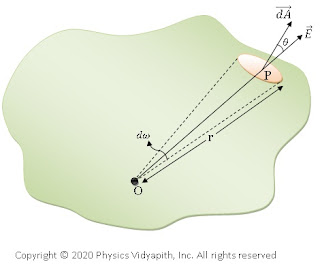
Let a charge $+q$ is placed at point $O$ within a closed surface of irregular shape. Consider a point $P$ on the surface which is at a distance $r$ from the point $O$. Now take a small element or area $\overrightarrow{dA}$ around the point $P$. If $\theta$ is the angle between $\overrightarrow{E}$ and $\overrightarrow{dA}$ then electric flux through small element or area $\overrightarrow{dA}$
$d\phi_{E}=\overrightarrow{E}\cdot\overrightarrow{dA}$
$d\phi_{E}=E\:dA\:cos\theta \qquad\quad\quad (1)$
According to Coulomb's law, the electric field intensity $E$ at point $P$.
$E=\frac{1}{4\pi\epsilon_{0}}\frac{q}{r^{2}}$
Now substitute the value of electric field intensity $E$ in equation $(1)$
$d\phi_{E}=\frac{q}{4\pi\epsilon_{0}}\frac{dA\:cos\theta}{r^{2}}$
but $\frac{dA\:cos\theta}{r^{2}}$ is the solid angle $d\omega$ subtended by $dA$ at point $O$. Hence the above equation can be written as
$d\phi_{E}=\frac{q}{4\pi\epsilon_{0}}d\omega$
So, The total flux $\phi_{E}$ over the entire surface can be found by integrating the above equation
$\oint d\phi_{E}= \frac{q}{4\pi\epsilon_{0}}\oint d\omega$
For entire surface solid angle $d\omega$ will be equal to $4\pi$ i.e. $d\omega=4\pi$
$\phi _{E}= \frac{q}{\epsilon_{0}}$
If the closed surface enclosed with several charges like $q_{1},q_{2},q_{3},.....-q_{1},-q_{2},-q_{3},.....$. Now each charge will contribute to the total electric flux $\phi_{E}$.
$\phi_{E}= \frac{1}{\epsilon_{0}}\left [ q_{1}+q_{2}+q_{3}...-q_{1}-q_{2}-q_{3}... \right ]$
Here $\quad q=q_{i}-q_{j}$
$\phi_{E}= \frac{1}{\epsilon_{0}}\sum_{i=1,j=1}^{n}(q_{i}-q_{j})$
$\phi_{E}= \frac{1}{\epsilon_{0}}\sum q$
Where $\sum q$ → Algebraic Sum of all the charges
2. When the charge is outside the surface:
Let a point charge $+q$ be situated at point $O$ outside the closed surface. Now a cone of solid angle $d\omega$ from point $O$ cuts the surface area $dA_{1}$, $dA_{2}$ at point $P$ and $Q$ respectively. The electric flux for an outward normal is positive while for inward normal is negative so
The electric flux at point $P$ through an area
$d\phi_{1}$= $-\left (\frac{q}{4\pi \epsilon_{0}} \right )d\omega$
The electric flux at point $Q$ through area
$d\phi_{2}$= $+\left (\frac{q}{4\pi \epsilon_{0}} \right )d\omega$
 The Total electric flux will be sum of all the electric flux passing through areas of surface →
$\phi_{E}=d\phi_{1}+d\phi_{2}$
$\phi_{E}=-\left ( \frac{q}{4\pi \epsilon_{0}} \right )d\omega+\left ( \frac{q}{4\pi \epsilon_{0}} \right )d\omega $
$\phi_{E}=0$
The above equation is true for all cones from point $O$ through any surface, however irregular it may be-
This verifies Gauss's law.
Application of Gauss's law:
There are following some important application given below:
The electric flux passing normal through any closed hypothetical surface is always equal to the $\frac{1}{\epsilon_{0}}$ times of the total charge enclosed within that closed surface. This closed hypothetical surface is known as Gaussian surface.
2.) The magnitude of the electric field at every point where it is perpendicular to the surface has a constant value.
2.) When the charge is outside the surface
 |
| When charge is inside the surface |

The total electric flux over the entire surface due to an external charge is zero.
- Electric field intensity due to a point charge
- Electric field intensity due to uniformly charged spherical Shell (for Thin and Thick)
- Electric field intensity due to a uniformly charged solid sphere (Conducting and Non-conducting)
- Electric field intensity due to uniformly charged infinite plane sheet (for Thin and Thick)
- Electric field intensity due to uniformly charged parallel sheet
- Electric field intensity due to charged infinite length wire
Vector Form of Coulomb's Law
Derivation of vector form of Coulomb's law:
Let us consider, Two-point charges $+q_{1}$ and $+q_{2}$ are separated at a distance $r$ (magnitude only) in a vacuum as shown in the figure given below.
 Let $\overrightarrow{F_{12}}$ is the force on charge $+q_{1}$ due to charge $+q_{2}$ and $\overrightarrow{F_{21}}$ is the force on charge $+q_{2}$ due to charge $+q_{1}$. Then
$\overrightarrow{F_{12}}=\frac{1}{4\pi \varepsilon _{0}}\frac{q_{1}q_{2}}{r^2}\:\:\hat{r_{21}}\qquad(1)$
Where $\widehat{r}_{21}$ ➝ Unit Vector Pointing from charge $+q_{2}$ to charge $+q_{1}$
$\overrightarrow{F_{21}}=\frac{1}{4\pi \varepsilon _{0}}\frac{q_{1}q_{2}}{r^2}\:\:\hat{r_{12}}\qquad(2)$
Where$\widehat{r}_{12}$ ➝ Unit Vector Pointing from charge $+q_{1}$ to charge $+q_{2}$
From the above figure, we can conclude that the direction of unit vector $\widehat{r}_{12}$ and $\widehat{r}_{21}$ is opposite. i.e.
$\hat{r_{12}}=-\hat{r_{21}}\qquad(3)$
So from equation $(2)$ and equation $(3)$, we can write as
$\overrightarrow{F_{21}}=-\frac{1}{4\pi \varepsilon _{0}}\frac{q_{1}q_{2}}{r^2}\:\:\hat{r_{21}}\qquad(4)$
Now, Put the value of equation $(1)$ in equation $(4)$. So equation $(4)$, we can write as
$\overrightarrow{F_{21}}=-\overrightarrow{F_{12}}\qquad (5)$
The above equation $(5)$ shows that " The Coulomb's force is Action and Reaction Pair. This force acts on different bodies." If
$\overrightarrow{F_{12}}=\overrightarrow{F_{21}}=\overrightarrow{F}$
And
$ \hat{r_{12}}=\hat{r_{21}}=\hat{r}$
Then generalized vector form of Coulomb's Law$\overrightarrow{F}=\frac{1}{4\pi\varepsilon _{0}}\frac{q_{1}q_{2}}{r^2}\:\hat{r}$
Where $\hat{r}=\frac{\overrightarrow{r}}{r}$
$ \overrightarrow{F}=\frac{1}{4\pi \varepsilon _{0}}\frac{q_{1}q_{2}}{r^3}\:\overrightarrow{r}$
Where $\overrightarrow{r}$ is displacement vector
This is a generalized vector form of Coulomb's law.

Conversion of Galvanometer into an Ammeter
What is Ammeter?
An Ammeter is an instrument that is used to measure the electric current in the electric circuits directly in Ampere. The instrument which measures the current of the order of milliampere $(mA)$ is called the milliammeter. The internal resistance of the ideal ammeter is always zero.
What is Galvanometer?
The galvanometer is an instrument that is used to measure the very small amount of the electric charge passing through the circuit. The internal resistance of the Galvanometer is not zero.
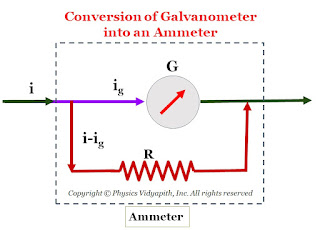
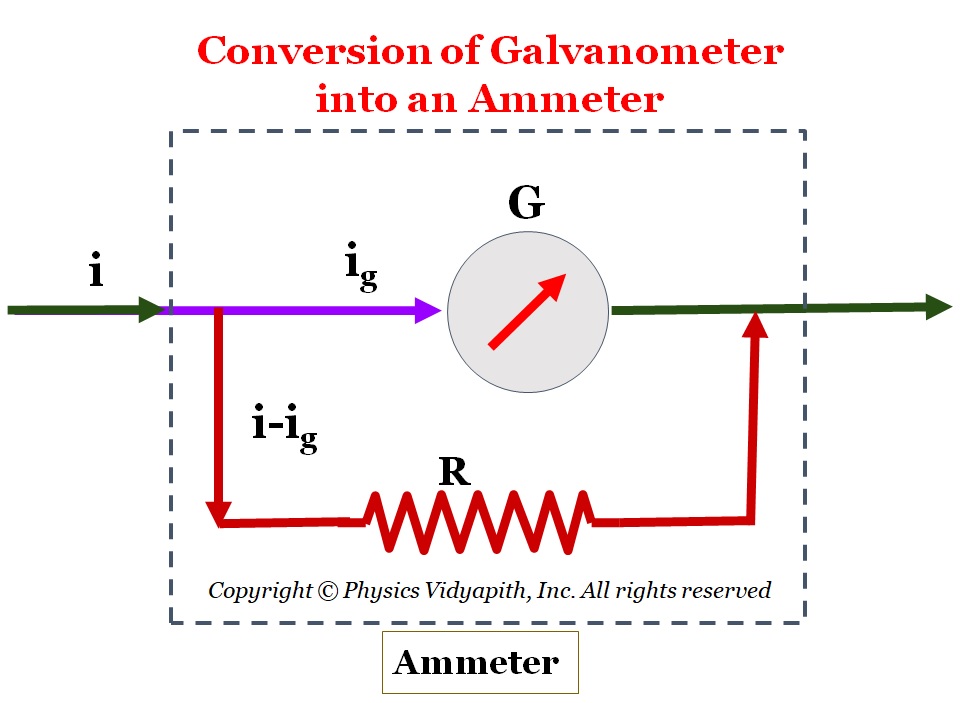
Galvanometer used as Ammeter: To use the galvanometer as an ammeter in the circuit, The resistance of the galvanometer should be very small or almost zero as compared to the other resistance of the circuit. Because the internal resistance of an ideal ammeter is zero.
So a low resistance is connected in parallel to the galvanometer which is known as a shunt.
When a low resistance is connected in parallel to the galvanometer then the resultant resistance decreases as compared to the other resistance of the circuit and it can be easily used as an ammeter and the actual current can be measured through it.
Mathematical Analysis:
Let us consider, $G$ is the resistance of the coil of the galvanometer and the $i_{g}$ current, passing through it, produces full scale deflection. If $i$ is the maximum current of the circuit then a part of current $i_{g}$ passes through the galvanometer and the remaining current $(i-i_{g})$ passes through the shunt $S$. Since $S$ and $G$ are parallel, the potential difference across them will be the same:
$i_{g} \times G = \left( i- i_{g} \right) \times S \qquad(1)$
$\frac{i_{g}}{i}=\frac{S}{S+G}$
i.e. only $\frac{S}{S+G}$th part of the total current will flow in the coil of the Galvanometer. Again from equation $(1)$:
$S=\left(\frac{i_{g}}{i-i_{g}}\right)G \qquad(2)$
If the current $i_{g}$ passes through the coil of the galvanometer and produces a full-scale deflection on the meter scale of a galvanometer, then the current $i$ in the circuit corresponds to the full-scale deflection. Thus, with a shunt $S$ of the above value, the galvanometer will be an ammeter in the range $0$ to $i$ ampere.
Example: Let a current of $1 A$ in the coil of a galvanometer produce a full-scale deflection. To convert it into an ammeter of range $10A$, a shunt is required such that when the current in the circuit is $10A$, only $1A$ flows in the coil remaining passes through the shunt. Now From substitute the $i_{g}=1A$ and $i=10A$ in the above equation $(2)$:
$\frac{S}{G}= \frac{1}{\left( 10 -1 \right)}$
$\frac{S}{G}= \frac{1}{9}$
The resistance of the shunt should be only $\frac{1}{9}$th the resistance of the galvanometer coil.
Note: As the shunt resistance value is very small so the combined resistance of the galvanometer and the shunt also becomes very small and hence the ammeter has a much smaller resistance than the galvanometer.
Resistance of Ammeter:
$\frac{1}{R_{A}}=\frac{1}{G}+\frac{1}{S}$
$R=\frac{G\:S}{G+S}$
When a Galvanometer is used in the circuit and connected in the series to measure the electric current:
The galvanometer is used in series to measure the electric current of the circuit so that the whole amount of the current passes through it. but the galvanometer will have some resistance due to the resultant resistance of the circuit increasing and the current in the circuit somewhat decreasing. Therefore the current read by the Galvanometer is less than the actual current.
Popular Posts
-
 Derivation→ Let us consider, The charge on a parallel-plate capacitor = $q$ The area of parallel-plate = $A$ The dis...
 -
 A.) Electric field intensity at different points in the field due to the uniformly charged solid conducting sphere: Let us consider, A s...
 -
 Derivation→ Let us consider, a current-carrying conductor $XY$ having length $l$ in which current $i$ is flowing from $X$ to $Y$. Now,...
 -
Derivation of Einstein Coefficient Relation→ Let us consider the $N_{1}$ and $N_{2}$ is the mean population of lower energy state and upp...
-
 Alternating Current Circuit Containing Inductance only (L-Circuit): Let us consider, An alternating current circuit containing a coil of i...
 -
 Calculation of Motion of a body in a vertical Circle: Let us consider, A body that has mass $m$ moving in a vertical circle of radius $r$....
 -
A diffraction grating (or $N$-slits) consists of a large number of parallel slits of equal width and separated from each other by equal opaq...
-
 Description: The different series of hydrogen spectra can be explained by Bohr's theory. According to Bohr's theory, If the ioni...
 -
 Alternating Current Circuit containing Resistance (R-Circuit): Let us consider, An alternating current circuit containing resistance $R$ on...
 -
 Electric Dipole and Derivation of Electric field intensity at different points of an electric dipoleElectric Dipole: When two equal (i.e., equal in magnitude) and opposite-charge particles are placed at a very small distance apart, the ...
