Wheatstone's Bridge

It is an arrangement of four resistance used to determine one of this resistance quickly and accurately in terms of the remaining three resistance.

Objective: To find the unknown resistance with the help of the remaining three resistance.

Principle of Wheatstone Bridge: The principle of Wheatstone bridge is based on the principle of Kirchhoff's Law.

Construction: A Wheatstone bridge consists of four resistance $P$,$Q$,$R$, and $S$. This resistance is connected to form quadrilateral $ABCD$. A battery of EMF $E$ is connected between point $A$ and $C$ and a sensitive galvanometer is connected between point $B$ and $D$ Which is shown in the figure below.
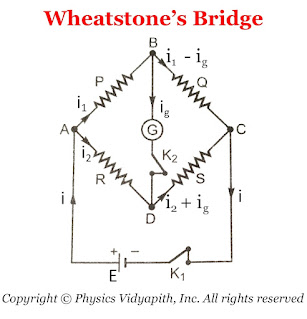
Wheatstone's Bridge
Diagram of Wheatstone's Bridge
Working: To find the unknown resistance $S$, The resistance $R$ is to be adjusted like there is no deflection in the galvanometer. which means that there is not any flow of current in the arm $BD$. This condition is called "Balanced Wheatstone bridge" i.e

$\frac{P}{Q}=\frac{R}{S}$

Derivation of Balanced Condition of Wheatstone's Bridge: In accordance with Kirchhoff's first law, the currents through various branches are shown in the figure above.

For Close Loop $ABDA$

$0=P \: I_{1} - R \: I_{2} +G \: I_{g} \qquad(1)$

For Close Loop $CBDC$

$0=Q \left( I_{1} - I_{g} \right) -S \left( I_{2} + I_{g} \right) - G\: I_{g} \qquad(2)$

For Balanced Wheatstone Bridge: $I_{g}=0$

SO from equation $(1)$ and equation $(2)$

$0=P \: I_{1} - R \: I_{2} $

$P \: I_{1} = R \: I_{2} \qquad(3)$

$0=Q I_{1} -S I_{2}$

$Q I_{1} = S I_{2} \qquad(4)$

Now divide the equation $(4)$ and equation $(3)$, then we get

$\frac{P}{Q}=\frac{R}{S}$

Kirchhoff's laws for an electric circuits

Kirchhoff's laws: Kirchhoff had given two laws for electric circuits i.e.
  1. Kirchhoff's Current Law or Junction Law

  2. Kirchhoff's Voltage Law or Loop Law
  1. Kirchhoff's Current Law or Junction Law: Kirchhoff's current law state that

    The algebraic sum of all the currents at the junction in any electric circuit is always zero.

    $\sum_{1}^{n}{i_{n}}=0$

    Sign Connection: While applying the KCL, the current moving toward the junction is taken as positive while the current moving away from the junction is taken as negative.
    Flow of Current in a Junction
    The flow of Current in a junction
    So from figure,the current $i_{1}$,$i_{2}$,$i_{5}$ is going toward the junction and the current $i_{3}$,$i_{4}$, So

    $\sum{i}= i_{1}+i_{2}+(-i_{3})+(-i_{4})+i_{5}$

    According to KCL $\sum{i}= 0$, Now the above equation can be written as

    $i_{1}+i_{2}+(-i_{3})+(-i_{4})+i_{5}=0 \qquad$

    $i_{1}+i_{2}+i_{5}=i_{3}+i_{4}$

    Thus, the sum of current going towards the junction is equal to the sum of current going away from the junction.

    In other words, at any junction, neither the charge accumulates nor the charge is removed. So this law represents conservation of charge.


  2. Kirchhoff's Voltage Law or Loop Law: Kirchhoff's voltage law state that:

    The algebraic sum of all the voltage or emf in any closed loop of an electric circuit is always zero.

    $\sum_{1}^{n}{E_{n}}=0$

    This means that the algebraic sum of all the emf applied in any closed loop is always equal to the algebraic sum of the product of current and resistance in the closed loop.

    $\sum{E}=\sum {i.R}$

    Sign Connection: While applying this law, a product of current and resistance is taken as positive when we traverse in the direction of the conventional current and the emf is taken positively when we traverse from negative to the positive electrode through the electrolyte.
    Distribution of current in a loop of circuit
    Distribution of Current in a Loop of Circuit
    So from the figure:

    For Mesh $(1)$

    $E_{1}-E_{2}=i_{1}R_{1}-i_{2}R_{2} \qquad(1)$

    For Mesh $(2)$

    $E_{2}=i_{2}R_{2}+\left( i_{1}+i_{2} \right)R_{3} \qquad(2)$

Displacement Current

Description of Displacement Current: The concept of displacement current was first introduced by Maxwell purely on the theoretical ground.

Maxwell postulates that "It is not only current in a conductor that produces a magnetic field but a changing electric field (or time varying electric field) in vacuum or in dielectric also produces the magnetic field. It means that a changing electric field is equivalent to a current which flows as long as the electric field is changing. This equivalent current in a vacuum or dielectric produces the same magnetic effect as an ordinary or conductor current in a conductor. This equivalent current is known as displacement current".

According to the Maxwell modified ampere's law.

$\oint \overrightarrow{B}. \overrightarrow{dl}= \mu_{\circ}i+\mu_{\circ}i_{d}$

Where $i_{d}$ = Displacement Current

Mechanism of Flow of Charge in Metals: Free Electron Gas Theory

Theory of Free Electron Gas Model → According to the electron gas theory

1. The free electrons are continuous in motion inside the metal. The motion of free electrons are random inside the metal.

2. When the free electrons are collisied to each other then the direction of electrons are changed.

3. Mean free Path: The length covered by free electrons, between the two successive collisions is called the "Mean Free Path".

4. Relaxation Time: The time taken between the two successive collisions of free electrons is called the Relaxation time. It is represented by $\tau$.

5. Drift velocity: When a potential is applied across the metal then these electrons do not move own velocity but it move with an average velocity in the opposite direction of the electric field. This average velocity is called the "Drift Velocity". The drift velocity of electrons depends upon the applied potential.

6. Mobility of Electrons: When a potential $V$ is applied across the metal then electrostatic force $F$ acts on the electrons i.e

$F=qE $

$F=NeE \qquad(1)$

Where
$N$ →The number of free electrons inside the metal
$E$ → The electric field due to the applied potential

When this electrostatic force is applied to the electrons then these electrons are accelerated with accelerated $a$ i.e

$F=ma \qquad(2)$

From equation $(1)$ and equation $(2)$ we can write

$ma=N\:e\:E$

$a=\frac{N}{m}eE$

$\frac{v_{d}}{\tau}=\frac{N}{m}eE \qquad \left( \because a=\frac{v_{d}}{\tau} \right)$

$v_{d}=\frac{Ne\tau}{m} E$

$v_{d}=\mu E$

Where $\mu=\frac{Ne\tau}{m}$. It is known as the mobility of electrons.

Derivation of Ohm's Law

Derivation→

Let us consider,

The length of the conductor = $l$
The cross-section area of the conductor = $A$
The potential difference across the conductor = $V$
The drift velocity of an electron in conductor = $v_{d}$

Now from the equation of the mobility of electron i.e.

$v_{d}= \mu E$

$v_{d}= \left( \frac{e\tau}{m} \right) E \qquad \left(\because \tau = \frac{e\tau}{m} \right)$

$v_{d}= \left( \frac{e\tau}{m} \right) \frac{V}{l}\qquad (1) \qquad \left(\because E = \frac{V}{l} \right)$

Now from the equation of drift velocity and electric current

$i=neAv_{d}$

Now substitute the value of $v_{d}$ from equation $(1)$ to above equation

$i=neA\left( \frac{e\tau}{m} \right) \frac{V}{l}$

$i=\left( \frac{ne^{2}A\tau}{ml} \right)V$

$\frac{V}{i}=\left( \frac{ml}{ne^{2}A\tau} \right)$

$\frac{V}{i}=R$

Where $R = \frac{ml}{ne^{2}A\tau} $ is known as electrical resistance of the conductor.

Thus

$V=iR$

This is Ohm's Law.

Relation between electric current and drift velocity

Derivation→ Let us consider

  • The length of the conductor = $l$

  • The cross-section area of the conductor = $A$

  • The total number of free electrons inside the conductor = $N$

  • The current flow in the conductor = $i$

  • Flow of electrons in conductor
    The flow of Electron in Conductor
  • The Relaxation time between the two successive collisions =$\tau$
  • According to the law of current density

    $J=\frac{i} {A} $

    $J=\frac{q} {A \tau} \qquad \left( \because i=\frac{q}{\tau} \right)$

    $J=\frac{N \: e }{A \tau} \qquad \left( \because q=Ne \right)$

    Now multiply by length of conductor $l$ in above equation. Therefore we get

    $J=\frac{N \: e \: l}{A \tau\: l} $

    $J=\frac{N \: e \: l}{V \tau\: }\qquad \left(\because V=A.l \right)$

    Where $V$ is volume of the conductor.

    $J=\frac{n \: e \: l}{ \tau }\qquad \left( \because n=\frac{N}{V} \right)$

    Where $n$ is total number of electrons per unit .

    $J=n \: e \: v_{d}\qquad \left( \because v_{d}=\frac{l}{\tau}\right)$

    Where $v_{d}$ are known as drift velocity of charged particles.

    Now substitute the value of current density $J$ from equation $(1)$ to above equation then above equation can be written as

    $i=neAv_{d}$

    Popular Posts