Principle, Construction and Working of the Ruby Laser

Principle of Ruby Laser → Ruby laser is the first working laser that was invented by T.H.Maima in 1960. It is a three-level solid-state pulsed laser that uses a synthetic ruby crystal or sapphire$(Al_{2}O_{3})$ as its gain medium and triply ionized chromium$(Cr^{+3})$ is used as a dopant.

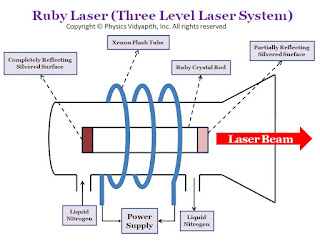
Construction of Ruby Laser → There are the following main components of ruby laser:
  1. Active Medium
  2. Resonant Cavity
  3. Pumping and Cooling Device

Ruby laser diagram
Ruby laser diagram
1. Active Medium → The active medium or gained medium in ruby laser is a synthetic ruby crystal or Aluminium oxide $(Al_{2}O_{3})$ in the form of a cylindrical rod having size $2-30cm$ in length and $0.5-2.0cm$ in diameter. The size of the rod main varies depending upon the use. This gain medium falls in the category of 'narrow line width' laser material. A triply ionised chromium $(Cr^{+3})$ is used as doping material or dopant which works as an active ion. For doping of ruby $(Al_{2}O_{3})$, chromium oxide $(Cr_{2}O_{3})$ is mixed as impurity in ruby and small fraction of aluminium ion $(Al^{+3})$ in ruby are replaced by chromium ions $(Cr^{+3})$. The concentration of chromium ions $(Cr^{+3})$ is of the order of $0.055%$ and at this concentration, the number of chromium ions $(Cr^{+3})$ per cubic meter is nearly $10^{25}$. It is the chromium ions $(Cr^{+3})$ that population is set up in ruby laser and gives rise to the laser action. The chromium ions $(Cr^{+3})$ are active centers and provide the energy levels for both lasing transitions and pumping. The host Aluminium oxide $(Al_{2}O_{3})$ itself does not participate directly in lasing action.

2. Resonant Cavity → The ends of the ruby are optically flat and parallel and then silvered, one end completely and the other only partially. The one end of the rod acts as fully reflecting and another one as partially reflecting. The reflectors can be plane-parallel or with a slight curvature, curved mirrors being more useful for compensating the thermal lensing of the rod which takes place during the pumping cycle. The space between the end faces is known as a resonant cavity in which light intensity can be built up or amplified by multiple reflections.

The ends of the ruby rod are polished with great precision, such that the ends are flat to within a quarter of a wavelength of the output light and parallel to each other within a few seconds of arc. The rod with its reflecting ends acts as a Fabry Perot resonator. Modern laser often uses rods with ends cut and polished at "Brewster's Angle" to eliminate the reflections from the ends of the rod.

3. Pumping and cooling Device → In the ruby laser, population inversion is done by optical pumping. Xenon flash lamps provide the most efficient operation of ruby lasers with a pulse duration ranging from milliseconds. The ruby rod is wound by a helical xenon flashlight tube with an excitation source in the form of a power supply. The pumping absorption bands are at $4000 A^{\circ}$ and $5500 A^{\circ}$ with an approximation bandwidth of $500 A^{\circ}$ at each of the wavelengths. Pulses of energies up to $100J$ can be obtained through the pulse repetition rate is comparatively low, of the order of one to two pulses per second which limit the average power. Ruby laser requires high pumping flux to get population inversion due to which a considerable amount of heat is generated during laser operation. Ruby laser being highly temperature-dependent requires an arrangement of effective cooling. Water cooling of the rod combined with the higher thermal conductivity of Ruby provides a sufficient cooling effect to remove the excess heat. For this purpose, water is circulated in a glass tube surrounding the laser system. Being transparent in the wavelength region of pumping bands water does not affect the pumping flux from the flash lamp before it gets absorbed by Ruby road. Liquid nitrogen is also used as a coolant material in ruby lasers.

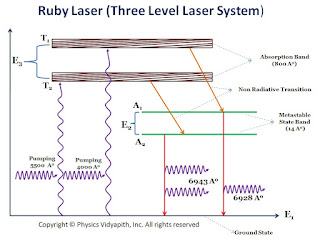
Working(Lasing Action) of Ruby Laser → The energy level diagram of chromium ion in ruby is shown in the figure below:
The energy level diagram of chromium ion in ruby
The energy level $E_{3}$ has two main pump bands or excited bands $T_{1}$ and $T_{2}$ having a bandwidth of nearly $800A^{\circ}$. The energy level $E_{2}$ which is known as the metastable state in ruby has a double energy level $A_{1}$ and $A_{2}$. These energy levels are separated by nearly $14A^{\circ}$. These are the twofold degenerate energy level.

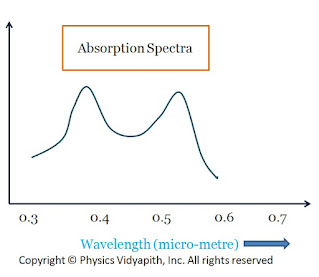
In the normal state, The chromium ions are in-ground energy state $E_{1}$. When light from the flash lamp is made to fall upon the ruby rod the incident radiation is absorbed by chromium ions and rises to an excited state $E_{3}$. The chromium ions in the ground state can absorb a photon of wavelength $5500A^{\circ}$ (green region) and jump to energy band $T_{2}$. It can also absorb the photon of a wavelength $4000A^{\circ}$ (Blue region) and jump to energy band $T_{1}$. The absorption spectrum of chromium ions is shown in the figure below
Absorption Spectra
Absorption Spectra
The chromium ion goes to upper energy state $T_{1}$and $T_{2}$ and stay for $10^{-8} sec $ and then make non radiative transition to metastable states $E_{1}$ and $E_{2}$ respectively which have very log life time $\approx10^{-3}sec$. The number of atoms in these states keeps increasing and at the same time number of atoms in the ground state $E_{1}$ goes on decreasing due to optical pumping. Thus the population inversion is achieved between the metastable state and ground state. At room temperature, if radiation is kept constantly, during the process of pumping, the population at $A_{2}$ level is almost $15%$ more than at level $A_{1}$. Some of the excited atoms in states $E_{3}$ return to ground state $E_{1}$ but with less probability.

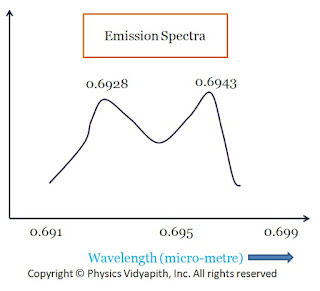
When the population inversion is achieved light amplification starts in the resonant cavity. When excited atoms at metastable state $E_{2}$ make transition to ground level $E_{1}$ there are two weak lines at $6943 A^{\circ}$ ($A_{2}$ → $E_{1}$) and $6928 A^{\circ}$ ($A_{1}$ → $E_{1}$) each of width $\approx 6 A^{\circ}$. But Under the lasing condition, the line $6943 A^{\circ}$ dominates over $6928 A^{\circ}$. The emission spectrum of chromium ions in ruby is shown in the figure below:
Emission Spectra
Emission Spectra
It shows that pumping transitions are spectrally broad while the emission transition is narrow. The wavelength of two spectral lines $6943 A^{\circ}$ and $6928 A^{\circ}$ are temperature dependent.

Numerical Aperture and Acceptance Angle of the Optical Fibre

Angle of Acceptance →

"If incident angle of light on the core for which the incident angle on the core-cladding interface equals the critical angle then incident angle of light on the core is called the "Angle of Acceptance."

Transmission of light when the incident angle is equal to the acceptance angle

If the incident angle is greater than the acceptance angle i.e. $\theta_{i}>\theta_{0}$ then the angle of incidence on the core-cladding interface will be less than the critical angle due to which part of the incident light is transmitted into cladding as shown in the figure below
Transmission of light when the incident angle is greater than the acceptance angle
If the incident angle is less than the acceptance angle i.e. $\theta_{i}<\theta_{0}$ then the angle of incidence on the core-cladding interface will be greater than the critical angle for which total internal reflection takes place inside the core. As shown in the figure below
Transmission of light when the incident angle is less than the acceptance angle
Acceptance cone →

"The light entering the core in a cone of semi-vertical angle $\theta_{0}$ is transmitted in the core through total internal reflections. This cone is known as the acceptance cone."

Numerical Aperture

"The sine of the angle of acceptance of the optical fibre is known as the numerical aperture of optical fibre."

The numerical aperture determines the light-gathering ability of the fibre. It measures the amount of light that can be accepted by a fibre. The numerical aperture depends upon the refractive index of the core and cladding material and does not depend on the physical dimension of the fibre. It is a dimensionless quantity that is less than unity. The value of the numerical aperture ranges from $0.13$ to $0.15$. A large numerical aperture implies that a fibre accepts a large amount of light from the source. It varies due to variations of refractive index in the core and it has zero value after the core-cladding boundary. The number of propagation modes to multimode graded-index fibre depends upon the parameter of numerical aperture and hence upon the relative refractive index difference $\Delta n$

Derivation of Angle of Acceptance and Numerical Aperture

Let us consider, step-index optical fibre for which

The incident angle on the axis of core = $\theta_{i}$
The refracted angle on the axis of core = $\theta_{r}$
The refractive index of core = $n_{1}$
The refractive index of cladding = $n_{2}$
The incident angle at the core-cladding interface = $\phi$.
Transmission of light when the incident angle is equal to the acceptance angle

When ray incident at point $A$ on the core then According to Snell's law

$\frac{sin \theta_{0}}{sin \theta_{r}}= \frac{n_{1}}{n_{0}} $

Where $n_{0}$ → refractive index of air and vacuum

$sin\theta_{0}=\frac{n_{1}}{n_{0}} sin \theta_{r} \qquad(1)$

Now the refracted ray incident at point $B$ at the interface of core and cladding. So for critical angle condition

$n_{1}\: sin\phi=n_{2} \: sin90^{0} $

From figure: $\phi=90-\theta_{r}$

So above equation can be written as

$n_{1}\: sin(90-\theta_{r})=n_{2} \: sin90^{0}$

$n_{1}\: cos \theta_{r}=n_{2}$

$cos\theta_{r}=\frac{n_{2}}{n_{1}} \qquad(2)$

$sin\theta_{r}=\sqrt{1-cos^{2}\theta_{r}}$

Now substitue the value of $cos\theta_{r}$ from equation$(2)$ to above equation then we get

$sin\theta_{r}=\sqrt{1- \left ( \frac{n_{2}}{n_{1}} \right)^{2}}$

$sin\theta_{r}=\frac{1}{n_{1}}\sqrt{n_{1}^{2}- n_{2}^{2}}$

Now substitue the value of $sin\theta_{r}$ in equation$(1)$ then we get

$sin\theta_{0}=\frac{n_{1}}{n_{0}}\frac{1}{n_{1}}\sqrt{n_{1}^{2}- n_{2}^{2}}$

$sin\theta_{0}=\frac{\sqrt{n_{1}^{2}- n_{2}^{2}}}{n_{0}}\qquad(3)$

This $sin\theta_{0}$ is known as Numerical Aperture. i.e.

$N.A.=\frac{\sqrt{n_{1}^{2}- n_{2}^{2}}}{n_{0}}$

If fibre is in the air then $n_{0}=1$ so the above equation can be written as

$N.A.=\sqrt{n_{1}^{2}- n_{2}^{2}}$

The equation $(3)$ also can be written as

$\theta_{0}=sin^{-1}\frac{\sqrt{n_{1}^{2}- n_{2}^{2}}}{n_{0}}$

The angle $\theta_{0}$ is known as the Angle of Acceptance.

The light is transmitted through the fibre when

$\theta_{i} < \theta_{0}$

i.e. $sin \theta_{i} < sin \theta_{0}$

$sin \theta_{i} < N.A.$

The light will be transmitted through the fibre with multiple total internal reflections when the above condition is satisfied.

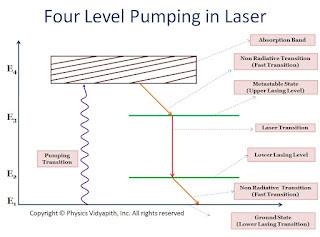
Four Level Pumping in Laser

Description:

In four-level pumping, atoms of ground energy state go to upper energy state$(E_{4})$ by pumping transition to achieve the population inversion. Due to the short time of the upper energy state atoms go to metastable state by nonradiative transitions or spontaneous emission. Atoms of metastable state come to lower lasing level by laser transition process. The atoms come from lower lasing level to ground state by nonradiative transition or spontaneous emission. This process is repeated continuously.

Four level pumping in Laser
Four-level pumping in Laser

In contrast to level pumping, the lower lasing transition level in the four-level scheme is not the ground state and is virtually vacant. As soon as some atoms are pumped to the upper lasing level, population inversion is achieved. So it is required less pumping energy than a three-level laser system. this is the major disadvantage of this scheme. Further, the lifetime of the lower lasing level is shorter as it is not a metastable state. Hence atom in level $E_{2}$ quickly drops to the ground state. This depletion of the $E_{2}$ energy level helps sustain the population inversion by avoiding and accumulation of atoms in the lower lasing level. Therefore four-level laser system can operate in a continuous wave mode.

Three level pumping in Laser

Description:

Three-level pumping in laser is suitable for attending population inversion.

When atoms of ground energy state observe the photon from incident energy. It goes from lower energy or ground energy state two to a higher energy state but the lifetime of a high energy state is very short that is $10^{-8}$ $sec$ i.e. So an atom cannot stay for a long time in high energy state i.e.$E_{3}$ and then the atom goes for non-radiative transition and reach to the metastable state. In a metastable state, Atoms cannot go to a lower energy state or ground energy state directly. Therefore, These atoms come from a metastable state to a lower energy state or ground energy state by lasing transition.

Three level pumping in Laser
Three-level pumping in Laser

This is the process of three-level pumping in a laser. For better pumping efficiency, The level $E_{3}$ should be the band of energy levels instead of being a single arrow line. It allows the use of pumping radiation of wider bandwidth to excite more atoms. However, the major disadvantage of the three-level scheme is that it requires very high pumping powers. The three-level laser system can produce light only in pulses. Once stimulated emission commences, the metastable state $E_{2}$ gets depopulated very rapidly and the population of the ground energy state increases quickly. As a result, the population inversion ends. One has to wait till population inversion is again established. Thus, the Three-level laser system operates in pulse mode.

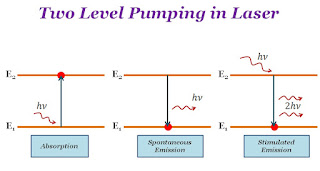
Two Level Pumping in Laser

Two-level pumping occurs between two energy levels. All the process of laser (absorption, spontaneous emission, or stimulated emission) occurs between two energy level. The absorption of light or emission of light energy is the difference between two energy levels. If two energy levels are $E_{1}$ and $E_{2}$ so absorption or emission of a photon →

$E_{2}-E_{1}=h\nu$

Where$h$ → Planck's Constant$\nu$ → Frequency of photon

Two-level pumping in laser is not suitable for attaining the population inversion. The transition of atoms between two energy levels by stimulated emission is called a lasing transition. The lower level is known as the lower lasing level and the upper level is known as the upper lasing level. The upper lasing level must be a metastable level. The uppermost level to which atoms are in the excited state is known as the pumping level. The transition between the ground level and pumping level is called the pumping transition.
Two-level pumping Laser

Absorption, Spontaneous Emission and Stimulated Emission of Radiation

Description of the absorption process:

When photons of appropriate energy are incident on lower-energy state atoms, these atoms absorb the photons and go from the lower-energy state to a higher or excited energy state. This process is called absorption.

$A + h\nu \rightarrow A^{*}$

Where

$A \rightarrow$ Lower energy state of the atom
$A^{*} \rightarrow$ Higher or excited energy state of the atom
Absorption Process in Laser
Mathematical Analysis of Absorption:

Let us consider, Two energy states $E_{1}$ and $E_{2}$ having population $N_{1}$ and $N_{2}$ respectively so

The rate of absorption transition for energy state $E_{1}$

$R_{abs}= -\frac{dN_{1}}{dt} \qquad(1)$

Where $\left(-\frac{dN_{1}}{dt}\right)$ shows that the rate of decrease in the population at the lower energy level $E_{1}$

The rate of absorption transition for energy state $E_{2}$

$R_{abs}= \frac{dN_{2}}{dt} \qquad(2)$

Where $\left(\frac{dN_{2}}{dt}\right)$ shows that the rate of increase in population at the higher energy level $E_{2}$

The rate of absorption depends upon the following factors:

1.) The rate of absorption is directly proportional to the population $N_{1}$ of the lower energy state $E_{1}$

$R_{abs}\propto N_{1} \qquad(3)$

2.) The rate of absorption is directly proportional to the energy density $\rho(v)$ of incident light on the lower energy state $E_{1}$

$R_{abs} \propto \rho(v) \qquad(4)$

From equation $(3)$ and equation $(4)$

$R_{abs} \propto N_{1} \rho(v) $

$R_{abs} = B_{12} N_{1} \rho(v) \qquad(5)$

Where $B_{12}$ is called the Einstein coefficient for induced absorption and it indicates the probability of an induced transition from energy state $E_{1} \: \rightarrow \: E_{2}$

At thermal equilibrium, the population (i.e., number of atoms per unit volume in the energy state) of the lower energy state is much larger than that in the higher energy state. So when light propagates through the medium then it gets absorbed.

Important features of the absorption process in a laser:

1.) The energy of the incident photon must be equal to the energy gap between the two energy states.

2.) Absorption is not directional. Atoms absorb photons coming from any direction.

3.) For absorption, the population of the lower energy state must be greater than the population of the higher energy state.

4.) The rate of absorption is a very fast process, occurring in nanoseconds or less.

5.) The rate of absorption helps define the gain coefficient and overall efficiency of the laser medium.

Description of the spontaneous emission process:

When the atom absorbs the energy incident it goes from a lower energy state to a higher energy state, In a higher energy state, the atom can not stay for a long time because the average lifetime of a higher energy state is $10^{-8}$ sec and atom emit the photon spontaneously and then comes from higher energy state to lower energy state. The process is called spontaneous emission.

$A^{*} \rightarrow A + h\nu$

Where

$A \rightarrow$ Lower energy state of the atom
$A^{*} \rightarrow$ Higher or excited energy state of the atom
Spontaneous Emission Process in Laser
Mathematical Analysis of Spontaneous Emission:

Let us consider, Two energy states $E_{1}$ and $E_{2}$ having population $N_{1}$ and $N_{2}$ respectively. So

The rate of spontaneous emission transition for energy state $E_{2}$

$R_{sp}= -\frac{dN_{2}}{dt} = -\frac{N_{2}}{\tau_{sp}} \qquad(1)$

Where $\left(-\frac{dN_{2}}{dt}\right)$ shows that the rate of decrease in the population at the higher energy level $E_{2}$

The rate of absorption depends upon only:

* The rate of spontaneous emission is directly proportional to the population $N_{2}$ of the higher energy state $E_{2}$

$R_{sp}\propto N_{2} \qquad(2)$

$R_{sp} \propto N_{2}$

$R_{sp} = A_{21} N_{2} \qquad(3)$

Where $A_{21}$ is called the Einstein coefficient for spontaneous emission, and it is a function of the frequency and properties of the material. It indicates the probability of spontaneous emission transition from energy state $E_{2} \: \rightarrow \: E_{1}$

The process of spontaneous emission is independent of the light energy.

From equation $(2)$ and equation $(3)$

$ -\frac{N_{2}}{\tau_{sp}} = A_{21} N_{2}$

$-\frac{1}{\tau_{sp}} = A_{21}$

$A_{21} = -\frac{1}{\tau_{sp}} \qquad(4)$

Important features of the spontaneous process in a laser:

1. The spontaneous emission is not amenable to control from outside.

2. It is essentially probabilistic in nature.

3. The light is not monochromatic because of various line-broadening processes.

4. Due to a lack of directionality, the light spreads in all directions around the source. The light intensity decreases rapidly with distance from the source.

5. The light is incoherent.

6. An atom can radiate into any of the $4 \pi$ steradians with any sense of polarization.

Description of the stimulated emission process:

When the higher energy state (or excited state) atom interacts with a photon of appropriate energy, the photon triggers that atom to transition to the lower energy state and emit two photons. This process is called stimulated emission.

$A^{*} + h\nu \rightarrow A + 2 h\nu$

Where

$A$ - Atom of the lower energy state.
$A^{*}$ - Atom of the excited energy state.
Stimulated Emission Process in Laser

Mathematical analysis of the stimulated emission process:

Let us consider, Two energy states $E_{1}$ and $E_{2}$ which have population $N_{1}$ and $N_{2}$ respectively so

The stimulated transition's rate for energy state $E_{2}$

$R_{st}= -\frac{dN_{2}}{dt} \qquad(1)$

Where $\left(-\frac{dN_{2}}{dt}\right) \rightarrow$ Decrease in population's rate at the higher energy state $E_{2}$

The rate of absorption depends upon the following factors:

1.) The stimulated transition's rate is directly proportional to the population $N_{2}$ of the higher energy state $E_{2}$

$R_{st}\propto N_{2} \qquad(2)$

2.) The stimulated transition's rate is directly proportional to the energy density $\rho(v)$ of incident light on the higher energy state $E_{2}$

$R_{st} \propto \rho(v) \qquad(3)$

From equation $(2)$ and equation $(3)$

$R_{st} \propto N_{2} \rho(v) $

$R_{st} = B_{21} N_{1} \rho(v) \qquad(5)$

Where $B_{21}$ is called the Einstein coefficient for stimulated emission and it indicates the probability of a stimulated transition from energy state $E_{2} \: \rightarrow \: E_{1}$.


Important features of the stimulated emission:

1.) The process of stimulated emission can be influenced or controlled from outside the system.

2.) The photon generated through stimulated emission propagates along the same path as the stimulating photon.

3.) The photon produced through stimulated emission is identical to the incident photon for its frequency, phase, and polarization.

4.) The light produced through stimulated emission is directional, coherent, and monochromatic.

5.) Light Amplification: 
Multiplication of Stimulated Photon into an Avalanche
One of the most remarkable aspects of stimulated emission is the multiplication of photons (i.e., exponential growth). When a single photon strikes an excited atom, it emits two photons. These two emitted photons are in the same phase and direction. These two photons stimulate two excited atoms in their path and produce a total of four photons, which are in the same phase and direction. This process continues, and the number of photons builds up in an avalanche-like manner.
Amplification of Laser Light
Since all the emitted light waves originate from a single initial photon and maintain the same phase, the waves are coherent and interfere constructively. As the coherent wave passes through the medium filled with excited atoms, its amplitude increases with each additional stimulated photon. This results in a continuous amplification of light, forming the basis of how lasers work.

6.) High Intensity: Because of constructive interference of the waves, the net intensity of the resultant light will be proportional to the square of the number of atoms emitting light. Thus

$I_{Total}=N^{2} I$

Hence, the light produced due to stimulated emission is of very higher intensity than the light generated through spontaneous emissions.
Popular Posts