Newton's rings in reflected monochromatic light

Newton's Rings:

Experimental Arrangement:

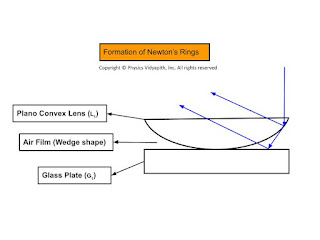
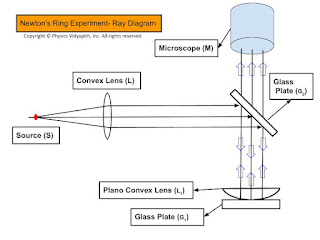
  • A plano-convex lens $l_{1}$ of large radius of curvature is placed on a plane glass plate $G_{1}$ with the curved surface touching the glass plate.

  • An air film is enclosed between the curved surface of the lens and the glass plate.

  • A sodium vapor lamp $S$ is kept at the focus of a biconvex lens $L$ which converts the diverging beam of light into a parallel beam. The parallel beam of light is made to fall on a glass plate $G_{2}$ kept at an angle of $45^{\circ}$ with the incident beam.

  • A part of incident light is reflected toward the plano-convex lens. This light is again reflected back, partially from the top and partially from the bottom of the air fil and transmitted by the glass plate $G_{2}$. The interference of these rays is observed through a microscope $M$.

  • Newtons Rings Experiment Setup-Ray Diagram
    Newtons Rings Experiment Setup-Ray Diagram
    Explanation of the formation of Newton's rings:

  • Division of amplitude takes place at the curved surface of the plano-convex lens.

  • The incident light is partially reflected and partially transmitted at the curved surface.

  • The transmitted ray is reflected from the glass plate. These two rays interfere in reflected light

  • The path difference between these rays depends on the thickness of the air film enclosed between the curved surfaces of the lens and glass plate which increases radially outward from the center. The thickness of the air film is zero at the center

  • Formation of Newton Rings
    Formation of Newton Rings
    Path difference:

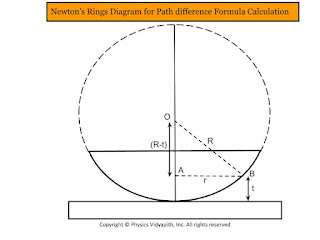
    Let $t$ is the thickness of air film at a radial distance of $r$ and $R$ is the radius of curvature. So the path difference for a wedge-shaped film is

    $\Delta=2 \mu t \: cos(r+\alpha) \pm \frac{\lambda}{2} \qquad(1)$

    HereRefractive index of air film ($\mu)=1$$\alpha$ is very small i.e. $\alpha \approx 0$For normal incidence $r=0$ i.e $cos(\alpha+r)=1$

    Now apply the above condition to equation $(1)$ then we get

    $\Delta = 2t + \frac{\lambda}{2} \qquad(2)$

    Newton’s Rings Diagram for Path difference Formula Calculation
    Newton’s Rings Diagram for Path difference Formula Calculation
    Form figure, In $\Delta OAB$, apply the Pythagoras theorem

    $OB^{2}=OA^{2}+AB^{2}$

    $R^{2}=(R-t)^{2}+r^{2}$

    $R^{2}=R^{2}+t^{2}-2Rt+r^{2}$

    $2Rt=t^{2}+r^{2}$

    As $t$ is very small, $t^{2}$ can be neglected in comparison with $r^{2}$. So

    $2Rt=r^{2}$

    $2t=\frac{r^{2}}{R} \qquad(3)$

    Here $r$- Radius of a circle for which thickness is $t$

    If $D$ is the diameter of this circle then

    $r=\frac{D}{2}$

    So from equation $(3)$

    $2t=\frac{D^{2}}{4R} \qquad(4)$

    Substitute the value of $2t$ in equation $(2)$ then we get

    $\Delta = \frac{D^{2}}{4R}+\frac{\lambda}{2}$

    Diameter of Bright rings:

    For bright rings, the condition for constructive interference is satisfied. i.e.

    $\Delta =n \lambda$

    So from the above equations, we get

    $\frac{D^{2}}{4R}+\frac{\lambda}{2}=n \lambda $

    Where $D_{n}$- Diameter of the $n^{th}$ bright ring

    $\frac{D^{2}}{4R}=(2n-1) \frac{\lambda}{2}$

    $D_{n}= \sqrt {2 \lambda R (2n-1)}$

    Where $n=1,2,3,4........$

    $D_{n} \propto \sqrt{(2n-1)}$

    i.e The diameter of the bright rings are proportional to the square root of odd natural numbers.

    Diameter of Dark ring:

    Condition for destructive interference is satisfied for dark rings i.e.

    $\Delta=(2n+1)\frac{\lambda}{2}$

    $\frac{D^{2}}{4R}+\frac{\lambda}{2}=(2n+1)\frac{\lambda}{2}$

    $\frac{D^{2}}{4R}+\frac{\lambda}{2}=n \lambda + \frac{\lambda}{2}$

    $\frac{D^{2}}{4R}=n \lambda$

    $D_{n}= \sqrt{4Rn\lambda}$

    $D_{n} \propto \sqrt{n}$

    Where $n=1,2,3,4........$

    i.e The diameter of dark rings are proportional to square root of natural numbers.

    Fringe width of wedge shaped thin film for normal incidence

    Derivation of Fringe width of the wedge-shaped thin film:

  • The distance between two consecutive bright (or dark) fringes is called the fringe width.

  • If the $n^{th}$ bright fringe is formed at a distance $x_{n}$ from the edge of the wedge shaped film where the thickness is $t_{n}$. So the path difference for $x_{n}$ bright fringe:


  • $(2n-1) \frac{\lambda}{2}= 2 \mu \: t_{n} \: cos(\alpha+r) \qquad(1)$

    For Normal IncidenceThe incident Angle $i=0$The refracted Angle $r=0$

    then from equation $(1)$

    $(2n-1) \frac{\lambda}{2}= 2 \mu \: t_{n} \: cos\alpha \qquad(2)$
    Fringe width of wedge shaped thin film for normal incidence
    Fringe width of wedge-shaped thin film for normal incidence
    From the figure, In $\Delta OAB$

    $tan \alpha = \frac{t_{n}}{x_{n}}$

    $t_{n}=x_{n} \: tan \alpha \qquad(3) $

    Now put the value of $t_{n}$ in equation $(2)$

    $(2n-1) \frac{\lambda}{2}= 2 \mu \: x_{n} \: tan \alpha \: cos\alpha $

    $(2n-1) \frac{\lambda}{2}= 2 \mu \: x_{n}\: \frac{sin \alpha}{cos\alpha} \: cos\alpha $

    $(2n-1) \frac{\lambda}{2}= 2 \mu \: x_{n} \: sin \alpha \qquad(4)$

    Similarly for $(n+1)^{th}$ bright fringe i.e put the $(n+1)$ in place of $n$ in above equation then we get

    $\left\{ 2(n+1)-1 \right\} \frac{\lambda}{2}= 2 \mu \: x_{n+1} \: sin \alpha $

    $(2n+1) \frac{\lambda}{2}= 2 \mu \: x_{n+1} \: sin \alpha \qquad(5)$

    Subtract the equation $(5)$ and equation$(4)$

    $2\mu \: (x_{n+1}-x_{n})\: sin \alpha =\lambda$

    $2\mu \beta \: sin \alpha =\lambda$

    Where $\beta=$ fringe Width$(x_{n+1}-x_{n})$

    $\beta=\frac{\lambda}{2\mu\: sin \alpha}$

    If $\alpha$ is very small so $sin \alpha \approx \alpha$

    $\beta=\frac{\lambda}{2\mu\: \alpha}$

    Interference of light due to a wedge shaped thin film

    Derivation of interference of light due to a wedge-shaped thin film:

    Interference of light due to wedge shaped thin film
    Interference of light due to wedge-shaped thin film

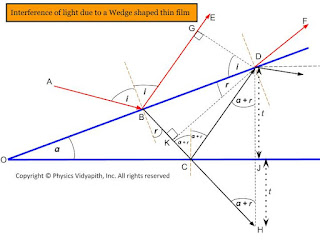
    The wedge-shaped film is bound by two plane surfaces inclined at angle $\alpha$.

    The thickness t of the film varies uniformly from zero at the edge to its maximum value at the other end.

    A Ray of light ab incident on the film will be partially reflected along be and partially transmitted along $BC$. The ray $BC$ will be partially reflected along $CD$ which will be again partially transmitted along $BF$. The two rays $BE$ and $DF$ in reflected light diverge.

    The path difference between ray $BE$ and $DF$ is

    $\Delta=\mu(BC+CD)-BG \qquad(1)$

    Where $\mu$- Refractive index of the film

    $\Delta CDJ$ and $\Delta CHJ$ are congruent so

    $ \begin{Bmatrix} CD=CH \\ DJ=JH=t \end{Bmatrix} \qquad(2)$

    From equation $(1)$

    $\Delta=\mu(BK+KC+CH)-BG \\ \because BD=BK+KC$

    $\Delta=\mu(BK+KH)-BG \qquad (3)$

    In $\Delta BDG$-

    $sin\:i = \frac{BG}{BD}$

    $BG=BD sin \: i \qquad(4)$

    In $\Delta BDK$

    $sin\:r =\frac{BK}{BD}$

    $BD=\frac{BK}{sin \: r} \qquad(5)$

    From equation $(4)$ and equation $(5)$

    $BG=BK. \frac{sin \: i}{sin \: r}$

    $BG=\mu . BK \quad(6) \quad (\because \mu=\frac{sin \: i}{sin \: r})$

    Now put the value of $BG$ in equation $(3)$

    $\Delta= \mu(BK+KH)- \mu. BK$

    $\Delta= \mu.KH \qquad(7)$

    In $\Delta DKH$

    $cos \: (\alpha + r)= \frac{KH}{DH}$

    $KH=DH \: cos \: (\alpha + r)$

    $KH=(DJ+JH) \: cos \: (\alpha + r)$

    $KH=2t \: cos \: (\alpha + r) \qquad(8) $ {From equation $(2)$}

    Now put the value of $KH$ in equation $(7)$

    $\Delta= 2\mu t \: cos \: (\alpha + r)$

    The ray $DF$ suffers a phase change of $\pi$ due to reflection from a denser medium at $C$. Whereas there is not any change in phase due to reflection for ray $BE$.

    $\Delta= 2\mu t \: cos \: (\alpha + r) \pm \frac{\lambda}{2}$

    For Constructive Interference:

    Path difference

    $\Delta= n \lambda$

    so

    $2\mu t \: cos \: (\alpha + r) \pm \frac{\lambda}{2}= n \lambda$

    $ 2\mu t \: cos \: (\alpha + r)= (2n \pm 1) \frac{\lambda}{2}$

    For Destructive Interference:

    Path difference

    $\Delta= (2n \pm 1) \frac{\lambda}{2}$

    so

    $2\mu t \: cos \: (\alpha + r) \pm \frac{\lambda}{2}=(2n \pm 1) \frac{\lambda}{2}$

    $2\mu t \: cos \: (\alpha + r) =2n \lambda$

    Interference of light due to thin film

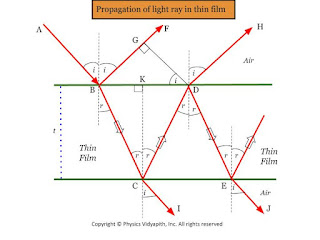
    Derivation of interference of light due to thin-film: Let's consider a Ray of light $AB$ incident on a thin film of thickness $t$ and the refractive index of a thin film is $\mu$

    The ray $AB$ is partially reflected and partially transmitted at $B$. The transmitted BC is against partially transmitted and partially reflected at $C$. The reflected ray $CD$ is partially reflected and partially refracted at $D$.
    Propagation of light ray in thin film
    Propagation of light ray in thin film
    The interference pattern in reflected light will be due to ray $BF$ and $DH$ which are coherent as they are both derived from the same Ray $AB$.

    The interference pattern in transmitted light will be due to ray $CI$ and $EJ$.

    The path difference between $BF$ and $DH$ ray will be

    $\Delta=\mu(BC+CD)-BG \qquad(1)$

    The triangle $\Delta BCK$ and $\Delta CDK$ are congruent because

    $\begin{Bmatrix} BK=KD \\ BC=CD \\ CK=t \end{Bmatrix} \qquad (2)$

    From equation $(1)$ and $(2)$

    $\Delta=2 \mu BC-BG \qquad(3)$

    In $\Delta BCK$

    $cos \: r= \frac{CK}{BC}$

    $BC= \frac{t}{cos \: r} \qquad(4)$

    In $\Delta BGD$

    $sin \: i= \frac{BG}{BD}$

    $BG= BD \: sin\: i $

    $BG= (BK+KD)\: sin\: i $

    $BG= 2BK \: sin\: i \qquad(5)$ {From eqaution $(2)$}

    Again In $\Delta BCK$

    $tan \:r = \frac{BK}{CK}$

    $BK=t.tan\:r \qquad(6)$

    Put the value of $BK$ in equation $(5)$

    $BG=2t\:sin \:i .tan\: r$

    $BG=2t\:sin \:i .\frac{sin \: r}{cos \: r}$

    $BG= 2t \frac{sin \:i}{sin \: r} \frac{sin^{2} \:r}{cos \: r}$

    $BG=2\mu t \frac{sin^{2} \:r}{cos \: r} \qquad (7)\qquad \left( \mu =\frac{sin \:i}{sin \: r}\right)$

    Now put the value of $BG$ and $BC$ in equation $(3)$

    $\Delta= \frac{2 \mu t}{cos \: r}-2\mu t\frac{sin^{2} \:r}{cos \: r}$

    $\Delta=\frac{2 \mu t}{cos \:r} \left[1-sin^{2} \:r \right]$

    $\Delta=2 \mu t \frac{cos^{2} \:r}{cos \:r} $

    $\Delta=2 \mu t \: cos \:r$

    Interference in a reflected ray:

    The ray $BF$ suffers phase change of $\pi$ due to reflection from the denser medium at $B$. Therefore the path difference of $\frac{\lambda}{2}$ is introduced between two rays due to reflection-

    $\Delta= 2\mu t \: cos\:r \pm \frac{\lambda}{2}$

    Constructive Interference due reflected ray:

    for constructive interference

    $\Delta=n \lambda$

    so from the above equations, we get

    $2\mu t \: cos\: r \pm \frac{\lambda}{2}=n \lambda$

    $2\mu t \: cos\: r = (2n \pm 1)\frac{\lambda}{2}$

    Destructive Interference due to reflected ray:

    for destructive interference

    $\Delta=(2n \pm 1)\frac{\lambda}{2}$

    so from the above equations, we get

    $2\mu t \: cos\: r \pm \frac{\lambda}{2}=(2n \pm 1)\frac{\lambda}{2}$

    $2\mu t \: cos\: r =n \lambda$

    Interference in transmitted ray:

    The ray $CI$ and $EJ$ in transmitted Ray have the same path difference as a reflected ray. There is not any change in phase for $CI$ due to reflection as it gets transmitted at $C$. The ray $EJ$ also does not undergo phase change due to reflection as it is reflected from the rarer medium at $C$ and $D$.

    $\Delta= 2\mu t \: cos\:r $

    Constructive Interference due to transmitted ray:

    for constructive interference

    $\Delta=n \lambda$

    so from the above equations, we get

    $2\mu t \: cos\: r =n \lambda$

    Destructive Interference due to transmitted ray:

    for destructive interference

    $\Delta=(2n \pm 1)\frac{\lambda}{2}$

    so from the above equations, we get

    $2\mu t \: cos\: r =(2n \pm 1)\frac{\lambda}{2}$

    $2\mu t \: cos\: r =n \lambda$

    Energy density in electromagnetic waves in free space

    What is the energy density in the electromagnetic wave in free space?

    The total energy stored in electromagnetic waves per unit volume due to the electric field and the magnetic field is called energy density in the electromagnetic wave in free space.

    $U=\epsilon_{0} E^{2}=\frac{B^{2}}{\mu_{0}}$

    Derivation of Energy density in electromagnetic waves in free space:

    The energy per unit volume due to the electric field is

    $U_{E}= \frac{1}{2} \overrightarrow{E}.\overrightarrow{D} \qquad(1)$

    The energy per unit volume due to the magnetic field is

    $U_{B}= \frac{1}{2} \overrightarrow{B}.\overrightarrow{H} \qquad(2)$

    The total energy density of electromagnetic waves is

    $U=U_{E}+U_{B} \qquad(3)$

    Now substitute the value of $U_{E}$ and $U_{B}$ in equation$(3)$ then we get

    $U=\frac{1}{2} \left( \overrightarrow{E}.\overrightarrow{D}+\overrightarrow{B}.\overrightarrow{H} \right)$ $U=\frac{1}{2} \left( \overrightarrow{E}.\epsilon_{0}\overrightarrow{E}+\overrightarrow{B}.\frac{1}{\mu_{0}}\overrightarrow{B} \right) \qquad ( \because \overrightarrow{B}= \mu_{0} \overrightarrow{H} \:OR \: \overrightarrow{D}= \epsilon_{0}\overrightarrow{E} )$

    $U=\frac{1}{2} \left( \epsilon_{0} E^{2}+\frac{B^{2}}{\mu_{0}} \right) \qquad ( \because \overrightarrow{E}\overrightarrow{E}= E^{2} \:OR \: \overrightarrow{B}.\overrightarrow{B}=B^{2})$

    $U=\frac{1}{2} \left( \epsilon_{0} E^{2}+\frac{E^{2}}{c^{2} \mu_{0}} \right) \qquad ( \because B=\frac{E}{c})$

    $U=\frac{1}{2} \left( \epsilon_{0} E^{2}+\frac{E^{2}}{c^{2} \mu_{0}} \right) $

    $U=\frac{1}{2} \left( \epsilon_{0} E^{2}+\epsilon_{0} E^{2} \right) \qquad ( \because c=\frac{1}{\sqrt{\mu_{0} \epsilon_{0}}})$

    $U=\frac{1}{2} \left(2 \epsilon_{0} E^{2} \right) $

    $U= \epsilon_{0} E^{2} $

    Similarly, the energy density of electromagnetic waves in free space in terms of the magnetic field $B$ can be written as:

    $U= \frac{B^{2}}{\mu_{0}} $

    The average value of energy density in the electromagnetic waves in free space:

    Now we will find the average value of energy density in the electromagnetic wave in free space from the above equation $U= \epsilon_{0} E^{2} $. So we get

    $\left< U \right> = \epsilon_{0} \left< E^{2} \right>$

    $\left< U \right> = \epsilon_{0} \frac{E_{0}^{2}}{2} \qquad \left (\because \left< E^{2} \right>=\frac{E_{0}^{2}}{2} \right)$

    $\left< U \right> = \epsilon_{0} E_{rms}^{2} \qquad \left (\because E_{rms}^{2}=\frac{E_{0}^{2}}{2} \right) \qquad (4)$

    We know that

    $\left< \overrightarrow{S} \right> = \frac{E_{rms}^{2}}{Z_{0}} .\hat{n} \qquad (5)$

    Now divide the equation $(5)$ by equation$(4)$

    $\frac{\left< \overrightarrow{S} \right>}{\left< U \right>}=\frac{\frac{E_{rms}^{2}}{Z_{0}} .\hat{n}}{\epsilon_{0} E_{rms}^{2}}$

    $\frac{\left< \overrightarrow{S} \right>}{\left< U \right>}=\frac{\hat{n}}{\epsilon_{0} Z_{0}}$

    $\frac{\left< \overrightarrow{S} \right>}{\left< U \right>}=\frac{\hat{n}}{\sqrt{\epsilon_{0} \mu_{0}}} \qquad(\because z_{0}= \sqrt{\frac{\mu_{0}}{\epsilon_{0}}})$

    $\frac{\left< \overrightarrow{S} \right>}{\left< U \right>}=\hat{n} c \qquad(\because c= \frac{1}{\sqrt{\mu_{0} \epsilon_{0}}})$

    $ \left< \overrightarrow{S} \right>=\hat{n} c \left< U \right> $

    The energy flow per unit area per unit time in an electromagnetic wave is the product of energy density, speed of light, and the direction of propagation. The ratio of the energy densities of the electric field and magnetic field:

    So from above equation $U_{E}=\epsilon_{0} E^{2}$ and equation $U_{B}=\frac{B^{2}}{\mu_{0}}$, we can find the ratio between them i.e.

    $\frac{U_{E}}{U_{B}}=\frac{\epsilon_{0} E^{2}}{\frac{B^{2}}{\mu_{0}}}$

    $\frac{U_{E}}{U_{B}}=\frac{\epsilon_{0} \mu_{0} E^{2}}{B^{2}}$

    $\frac{U_{E}}{U_{B}}=\frac{c^{2}}{c^{2}}$

    $\frac{U_{E}}{U_{B}}=1$

    $U_{E}=U_{B}$

    So the energy density of the electric field is the same as the energy density of the magnetic field.

    Poynting Vector and Poynting Theorem

    Poynting Vector:
    The rate of flow of electromagnetic energy per unit area per unit time (i.e. energy flux density or power flow of an electromagnetic field) is known as Poynting vector. It is represented by $\overrightarrow{S}$. It is a vector quantity.
    $\overrightarrow{S}= \frac{Energy \: flow}{Area \times Time}$

    $\overrightarrow{S}= \frac{Power Flow}{Area}$

    Vector formula form of Poynting Vector:

    $\overrightarrow{S}=\overrightarrow{E} \times \overrightarrow{H}$

    $\overrightarrow{S}=\frac{1} {\mu_{0}} (\overrightarrow{E} \times \overrightarrow{B})$

    Unit: $Watt/m^{2}$ Or $\frac{Kg}{s^{3}}$

    Poynting Theorem (Work energy theorem):

    The most important aspect of electrodynamics is:
    • Energy density stored with an electromagnetic wave
    • Energy Flux associated with an electromagnetic wave
    To derive the energy density and energy flux. We consider the conservation of energy in small volume elements in space. The work done per unit volume by an electromagnetic wave:

    $W=\overrightarrow{J}.\overrightarrow{E} \qquad(1)$

    This work done also consider as energy dissipation per unit volume. This energy dissipation must be connected with the net decrease in energy density and energy flow out of the volume. According to Modified Maxwell's Forth equation:

    $\overrightarrow{\nabla} \times \overrightarrow{H} = \overrightarrow{J} + \frac{\partial \overrightarrow{D} }{\partial t}$

    $\overrightarrow{J} = \overrightarrow{\nabla} \times \overrightarrow{H} - \frac{\partial \overrightarrow{D} }{\partial t} \qquad (2)$

    Now subtitute the value of $\overrightarrow{J}$ in equation $(1)$. Therefore we get

    $W=\overrightarrow{E}.\left( \overrightarrow{\nabla} \times \overrightarrow{H} - \frac{\partial \overrightarrow{D} }{\partial t}\right) \qquad(3) $

    Now we employ the vector identity

    $\overrightarrow{\nabla}. (\overrightarrow{E} \times \overrightarrow{H})= \overrightarrow{H} (\overrightarrow{\nabla} \times \overrightarrow{E})-\overrightarrow{E}.(\overrightarrow{\nabla} \times \overrightarrow{H})$

    $\overrightarrow{E}.(\overrightarrow{\nabla} \times \overrightarrow{H}) = \overrightarrow{H} (\overrightarrow{\nabla} \times \overrightarrow{E})-\overrightarrow{\nabla}. (\overrightarrow{E} \times \overrightarrow{H})\qquad (4)$

    From equation $(3)$ and equation $(4)$

    $ W= \overrightarrow{H} (\overrightarrow{\nabla} \times \overrightarrow{E})-\overrightarrow{\nabla}.(\overrightarrow{E} \times \overrightarrow{H}) - \overrightarrow{E} \left( \frac{\partial \overrightarrow{D} }{\partial t}\right) $

    $ W= \overrightarrow{H} \left( \frac{-\partial \overrightarrow{B} }{\partial t}\right)-\overrightarrow{\nabla}.(\overrightarrow{E} \times \overrightarrow{H}) - \overrightarrow{E} \left( \frac{\partial \overrightarrow{D} }{\partial t}\right) $

    $ W= -\overrightarrow{\nabla}.(\overrightarrow{E} \times \overrightarrow{H}) -\overrightarrow{H} \left( \frac{-\partial \overrightarrow{B} }{\partial t}\right) - \overrightarrow{E} \left( \frac{\partial \overrightarrow{D} }{\partial t}\right) $

    $ W= -\overrightarrow{\nabla}.(\overrightarrow{E} \times \overrightarrow{H}) -\frac{1}{2}\left [2 \overrightarrow{H} \left( \frac{-\partial \overrightarrow{B} }{\partial t}\right) + 2 \overrightarrow{E} \left( \frac{\partial \overrightarrow{D} }{\partial t}\right) \right] $

    $ W= -\overrightarrow{\nabla}.(\overrightarrow{E} \times \overrightarrow{H}) -\frac{1}{2}\left [ \overrightarrow{H} \left( \frac{\partial \overrightarrow{B} }{\partial t}\right)+\overrightarrow{H} \left( \frac{\partial \overrightarrow{B} }{\partial t}\right) + \overrightarrow{E} \left( \frac{\partial \overrightarrow{D} }{\partial t}\right)+ \overrightarrow{E} \left( \frac{\partial \overrightarrow{D} }{\partial t}\right) \right] $

    Put $B=\mu H$ and $D=\epsilon E$ in the above equation

    $ W= -\overrightarrow{\nabla}.(\overrightarrow{E} \times \overrightarrow{H}) -\frac{1}{2}\left [ \overrightarrow{H} \left( \frac{\partial \overrightarrow{B} }{\partial t}\right)+\frac{\overrightarrow{B}}{\mu} \left( \frac{\partial \left(\mu \overrightarrow{H}\right) }{\partial t}\right) + \overrightarrow{E} \left( \frac{\partial \overrightarrow{D} }{\partial t}\right)+ \frac{\overrightarrow{D}}{\epsilon} \left( \frac{\partial \left( \epsilon \overrightarrow{E}\right) }{\partial t}\right) \right] $

    $ W= -\overrightarrow{\nabla}.(\overrightarrow{E} \times \overrightarrow{H}) -\frac{1}{2}\left [ \overrightarrow{H} \left( \frac{\partial \overrightarrow{B} }{\partial t}\right)+\overrightarrow{B} \left( \frac{\partial \overrightarrow{H} }{\partial t}\right) + \overrightarrow{E} \left( \frac{\partial \overrightarrow{D} }{\partial t}\right)+ \overrightarrow{D} \left( \frac{\partial \overrightarrow{E} }{\partial t}\right) \right] $

    $ W= -\overrightarrow{\nabla}.(\overrightarrow{E} \times \overrightarrow{H}) -\frac{1}{2}\left [ \frac{ \partial \left(\overrightarrow{B}.\overrightarrow{H}\right) }{\partial t} + \frac{ \partial \left( \overrightarrow{E}.\overrightarrow{D}\right) }{\partial t} \right] $

    $ W= -\overrightarrow{\nabla}.(\overrightarrow{E} \times \overrightarrow{H}) - \frac{1}{2} \frac{\partial}{\partial t} \left( \overrightarrow{H}.\overrightarrow{B}+\overrightarrow{E}.\overrightarrow{D} \right) $

    $ JE= -\overrightarrow{\nabla}.(\overrightarrow{E} \times \overrightarrow{H}) - \frac{\partial}{\partial t} \left( \frac{\overrightarrow{H}.\overrightarrow{B}+\overrightarrow{E}.\overrightarrow{D} }{2} \right) \qquad \left( \because W= \overrightarrow{J}.\overrightarrow{E} \right) $

    $ -JE= \overrightarrow{\nabla}.\overrightarrow{S} + \frac{\partial}{\partial t} \left( \frac{\overrightarrow{H}.\overrightarrow{B}+\overrightarrow{E}.\overrightarrow{D} }{2} \right) \qquad (\because \overrightarrow{S}= \overrightarrow{E} \times \overrightarrow{H})$

    $ -JE= \overrightarrow{\nabla}.\overrightarrow{S} + \frac{\partial U}{\partial t} \qquad \left( \because U = \frac{\overrightarrow{H}.\overrightarrow{B}+\overrightarrow{E}.\overrightarrow{D} }{2} \right) $

    $ \overrightarrow{\nabla}.\overrightarrow{S} + \frac{\partial U}{\partial t} =-JE $

    This equation represents the conservation of energy principle. It is also known as Poynting theorem. Here Negative signs of work done to represent that electromagnetic flow with energy flux as continuity energy density. So this equation is also known as the continuity equation.

    Where

    $ \overrightarrow{\nabla}.\overrightarrow{S}$ $\rightarrow$ The flow of energy

    $U$ $\rightarrow$ Energy density of electromagnetic filed

    $S$ $\rightarrow$ Energy flux or Poyting vector

    If Current density $\overrightarrow{J}=0$ Then

    $ \overrightarrow{\nabla}.\overrightarrow{S} + \frac{\partial U}{\partial t} = 0 $

    $ \overrightarrow{\nabla}.\overrightarrow{S} = \frac{\partial U}{\partial t} $

    $ \overrightarrow{\nabla}.\overrightarrow{S} = \frac{\partial }{\partial t} (Storage \: energy) $
    Popular Posts