Interference of light due to thin film

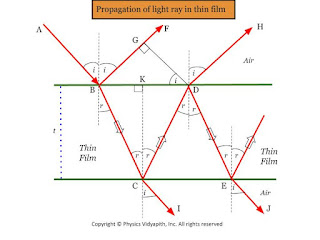
Derivation of interference of light due to thin-film: Let's consider a Ray of light $AB$ incident on a thin film of thickness $t$ and the refractive index of a thin film is $\mu$

The ray $AB$ is partially reflected and partially transmitted at $B$. The transmitted BC is against partially transmitted and partially reflected at $C$. The reflected ray $CD$ is partially reflected and partially refracted at $D$.
Propagation of light ray in thin film
The interference pattern in reflected light will be due to ray $BF$ and $DH$ which are coherent as they are both derived from the same Ray $AB$.

The interference pattern in transmitted light will be due to ray $CI$ and $EJ$.

The path difference between $BF$ and $DH$ ray will be

$\Delta=\mu(BC+CD)-BG \qquad(1)$

The triangle $\Delta BCK$ and $\Delta CDK$ are congruent because

$\begin{Bmatrix} BK=KD \\ BC=CD \\ CK=t \end{Bmatrix} \qquad (2)$

From equation $(1)$ and $(2)$

$\Delta=2 \mu BC-BG \qquad(3)$

In $\Delta BCK$

$cos \: r= \frac{CK}{BC}$

$BC= \frac{t}{cos \: r} \qquad(4)$

In $\Delta BGD$

$sin \: i= \frac{BG}{BD}$

$BG= BD \: sin\: i $

$BG= (BK+KD)\: sin\: i $

$BG= 2BK \: sin\: i \qquad(5)$ {From eqaution $(2)$}

Again In $\Delta BCK$

$tan \:r = \frac{BK}{CK}$

$BK=t.tan\:r \qquad(6)$

Put the value of $BK$ in equation $(5)$

$BG=2t\:sin \:i .tan\: r$

$BG=2t\:sin \:i .\frac{sin \: r}{cos \: r}$

$BG= 2t \frac{sin \:i}{sin \: r} \frac{sin^{2} \:r}{cos \: r}$

$BG=2\mu t \frac{sin^{2} \:r}{cos \: r} \qquad (7)\qquad \left( \mu =\frac{sin \:i}{sin \: r}\right)$

Now put the value of $BG$ and $BC$ in equation $(3)$

$\Delta= \frac{2 \mu t}{cos \: r}-2\mu t\frac{sin^{2} \:r}{cos \: r}$

$\Delta=\frac{2 \mu t}{cos \:r} \left[1-sin^{2} \:r \right]$

$\Delta=2 \mu t \frac{cos^{2} \:r}{cos \:r} $

$\Delta=2 \mu t \: cos \:r$

Interference in a reflected ray:

The ray $BF$ suffers phase change of $\pi$ due to reflection from the denser medium at $B$. Therefore the path difference of $\frac{\lambda}{2}$ is introduced between two rays due to reflection-

$\Delta= 2\mu t \: cos\:r \pm \frac{\lambda}{2}$

Constructive Interference due reflected ray:

for constructive interference

$\Delta=n \lambda$

so from the above equations, we get

$2\mu t \: cos\: r \pm \frac{\lambda}{2}=n \lambda$

$2\mu t \: cos\: r = (2n \pm 1)\frac{\lambda}{2}$

Destructive Interference due to reflected ray:

for destructive interference

$\Delta=(2n \pm 1)\frac{\lambda}{2}$

so from the above equations, we get

$2\mu t \: cos\: r \pm \frac{\lambda}{2}=(2n \pm 1)\frac{\lambda}{2}$

$2\mu t \: cos\: r =n \lambda$

Interference in transmitted ray:

The ray $CI$ and $EJ$ in transmitted Ray have the same path difference as a reflected ray. There is not any change in phase for $CI$ due to reflection as it gets transmitted at $C$. The ray $EJ$ also does not undergo phase change due to reflection as it is reflected from the rarer medium at $C$ and $D$.

$\Delta= 2\mu t \: cos\:r $

Constructive Interference due to transmitted ray:

for constructive interference

$\Delta=n \lambda$

so from the above equations, we get

$2\mu t \: cos\: r =n \lambda$

Destructive Interference due to transmitted ray:

for destructive interference

$\Delta=(2n \pm 1)\frac{\lambda}{2}$

so from the above equations, we get

$2\mu t \: cos\: r =(2n \pm 1)\frac{\lambda}{2}$

$2\mu t \: cos\: r =n \lambda$

Energy density in electromagnetic waves in free space

What is the energy density in the electromagnetic wave in free space?

The total energy stored in electromagnetic waves per unit volume due to the electric field and the magnetic field is called energy density in the electromagnetic wave in free space.

$U=\epsilon_{0} E^{2}=\frac{B^{2}}{\mu_{0}}$

Derivation of Energy density in electromagnetic waves in free space:

The energy per unit volume due to the electric field is

$U_{E}= \frac{1}{2} \overrightarrow{E}.\overrightarrow{D} \qquad(1)$

The energy per unit volume due to the magnetic field is

$U_{B}= \frac{1}{2} \overrightarrow{B}.\overrightarrow{H} \qquad(2)$

The total energy density of electromagnetic waves is

$U=U_{E}+U_{B} \qquad(3)$

Now substitute the value of $U_{E}$ and $U_{B}$ in equation$(3)$ then we get

$U=\frac{1}{2} \left( \overrightarrow{E}.\overrightarrow{D}+\overrightarrow{B}.\overrightarrow{H} \right)$ $U=\frac{1}{2} \left( \overrightarrow{E}.\epsilon_{0}\overrightarrow{E}+\overrightarrow{B}.\frac{1}{\mu_{0}}\overrightarrow{B} \right) \qquad ( \because \overrightarrow{B}= \mu_{0} \overrightarrow{H} \:OR \: \overrightarrow{D}= \epsilon_{0}\overrightarrow{E} )$

$U=\frac{1}{2} \left( \epsilon_{0} E^{2}+\frac{B^{2}}{\mu_{0}} \right) \qquad ( \because \overrightarrow{E}\overrightarrow{E}= E^{2} \:OR \: \overrightarrow{B}.\overrightarrow{B}=B^{2})$

$U=\frac{1}{2} \left( \epsilon_{0} E^{2}+\frac{E^{2}}{c^{2} \mu_{0}} \right) \qquad ( \because B=\frac{E}{c})$

$U=\frac{1}{2} \left( \epsilon_{0} E^{2}+\frac{E^{2}}{c^{2} \mu_{0}} \right) $

$U=\frac{1}{2} \left( \epsilon_{0} E^{2}+\epsilon_{0} E^{2} \right) \qquad ( \because c=\frac{1}{\sqrt{\mu_{0} \epsilon_{0}}})$

$U=\frac{1}{2} \left(2 \epsilon_{0} E^{2} \right) $

$U= \epsilon_{0} E^{2} $

Similarly, the energy density of electromagnetic waves in free space in terms of the magnetic field $B$ can be written as:

$U= \frac{B^{2}}{\mu_{0}} $

The average value of energy density in the electromagnetic waves in free space:

Now we will find the average value of energy density in the electromagnetic wave in free space from the above equation $U= \epsilon_{0} E^{2} $. So we get

$\left< U \right> = \epsilon_{0} \left< E^{2} \right>$

$\left< U \right> = \epsilon_{0} \frac{E_{0}^{2}}{2} \qquad \left (\because \left< E^{2} \right>=\frac{E_{0}^{2}}{2} \right)$

$\left< U \right> = \epsilon_{0} E_{rms}^{2} \qquad \left (\because E_{rms}^{2}=\frac{E_{0}^{2}}{2} \right) \qquad (4)$

We know that

$\left< \overrightarrow{S} \right> = \frac{E_{rms}^{2}}{Z_{0}} .\hat{n} \qquad (5)$

Now divide the equation $(5)$ by equation$(4)$

$\frac{\left< \overrightarrow{S} \right>}{\left< U \right>}=\frac{\frac{E_{rms}^{2}}{Z_{0}} .\hat{n}}{\epsilon_{0} E_{rms}^{2}}$

$\frac{\left< \overrightarrow{S} \right>}{\left< U \right>}=\frac{\hat{n}}{\epsilon_{0} Z_{0}}$

$\frac{\left< \overrightarrow{S} \right>}{\left< U \right>}=\frac{\hat{n}}{\sqrt{\epsilon_{0} \mu_{0}}} \qquad(\because z_{0}= \sqrt{\frac{\mu_{0}}{\epsilon_{0}}})$

$\frac{\left< \overrightarrow{S} \right>}{\left< U \right>}=\hat{n} c \qquad(\because c= \frac{1}{\sqrt{\mu_{0} \epsilon_{0}}})$

$ \left< \overrightarrow{S} \right>=\hat{n} c \left< U \right> $

The energy flow per unit area per unit time in an electromagnetic wave is the product of energy density, speed of light, and the direction of propagation. The ratio of the energy densities of the electric field and magnetic field:

So from above equation $U_{E}=\epsilon_{0} E^{2}$ and equation $U_{B}=\frac{B^{2}}{\mu_{0}}$, we can find the ratio between them i.e.

$\frac{U_{E}}{U_{B}}=\frac{\epsilon_{0} E^{2}}{\frac{B^{2}}{\mu_{0}}}$

$\frac{U_{E}}{U_{B}}=\frac{\epsilon_{0} \mu_{0} E^{2}}{B^{2}}$

$\frac{U_{E}}{U_{B}}=\frac{c^{2}}{c^{2}}$

$\frac{U_{E}}{U_{B}}=1$

$U_{E}=U_{B}$

So the energy density of the electric field is the same as the energy density of the magnetic field.

Poynting Vector and Poynting Theorem

Poynting Vector:
The rate of flow of electromagnetic energy per unit area per unit time (i.e. energy flux density or power flow of an electromagnetic field) is known as Poynting vector. It is represented by $\overrightarrow{S}$. It is a vector quantity.
$\overrightarrow{S}= \frac{Energy \: flow}{Area \times Time}$

$\overrightarrow{S}= \frac{Power Flow}{Area}$

Vector formula form of Poynting Vector:

$\overrightarrow{S}=\overrightarrow{E} \times \overrightarrow{H}$

$\overrightarrow{S}=\frac{1} {\mu_{0}} (\overrightarrow{E} \times \overrightarrow{B})$

Unit: $Watt/m^{2}$ Or $\frac{Kg}{s^{3}}$

Poynting Theorem (Work energy theorem):

The most important aspect of electrodynamics is:
  • Energy density stored with an electromagnetic wave
  • Energy Flux associated with an electromagnetic wave
To derive the energy density and energy flux. We consider the conservation of energy in small volume elements in space. The work done per unit volume by an electromagnetic wave:

$W=\overrightarrow{J}.\overrightarrow{E} \qquad(1)$

This work done also consider as energy dissipation per unit volume. This energy dissipation must be connected with the net decrease in energy density and energy flow out of the volume. According to Modified Maxwell's Forth equation:

$\overrightarrow{\nabla} \times \overrightarrow{H} = \overrightarrow{J} + \frac{\partial \overrightarrow{D} }{\partial t}$

$\overrightarrow{J} = \overrightarrow{\nabla} \times \overrightarrow{H} - \frac{\partial \overrightarrow{D} }{\partial t} \qquad (2)$

Now subtitute the value of $\overrightarrow{J}$ in equation $(1)$. Therefore we get

$W=\overrightarrow{E}.\left( \overrightarrow{\nabla} \times \overrightarrow{H} - \frac{\partial \overrightarrow{D} }{\partial t}\right) \qquad(3) $

Now we employ the vector identity

$\overrightarrow{\nabla}. (\overrightarrow{E} \times \overrightarrow{H})= \overrightarrow{H} (\overrightarrow{\nabla} \times \overrightarrow{E})-\overrightarrow{E}.(\overrightarrow{\nabla} \times \overrightarrow{H})$

$\overrightarrow{E}.(\overrightarrow{\nabla} \times \overrightarrow{H}) = \overrightarrow{H} (\overrightarrow{\nabla} \times \overrightarrow{E})-\overrightarrow{\nabla}. (\overrightarrow{E} \times \overrightarrow{H})\qquad (4)$

From equation $(3)$ and equation $(4)$

$ W= \overrightarrow{H} (\overrightarrow{\nabla} \times \overrightarrow{E})-\overrightarrow{\nabla}.(\overrightarrow{E} \times \overrightarrow{H}) - \overrightarrow{E} \left( \frac{\partial \overrightarrow{D} }{\partial t}\right) $

$ W= \overrightarrow{H} \left( \frac{-\partial \overrightarrow{B} }{\partial t}\right)-\overrightarrow{\nabla}.(\overrightarrow{E} \times \overrightarrow{H}) - \overrightarrow{E} \left( \frac{\partial \overrightarrow{D} }{\partial t}\right) $

$ W= -\overrightarrow{\nabla}.(\overrightarrow{E} \times \overrightarrow{H}) -\overrightarrow{H} \left( \frac{-\partial \overrightarrow{B} }{\partial t}\right) - \overrightarrow{E} \left( \frac{\partial \overrightarrow{D} }{\partial t}\right) $

$ W= -\overrightarrow{\nabla}.(\overrightarrow{E} \times \overrightarrow{H}) -\frac{1}{2}\left [2 \overrightarrow{H} \left( \frac{-\partial \overrightarrow{B} }{\partial t}\right) + 2 \overrightarrow{E} \left( \frac{\partial \overrightarrow{D} }{\partial t}\right) \right] $

$ W= -\overrightarrow{\nabla}.(\overrightarrow{E} \times \overrightarrow{H}) -\frac{1}{2}\left [ \overrightarrow{H} \left( \frac{\partial \overrightarrow{B} }{\partial t}\right)+\overrightarrow{H} \left( \frac{\partial \overrightarrow{B} }{\partial t}\right) + \overrightarrow{E} \left( \frac{\partial \overrightarrow{D} }{\partial t}\right)+ \overrightarrow{E} \left( \frac{\partial \overrightarrow{D} }{\partial t}\right) \right] $

Put $B=\mu H$ and $D=\epsilon E$ in the above equation

$ W= -\overrightarrow{\nabla}.(\overrightarrow{E} \times \overrightarrow{H}) -\frac{1}{2}\left [ \overrightarrow{H} \left( \frac{\partial \overrightarrow{B} }{\partial t}\right)+\frac{\overrightarrow{B}}{\mu} \left( \frac{\partial \left(\mu \overrightarrow{H}\right) }{\partial t}\right) + \overrightarrow{E} \left( \frac{\partial \overrightarrow{D} }{\partial t}\right)+ \frac{\overrightarrow{D}}{\epsilon} \left( \frac{\partial \left( \epsilon \overrightarrow{E}\right) }{\partial t}\right) \right] $

$ W= -\overrightarrow{\nabla}.(\overrightarrow{E} \times \overrightarrow{H}) -\frac{1}{2}\left [ \overrightarrow{H} \left( \frac{\partial \overrightarrow{B} }{\partial t}\right)+\overrightarrow{B} \left( \frac{\partial \overrightarrow{H} }{\partial t}\right) + \overrightarrow{E} \left( \frac{\partial \overrightarrow{D} }{\partial t}\right)+ \overrightarrow{D} \left( \frac{\partial \overrightarrow{E} }{\partial t}\right) \right] $

$ W= -\overrightarrow{\nabla}.(\overrightarrow{E} \times \overrightarrow{H}) -\frac{1}{2}\left [ \frac{ \partial \left(\overrightarrow{B}.\overrightarrow{H}\right) }{\partial t} + \frac{ \partial \left( \overrightarrow{E}.\overrightarrow{D}\right) }{\partial t} \right] $

$ W= -\overrightarrow{\nabla}.(\overrightarrow{E} \times \overrightarrow{H}) - \frac{1}{2} \frac{\partial}{\partial t} \left( \overrightarrow{H}.\overrightarrow{B}+\overrightarrow{E}.\overrightarrow{D} \right) $

$ JE= -\overrightarrow{\nabla}.(\overrightarrow{E} \times \overrightarrow{H}) - \frac{\partial}{\partial t} \left( \frac{\overrightarrow{H}.\overrightarrow{B}+\overrightarrow{E}.\overrightarrow{D} }{2} \right) \qquad \left( \because W= \overrightarrow{J}.\overrightarrow{E} \right) $

$ -JE= \overrightarrow{\nabla}.\overrightarrow{S} + \frac{\partial}{\partial t} \left( \frac{\overrightarrow{H}.\overrightarrow{B}+\overrightarrow{E}.\overrightarrow{D} }{2} \right) \qquad (\because \overrightarrow{S}= \overrightarrow{E} \times \overrightarrow{H})$

$ -JE= \overrightarrow{\nabla}.\overrightarrow{S} + \frac{\partial U}{\partial t} \qquad \left( \because U = \frac{\overrightarrow{H}.\overrightarrow{B}+\overrightarrow{E}.\overrightarrow{D} }{2} \right) $

$ \overrightarrow{\nabla}.\overrightarrow{S} + \frac{\partial U}{\partial t} =-JE $

This equation represents the conservation of energy principle. It is also known as Poynting theorem. Here Negative signs of work done to represent that electromagnetic flow with energy flux as continuity energy density. So this equation is also known as the continuity equation.

Where

$ \overrightarrow{\nabla}.\overrightarrow{S}$ $\rightarrow$ The flow of energy

$U$ $\rightarrow$ Energy density of electromagnetic filed

$S$ $\rightarrow$ Energy flux or Poyting vector

If Current density $\overrightarrow{J}=0$ Then

$ \overrightarrow{\nabla}.\overrightarrow{S} + \frac{\partial U}{\partial t} = 0 $

$ \overrightarrow{\nabla}.\overrightarrow{S} = \frac{\partial U}{\partial t} $

$ \overrightarrow{\nabla}.\overrightarrow{S} = \frac{\partial }{\partial t} (Storage \: energy) $
Special Relativity- MCQ

Special Relativity- MCQ
You'll have 60 seconds to answer each question.
Time's Up
score:

Test Result

Total Questions:

Attempt:

Correct:

Wrong:

Percentage:

Characteristic impedance of electromagnetic wave

We know that the electromagnetic wave propagates perpendicular to both electric field and magnetic field which can describe as

$\overrightarrow{k} \times \overrightarrow{E}= \omega \overrightarrow{B} \qquad(1)$

If $\hat{n}$ is a unit vector in the direction of the propagation then

$\overrightarrow{k}=k \hat{n}$

Substitute these values in equation$(1)$ then we get

$k(\hat{n} \times \overrightarrow{E})= \omega \overrightarrow{B}$

$\overrightarrow{B}= \frac{k}{\omega}(\hat{n} \times \overrightarrow{E}) \qquad(2)$

But the value of $k$ and $\omega$ is

$k=\frac{2\pi}{\lambda}$

$\omega=2 \pi \nu$

Then value of $\frac{k}{\omega}=\frac{1}{c}$

Now substitute the value of $\frac{k}{\omega}$ in equation$(2)$ then we get

$\overrightarrow{B}= \frac{1}{c}(\hat{n} \times \overrightarrow{E})$

The magnitude form of the above equation can be written as

$B=\frac{E}{c}$

$\frac{E}{B}=c$

$\frac{E}{\mu_{0}H}=c \qquad (\because B=\mu_{0} H)$

$\frac{E}{H}=\mu_{0}c$

$\frac{E}{H}=\frac{\mu_{0}}{\sqrt{\mu_{0} \epsilon_{0}}} \qquad(\because c=\frac{1}{\sqrt{\mu_{0} \epsilon_{0}}})$

$\frac{E}{H}= \sqrt{\frac{\mu_{0}}{\epsilon_{0}}}$

The term $\frac{E}{H}$ has dimensions of the impedance and is known as characteristic impedance or intrinsic impedance of free space. It is represented by $(Z_{0})$.

$Z_{0}=\frac{E}{H}=\sqrt{\frac{\mu_{0}}{\epsilon_{0}}}$

Now substitute the value of $\mu_{0}$ and $\epsilon_{0}$ i.e.

$\mu_{0}=4\pi \times 10^{-7}$

$\epsilon_{0}=8.854 \times 10^{-12}$

$Z_{0}=\sqrt{\frac{4\pi \times 10^{-7}}{8.854 \times 10^{-12}}}$

$Z_{0}=376.73\: \Omega $

$Z_{0}=120\pi \: \Omega $

Radiation pressure of electromagnetic wave

When an electromagnetic wave strikes a surface then its momentum changes. the rate of change of momentum is equal to the applied force. this force acting on the unit area of the surface exerts a pressure called radiation pressure$(P_{rad})$.

Let us consider a plane electromagnetic wave incident normally on a perfectly absorbing surface of area $A$ for a time $t$. If energy $U$ is absorbed during this time then momentum $P$ delivered to the surface is given according to Maxwell's prediction by

$P=\frac{U}{C} \qquad(1)$

If $S$ is the energy flow per unit area per unit time i.e. Poynting vector then the energy density

$U=SAt \qquad(2)$

From equation $(1)$ and equation $(2)$

$P=\frac{SAt}{c}$

$P=UAt \qquad (\because U=\frac{S}{c})$

$\frac{P}{t}=UA \qquad (3)$

If average force $(F)$ acting on the surface, is equal to the average rate of change of momentum $(P)$, is delivered to the surface then

$F=\frac{P}{t} \qquad(4)$

Now from equation$(3)$ and equation$(4)$ we get

$F=UA \qquad(5)$

The radiation pressure $(P_{rad})$ exerted on the surface is

$P_{rad}=\frac{F}{A} \qquad(6)$

Now substitute the value of $F$ from equation$(5)$ in equation$(6)$ then we get

$P_{rad}=\frac{UA}{A}$

$P_{rad}=U$

Hence, the radiation pressure exerted by a normally incident play electromagnetic wave on a perfect absorber is equal to the energy density of the wave.

For a perfect reflector or for a perfect reflecting surface, the radiation after reflection has momentum equal in magnitude but opposite in direction to the incident radiation. Then the momentum imparted to the surface will therefore be twice as on perfect absorber i.e.

$P_{rad}=2U$

Popular Posts