Maxwell's fourth equation is the differential form of Ampere's circuital law.
$\overrightarrow{\nabla} \times \overrightarrow{H} = \overrightarrow{J} + \frac{\partial{\overrightarrow{D}}}{\partial{t}}$
Derivation:
According to Ampere's circuital law
$\oint_{l} \overrightarrow{B}. \overrightarrow{dl}=\mu_{0} i \qquad(1)$
According to Stroke's theorem-
$\oint_{l} \overrightarrow{B}.\overrightarrow{dl}=\oint_{S} (\overrightarrow{\nabla} \times \overrightarrow{B}). \overrightarrow{dS} \qquad(2)$
From equation$(1)$ and equation$(2)$
$\oint_{S} (\overrightarrow{\nabla} \times \overrightarrow{B}). \overrightarrow{dS} = \mu_{0} i \qquad(3)$
where $i=\oint_{S} \overrightarrow{J}. \overrightarrow{dS} \qquad(4)$
So from equation$(3)$ and equation$(4)$
$\oint_{S} (\overrightarrow{\nabla} \times \overrightarrow{B}). \overrightarrow{dS} = \mu_{0} \oint_{S} \overrightarrow{J}. \overrightarrow{dS}$
$\oint_{S} (\overrightarrow{\nabla} \times \overrightarrow{B}). \overrightarrow{dS} - \mu_{0} \oint_{S} \overrightarrow{J}. \overrightarrow{dS}=0$
$\oint_{S} [(\overrightarrow{\nabla} \times \overrightarrow{B}) - \mu_{0} \overrightarrow{J}]. \overrightarrow{dS}=0$
$(\overrightarrow{\nabla} \times \overrightarrow{B}) - \mu_{0} \overrightarrow{J}=0$
$\overrightarrow{\nabla} \times \overrightarrow{B} = \mu_{0} \overrightarrow{J}$
We know that $\overrightarrow{B}=\mu_{0} \overrightarrow{H}$. So the above equation can be again written as-
$\overrightarrow{\nabla} \times \overrightarrow{H} = \overrightarrow{J}$
Modified Maxwell's fourth equation:
The modified Maxwell's fourth equation is the differential form of the modified Ampere's circuital law.
We know the modified Ampere's circuital law-
$\oint_{l} \overrightarrow{B}. \overrightarrow{dl}=\mu_{0} i + i_{d}$
Where $i_{d}$ - Displacement current
So the derivation of the modified Maxwell equation is similar to the above derivation. Therefore the modified Maxwell's fourth equation can be written as-
$\overrightarrow{\nabla} \times \overrightarrow{H} = \overrightarrow{J} + \overrightarrow{J_{d}} \qquad(1)$
Where $\overrightarrow{J_{d}}$ - Displacement current density
And the value of $\overrightarrow{J_{d}}$ is
$\overrightarrow{J_{d}}=\epsilon_{0} \frac{\partial{\overrightarrow{E}}}{\partial{t}}$
$\overrightarrow{J_{d}}=\frac{\partial{\overrightarrow{D}}}{\partial{t}} \qquad(\because \overrightarrow{D}=\epsilon_{0} \overrightarrow{E})$
Now substitute the value of $\overrightarrow{J_{d}}$ in equation $(1)$, then
$\overrightarrow{\nabla} \times \overrightarrow{H} = \overrightarrow{J} + \frac{\partial{\overrightarrow{D}}}{\partial{t}}$
This is modified by Maxwell's fourth equation.
Derivation of Maxwell's third equation
Maxwell's third equation is the differential form of Faraday's law induction.i.e
$\overrightarrow{\nabla} \times \overrightarrow{E}=- \frac{\partial{\overrightarrow{B}}}{\partial{t}}$
Derivation:
According to Faraday's Induced law-
$e=-\frac{\partial{\phi_{B}}}{\partial{t}} \qquad(1)$
According to Gauss's law of magnetism-
$\phi_{B}=\oint_{S} \overrightarrow{B}.\overrightarrow{dS} \qquad(2)$
Now substitute the value of $\phi_{B}$ in equation $(1)$
$e=-\frac{\partial}{\partial{t}} \oint_{S} \overrightarrow{B}.\overrightarrow{dS}$
$e=-\oint_{S} \frac{\partial{\overrightarrow{B}}}{\partial{t}}.\overrightarrow{dS} \qquad(3)$
The line integral of the electric field around a closed loop is called electromotive force. Thus
$e=\oint_{l} \overrightarrow{E}.\overrightarrow{dl} \qquad(4)$
from equation $(3)$ and $(4)$
$\oint_{l} \overrightarrow{E}.\overrightarrow{dl}=-\oint_{S} \frac{\partial{\overrightarrow{B}}}{\partial{t}}.\overrightarrow{dS} \qquad(5)$
According to Stroke's Theorem-
$\oint_{l} \overrightarrow{E}.\overrightarrow{dl}=\oint_{S} (\overrightarrow{\nabla} \times \overrightarrow{E}).\overrightarrow{dS} \qquad(6)$
from equation $(5)$ and equation $(6)$
$\oint_{S} (\overrightarrow{\nabla} \times \overrightarrow{E}).\overrightarrow{dS}=-\oint_{S} \frac{\partial{\overrightarrow{B}}}{\partial{t}}.\overrightarrow{dS}$
$\oint_{S} [(\overrightarrow{\nabla} \times \overrightarrow{E})+ \frac{\partial{\overrightarrow{B}}}{\partial{t}}].\overrightarrow{dS}=0$
If the surface is arbitrary then-
$(\overrightarrow{\nabla} \times \overrightarrow{E})+ \frac{\partial{\overrightarrow{B}}}{\partial{t}}=0$
$\overrightarrow{\nabla} \times \overrightarrow{E}=- \frac{\partial{\overrightarrow{B}}}{\partial{t}}$
This is Maxwell's third equation.
Derivation of Maxwell's second equation
Maxwell's second equation is the differential form of Gauss's law of magnetism.
As magnetic, monopoles do not exist in magnets and the magnetic field lines form closed loops. There is no source of the magnetic field from which the lines will either only diverge or only converge. Hence the divergence of the magnetic field is zero.
$\overrightarrow{\nabla}. \overrightarrow{B}=0$
Derivation-
According to Gauss's law of magnetism
$\oint_{S} \overrightarrow{B}. \overrightarrow{dS}=0 \qquad(1)$
Now apply the Gauss's divergence theorem-
$\oint_{S} \overrightarrow{B}. \overrightarrow{dS}= \oint_{v} \overrightarrow{\nabla}.\overrightarrow{B}.dV \qquad (2)$
from equation $(1)$ equation $(2)$
$\oint_{v} (\overrightarrow{\nabla}.\overrightarrow{B}).dV =0$
$\overrightarrow{\nabla}.\overrightarrow{B} =0$
Derivation of Maxwell's first equation
Maxwell's first equation is the differential form of Gauss's law of electrostatics.i.e
$\overrightarrow{\nabla}.\overrightarrow{E}= \frac{\rho}{\epsilon_{0}} $
Derivation:
According to Gauss's law for electrostatic-
$\oint_{s} \overrightarrow{E}.\overrightarrow{dS}=\frac{q}{\epsilon_{0}} \qquad(1)$
For continuous charge distribution inside the surface-
$q=\oint_{v}\rho.dV$
Where
$\rho$→Charge density
dV→Small volume
Now substitute the value of $q$ in equation $(1)$ then
$\oint_{s}\overrightarrow{E}.\overrightarrow{dS}=\frac{1}{\epsilon_{0}} \oint_{v}\rho.dV \qquad(2)$
Now according to Gauss's divergence theorem-
$\oint_{s} \overrightarrow{E}.\overrightarrow{dS}= \oint_{v} \overrightarrow{\nabla}.\overrightarrow{E} dV \qquad (3)$
From equation$(2)$ and equation$(3)$, we can write the above equation-
$\oint_{v} \overrightarrow{\nabla}.\overrightarrow{E} dV= \frac{1}{\epsilon_{0}} \oint_{v}\rho.dV $
$\oint_{v} \overrightarrow{\nabla}.\overrightarrow{E} dV- \frac{1}{\epsilon_{0}} \oint_{v}\rho.dV=0 $
$\oint_{v} (\overrightarrow{\nabla}.\overrightarrow{E}- \frac{\rho}{\epsilon_{0}})dV=0 $
On solving the above equation-
$\overrightarrow{\nabla}.\overrightarrow{E}- \frac{\rho}{\epsilon_{0}}=0 $
$\overrightarrow{\nabla}.\overrightarrow{E}= \frac{\rho}{\epsilon_{0}} $
This is Maxwell's first equation.
$\rho$→Charge density
dV→Small volume
Conservative force and non conservative force
Conservative force:
There are the following points that describe the conservative force-
1.) The conservative force depends only on the position of the particle and does not depend on the path of the particle.
2.) In a conservative force, the kinetic energy of the particle does not change between the positions.
 Let us consider a particle is moving from position $A$ to position $B$ under the conservative force. If the kinetic energy of the particle at position $A$ and $B$ is $K_{i}$ ,$K_{f}$ respectively then for conservative force-
$K_{i}=K_{f}$
3.) In conservative force, the work done by the force in completing one round between any two positions is zero.
According to the work-energy theorem
$W=\Delta{K}$
$W=K_{f}-K_{i} \quad(1)$
For a conservative force, the kinetic energy of the particle does not change between the positions of the particle i.e., $ K_{f}=K_{i}$. So from equation $(1)$
$W=0$
Alternative Method:
The above statement can also be proven by the following method-
The work is done by the conservative force to move a particle from position $A$ to position $B$ = $W_{AB}$.
The work done by the conservative force to move a particle from position $B$ to position $A$ = $W_{BA}$
We know that the kinetic energy of the particle does not change between the positions, so the work done by the force between the positions will be equal and opposite. i.e
$W_{AB}=-W_{BA}$
$W_{AB}+W_{BA}=0$
So, from above, we can conclude that the net work done by force between the two positions in completing one round is zero.
4.) The central force is also known as the conservative force.
5.) The conservative force is always equal to the negative gradient of potential energy.
$\overrightarrow{F}=-\overrightarrow{\nabla}U$
$\overrightarrow{F}= -\frac{dU}{dr}$
Non-conservative force:
1.) The non-conservative force is path-dependent between the two positions and does not depend on the positions of the particle.
2.) The kinetic energy of the particle varies from one position to another due to friction.
3.) For a non-conservative force, the work done by the force in completing one round between two positions is not zero.
4.) This is not a central force.
5.) The non-conservative force does not equal the negative gradient of potential energy.
4.) The central force is also known as the conservative force.
5.) The conservative force is always equal to the negative gradient of potential energy.
Biot Savart's Law and Equation
Biot-Savart Law:
Biot-Savart law was discovered in 1820 by two physicists Jeans-Baptiste Biot and Felix Savart. According to this law:
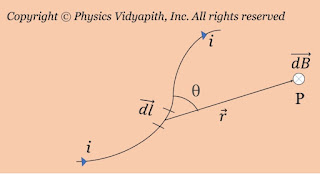 From equation $(1)$,$(2)$,$(3)$,$(4)$ :
$\qquad dB \propto \frac{i dl sin\theta}{r^{2}}$
Now replace the proportional sign with the constant i.e. $\frac{\mu_{0}}{4 \pi}$. Therefore the above given equation can be written as
$ dB = \frac{\mu_{0}}{4 \pi} \frac{i dl sin\theta}{r^{2}}$
The magnetic field at point $P$ due to entire conductor:-
$ B =\frac{\mu_{0}}{4 \pi} \int \frac{i dl sin\theta}{r^{2}}$
Case$(1)$: If $\theta=0^{\circ}$ then the magnetic field will be zero from the above equation i.e.
$B=0$
Case$(2)$: If $\theta=90^{\circ}$ then the magnetic field will be maximum from the above equation i.e.
$B =\frac{\mu_{0}}{4 \pi} \int \frac{i dl}{r^{2}}$.
The vector form of Biot-Savart magnetic field equation is:-
$ \overrightarrow{B} =\frac{\mu_{0} i}{4 \pi} \int \frac{ \overrightarrow{dl} \times \overrightarrow{r}}{r^{3}}$
- The magnetic field is directly proportional to the length of the current element.
$dB \propto dl \qquad (1)$
- The magnetic field is directly proportional to the current flowing in the conductor.
$dB \propto i \qquad (2)$
- The magnetic field is inversely proportional to the square of the distance between length of the current element $dl$ and point $P$ (This is that point where the magnetic field has to calculate).
$dB \propto \frac{1}{r^{2}} \qquad (3)$
- The magnetic field is directly proportional to the angle of sine. This angle is the angle between the length of the current element $dl$ and the line joining to the length of the current element $dl$ and point $P$.
$dB \propto sin\theta \qquad (4)$
Popular Posts
-
 Derivation→ Let us consider, The charge on a parallel-plate capacitor = $q$ The area of parallel-plate = $A$ The dis...
 -
 A.) Electric field intensity at different points in the field due to the uniformly charged solid conducting sphere: Let us consider, A s...
 -
 Derivation→ Let us consider, a current-carrying conductor $XY$ having length $l$ in which current $i$ is flowing from $X$ to $Y$. Now,...
 -
Derivation of Einstein Coefficient Relation→ Let us consider the $N_{1}$ and $N_{2}$ is the mean population of lower energy state and upp...
-
 Alternating Current Circuit Containing Inductance only (L-Circuit): Let us consider, An alternating current circuit containing a coil of i...
 -
 Calculation of Motion of a body in a vertical Circle: Let us consider, A body that has mass $m$ moving in a vertical circle of radius $r$....
 -
A diffraction grating (or $N$-slits) consists of a large number of parallel slits of equal width and separated from each other by equal opaq...
-
 Alternating Current Circuit containing Resistance (R-Circuit): Let us consider, An alternating current circuit containing resistance $R$ on...
 -
 Description: The different series of hydrogen spectra can be explained by Bohr's theory. According to Bohr's theory, If the ioni...
 -
 Electric Dipole and Derivation of Electric field intensity at different points of an electric dipoleElectric Dipole: When two equal (i.e., equal in magnitude) and opposite-charge particles are placed at a very small distance apart, the ...
