Self Induction:
When a changing current flows in a coil then due to the change in magnetic flux in the coil produces an electro-motive force $\left(emf \right)$ in that coil. This phenomenon is called the principle of Self Induction.
The direction of electro-motive force can be found by applying "Lenz's Law".
Mathematical Analysis of Coefficient of Self Induction:
Let us consider that a coil having the number of turns is $N$. If the change in current is $i$, then linkage flux in a coil will be
$N \phi \propto i$
$N\phi = L i \qquad(1)$
Where $L$ $\rightarrow$ Coefficient of Self Induction.
According to Faraday's law of electromagnetic induction. The electro-motive force $\left(emf \right)$ in a coil is
$e=-N\left( \frac{d \phi}{dt} \right)$
$e=-\frac{d \left(N \phi \right)}{dt} \qquad(2)$
From equation $(1)$ and equation $(2)$
$e=-\frac{d \left(L i\right)}{dt} $
$e=-L \left(\frac{d i}{dt} \right) $
$L = \frac{e}{\left(\frac{d i}{dt} \right)}$
If $\left(\frac{d i}{dt} \right) = 1$
Then
$L = e$
The above equation shows that If the rate of flow of current in a coil is unit then the coefficient of self-induction in that coil will be equal to the induced electro-motive force $\left( emf \right)$.
Mutual Induction Phenomenon and its Coefficient
Mutual Induction:
When two coils are placed near each other then the change in current in one coil ( Primary Coil) produces electro-motive force $\left( emf \right)$ in the adjacent coil ( i.e. secondary coil). This phenomenon is called the principle of Mutual Induction.
The direction of electro-motive force $\left( emf \right)$ depends or can be found by "Lenz's Law"
Mathematical Analysis of Coefficient of Mutual Induction:
Let us consider that two coils having the number of turns are $N_{1}$ and $N_{2}$. If these coils are placed near to each other and the change in current of the primary coil is $i_{1}$, then linkage flux in the secondary coil will be
$N_{2}\phi_{2} \propto i_{1}$
$N_{2}\phi_{2} = M i_{1} \qquad(1)$
Where $M$ $\rightarrow$ Coefficient of Mutual Induction.
According to Faraday's law of electromagnetic induction. The electro-motive force $\left( emf \right)$ in the secondary coil is
$e_{2}=-N_{2}\left( \frac{d \phi_{2}}{dt} \right)$
$e_{2}=-\frac{d \left(N_{2} \phi_{2} \right)}{dt} \qquad(2)$
From equation $(1)$ and equation $(2)$
$e_{2}=-\frac{d \left(M i_{1} \right)}{dt} $
$e_{2}=-M \left(\frac{d i_{1}}{dt} \right) $
$M = \frac{e_{2}}{\left(\frac{d i_{1}}{dt} \right)}$
If $\left(\frac{d i_{1}}{dt} \right) = 1$
Then
$M = e_{2}$
The above equation shows that If the rate of flow of current in the primary coil is unit then the coefficient of mutual induction will be equal to the induced electro-motive force $\left( emf \right)$ in the secondary coil.
Faraday's laws of electromagnetic induction
Faraday's Laws of Electromagnetic Induction:
The Faraday's experiment shows the two laws which are known as Farday's laws of electromagnetic induction
First Law (Neumann's Law): The rate of change of magnetic flux through a circuit is equal to the emf produced in the circuit. This is also known as "Neumann Law"
$e=-\frac{\Delta \phi}{ \Delta t}$
Here negative sign shows the direction of emf.
If $\Delta t \rightarrow 0$
$e=-\frac{d \phi}{ d t}$
This equation represents an independent experimental law that cannot be derived from other experimental laws.
If the circuit is a tightly wound coil of $N$ turns, then the induced emf
$e=-N\frac{d \phi}{ d t}$
$e=-\frac{d \left(N \phi\right)}{ dt}$
Here $N \phi$ is called the 'Linkage magnetic flux'.
Note: The change in flux induces emf, not the current.
Second Law (Lenz's Law): The direction of induced EMF produced in a closed circuit is such that it opposes the original cause that produces it. It is also called "Lenz's law". The direction of induced EMF is described by Fleming's right-hand rule.
Paramagnetic Substances and Its properties
Paramagnetic Substances :
Those substances, which are placed in the external magnetic field and they are weakly magnetized in the direction of the external magnetic field, are called paramagnetic substances.
The susceptibility $\chi_{m} $ of paramagnetic substances is small and positive. Further, When a paramagnetic substance is placed in the magnetic field, then the flux density of the paramagnetic substance is slightly more than the free space. Thus, the relative permeability of paramagnetic substance $\mu_{r}$, is slightly more than 1.
Properties of Paramagnetic substances:
1. When a rod of a paramagnetic material is suspended freely between external magnetic poles (i.e. Between North and South Poles) then its axis becomes along the direction of the external magnetic field $B$ (Figure). The poles produced on the two sides of the rod are opposite to the poles of the external magnetic field.
2. In a non-uniform magnetic field, a paramagnetic substance tends to move from the weaker magnetic field to the stronger magnetic field. If a paramagnetic liquid is taken in a watch glass placed on two magnetic poles very near to each other, then the liquid rises in the middle as shown in the figure below(Figure) where the field is strongest. Now, if the distance between the poles is increased, the liquid is depressed in the middle, because now the field is strongest near the poles.
3. If the solution of a paramagnetic substance is poured into a U-tube and apply the strong magnetic field into one arm of this U-tube then the level of the solution in that arm rises. As shown in the figure below:
4. When paramagnetic gas molecules are passed between the poles of a magnet then paramagnetic gas molecules are attracted toward the magnetic field.
5. The susceptibility of a paramagnetic substance is inversely dependent on temperature.
$\chi \propto \frac{1}{T_{C}-T}$
Explanation of Paramagnetism on the Basis of Atomic Model:
The property of Paramagnetism is generally found in those substances whose atoms (or ions or molecules) have an 'odd' number of electrons. In these odd numbers of electrons one electron is not able to form a pair because the net magnetic dipole moment of the atoms (or ions or molecules) are not zero. but in the absence of an external magnetic field, these magnetic dipole moments are randomly arranged inside the substance because the net magnetic dipole moment of the material is zero.
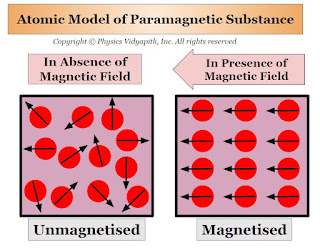
When a paramagnetic substance is placed in an external magnetic field $B$ then the magnetic dipole moment of the atoms (or ions or molecules) are weakly aligned in the direction of the external magnetic field. Thus, a small magnetic dipole moment is induced in the substance which is directly proportional to the magnetic field $B$. Hence, the paramagnetic substance is magnetized in the direction of the external magnetic field $B$, and the field lines become less dense inside the paramagnetic substance compared to those outside.
Work energy theorem Statement and Derivation
Work-energy theorem statement:
The work between the two positions is always equal to the change in kinetic energy between these positions. This is known as the work energy Theorem.
$W=K_{f}-K_{i}$
$W=\Delta K$
Derivation of the Work-energy theorem:
According to the equation of motion:
$v^{2}_{B}=v^{2}_{A}+2as $
$2as=v^{2}_{B}-v^{2}_{A}$
$2mas=m(v^{2}_{B}-v^{2}_{A})$
$mas=\frac{m}{2} (v^{2}_{B}-v^{2}_{A})$
$Fs=\frac{1}{2}mv^{2}_{B}-\frac{1}{2}mv^{2}_{A} \qquad (\because F=ma)$
$W=\frac{1}{2}mv^{2}_{B}-\frac{1}{2}mv^{2}_{A} \qquad (\because W=Fs)$
$W=K_{f}-K_{i}$
Where
$K_{f}$= Final Kinetic Energy at position $B$
$K_{i}$= Initial Kinetic Energy at position $A$
$W=\Delta K$
Alternative Method (Integration Method):
We know that the work done by force on a particle from position $A$ to position $B$ is-
$W=\int F ds$
$W=\int (ma)ds \qquad (\because F=ma)$
$W=m \int \frac{dv}{dt}ds$
$W=m \int dv \frac{ds}{dt}$
$W=m \int v dv \qquad (\because v=\frac{ds}{dt})$
If position $A$ is the initial point where velocity is $v_{A}$ and position $B$ is the final point where velocity is $v_{B}$ then work is done by force under the limit-
$W=m \int_{v_{A}}^{v_{B}} v dv$
$W=m[\frac{v^{2}}{2}]_{v_{A}}^{v_{B}} $
$W=\frac{1}{2}mv^{2}_{B}-\frac{1}{2}mv^{2}_{A}$
$W=K_{f}-K_{i}$
$W=\Delta {K}$
$K_{f}$= Final Kinetic Energy at position $B$
$K_{i}$= Initial Kinetic Energy at position $A$
Popular Posts
-
Angle of Acceptance → "If incident angle of light on the core for which the incident angle on the core-cladding interface equals t...
-
Principle: The principle of the compound microscope is based on the magnification of an image by using two lenses. Construction: A comp...
-
Description: Unit of Energy The SI unit of energy is the Joule (J) , named after the English physicist James Prescott Joule. 1 Joule is...
-
Derivation→ Let us consider, The charge on a parallel-plate capacitor = $q$ The area of parallel-plate = $A$ The dis...
-
Gaussian Surface and its Properties: The Gaussian surface is a hypothetical or imaginary closed three-dimensional surface. This surface i...
-
A.) Electric field intensity at different points in the field due to the uniformly charged solid conducting sphere: Let us consider, A s...
-
Derivation→ Let us consider, a current-carrying conductor $XY$ having length $l$ in which current $i$ is flowing from $X$ to $Y$. Now,...
-
Population of energy level: The number of atoms per unit volume in any energy level is called the population of that energy level. The...
-
Principle of Ruby Laser → Ruby laser is the first working laser that was invented by T.H.Maima in 1960. It is a three-level solid-stat...
-
Let a plane wavefront be incident normally on slit $S_{1}$ and $S_{2}$ of equal $e$ and separated by an opaque distance $d$.The diffracted l...
Categories
Quantum Mechanics
Optics
Electromagnetic Wave Theory
Electrostatic
Laser System & Application
Classical Mechanics
Gravitation
Alternating Current Circuits
Current Electricity
Magnetic Effect of Current
Topic wise MCQ
Relativity
Nuclear Physics
Capacitors
Current carrying loop in magnetic field
Mechanical Properties of Fluids
Optical Fibre
Waves
Atomic and Molecular Physics
Nanoscience & Nanotechnology
Electromagnetic Induction
Energy Science and Engineering
Heat and Thermodynamics
Magnetic Substances
Photoelectric Effect
Error and Measurement
Kinematics Theory Of Gases
Numerical Problems and Solutions
Semiconductors
Biomedical
Dielectric Materials
Superconductors
Units and Dimensions


